
Trending
In July 2013, Dushore resident John Smithkors was scuba-diving in Loyalsock Creek when he came upon the remains of a steam locomotive that had been lying underwater for 108 years. Exploring abutments from two long-gone bridges near Hillsgrove, Smithkors had found the three-foot smokestack from a Climax B steamer known as "the dinky in the drink," its crew having gotten a bit overzealous while dismantling the bridge it was sitting on.
The aging relic was eventually removed to the Sullivan County Historical Society museum in Laporte, where it remains on display. But that took a year of effort, including help from North Central Pennsylvania's very active scuba community.
Perhaps our area seems an unlikely locale for such a community but there is a broad and impressive spectrum of underwater activities available in the Susquehanna Valley.
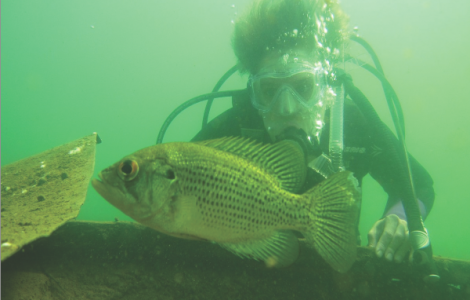
Local snorkelers and scuba-divers can enjoy wildlife in and on the water. They dive at night and during winter, go snorkel-fishing, clean up tires and other waste, search competitively for pre-sunk treasure and, of course, they explore bottom-dwelling boats and lumber cribs, plus at least one other train.
But you have to know what you're doing, and that's where two local dive-shops come in.
Williamsport area's A Water Odyssey Scuba (AWOS) and Jersey Shore area's Sunken Treasure Scuba Center (STSC) offer a range of equipment, service, training and trips for beginners and experts alike.
AWOS was founded in 1965 by Don Cook and is currently overseen by his successor, Frank Morrow.
Sunken Treasure is now in its 44th year under owner Rich Best. Each offers scuba certification through the Professional Association of Diving Instructors, along with sales, repair, rentals and refills.
Morrow, with more than 50 years' experience, has been certified to instruct since 1979 and runs the shop with his wife, Lynn. Initially influenced by Jacques Cousteau, he began diving as a youth, exploring the Finger Lakes with his younger brother.
Best, who along with Smithkors helped in the Hillsgrove smokestack extraction, was also instruction-certified in 1979. He told West Branch Life that STSC tries to dive "every other weekend, generally at Jay Street in Lock Haven (in the Susquehanna)."
In addition, "We do two underwater cleanups each year, along with just picking up trash when we see it."
Best said they also execute night-dives, underwater pumpkin-carving contests and even some forays with metal detectors.
"Although the water is rarely deeper than 25 feet," says Morrow, "there are many places to explore the underwater world in Central Pennsylvania. Loyalsock Creek, Lycoming Creek and the West Branch are open to exploration. Most divers dive the local area from May to October … and a few enjoy diving beneath the ice in winter."
Morrow adds that, in addition to these recreational activities, many local divers work tirelessly and often voluntarily, to help locate submerged items for criminal investigations and to recover drowning victims.
Loyalsock resident Al Almarzouqi, who has dived around the world and got married underwater off Key Largo in 2001, points out that there is good public access at Lock Haven's Jay Street Bridge. He also recommends former a train trestles along the Pine Creek Rail Trail, plus the so-called "Cannon Hole," a deep spot where Loyalsock Creek flows into the Susquehanna.
Almarzouqi likewise suggests the Arch Street Bridge Williamsport.
"There are tons of old log cribs and also sunken parts of an old train. I have not done that dive in years, but in the summer, parts of that train would be visible from our boat," he says.
Several other locals mentioned log cribs, which are large wooden structures that held logs together during downriver runs in the glory days of North Central Pennsylvania's bustling lumber industry.
"Many are still underwater from Lock Haven to Williamsport on the Susquehanna River," says Best. "They are massive to look at, attract a lot of fish and you just never know what you might find around them."
For fans of underwater artifacts, Best points out there's a sunken concrete barge on the north side of the Susquehanna about 200 yards below the former Antlers Club in Williamsport and is marked by a buoy.
The river also contains a sunken boat from the 19th Century but STSC has sole permission to dive that site for historical purposes. Two other sources hinted at underwater limestone caverns in more distant Pennsylvania locales, but those can be dangerous and no one wanted to give details.
Dr. Frank Lynch of Hershey recalls exploring water-filled quarries near Dutch Springs and Bainbridge. These curated sites contain bulldozers, vans, airplanes, a trolley car and even a Sikorski helicopter. Though they are, sadly, no longer open to the public, Morrow has a photo of his grandson at the controls of a submerged commercial airliner at Dutch Springs.
Another local dive enthusiast is Gabe Cellini, a 2016 Loyalsock High School graduate who thereafter served four years in the Marines.
"I grew up snorkeling all over the greater Williamsport area," Cellini recalls. "Some of my fondest memories are when my grandfather, brother and I would snorkel behind Bowman Field in Lycoming Creek. We'd spend the entire day there."
When referring to the Susquehanna's spillway across from Wegmans,he cautions, "It tends to be quite murky, so it's harder to snorkel enjoyably ... but I've found a few places there as well."
Cellini points out that there's plenty of wildlife, including crayfish. He ways "I like to use [crayfish] for snorkel fishing. I attach one to a few feet of line, swim up to a structure, let it go and catch everything from rock bass to channel catfish."
Cellini has also seen beavers and otters, while Best likewise points to the variety of fish. But, he insists, it wasn't always this way. "When I started diving in the seventies near Lock Haven," says Best, "there was nothing alive in the water. Now it's common to see large schools of bass in the area, along with trout, crappie, suckers, turtles, walleye, rock bass and bluegills. Recently, the state put in over 22,000 freshwater American eels in the Lock Haven Basin. You might even get a peek at the strange-looking hellbender, which is a large salamander that can grow up to 30 inches. Despite its name, it is docile and harmless.
Several divers stress the importance of getting permission when entering the water from private property and all stress using safety measures. This includes the buddy system, which means never diving alone, and regular inspections of equipment. Morrow urges, "[Use] a diver-down flag so the boaters know where you are."
Best adds that the increasing number of recreational boats makes weekdays a good choice for the busy Susquehanna. While on weekends, creeks are both safer and less crowded.
Before diving in Almarzouqi cautions,"Respect what's underwater. Watch for sharp metal objects or old nails on some of the cribs. Always have a dive flag. Get certified and join a local dive crew."