
The seductive sands of ‘Lawrence of Arabia’
Trending
I've slowly -- very slowly -- been attempting to work my way through missing entries of the catalog of "the greats" which I have missed for one reason or another. Most of these were skipped when I was younger due to their subject material simply not being appealing, but one was more due to its sheer scope and length than my lack of interest in it.
I am writing, of course, of "Lawrence of Arabia" -- a movie which frequently comes up in conversation, but it seems one which few people have ever actually sat down and watched. A cinematic "War and Peace," if you will.
Well, this summer I resolved to finally climb that particular mountain, and the view was as stupendous as the critics attest.
Make no mistake: it is an endeavor, especially for the modern viewer fattened as we are with fast-moving contemporary flicks. Some of the sprawling shots throughout its nearly 4-hour runtime are, while gorgeous, something of a challenge to hold your attention through.
But it is here where I find myself defending the film.
First, a brief overview. "Lawrence of Arabia" is a loose biopic, centered around the titular T. E. Lawrence, a British officer, among other things, stationed in Egypt during World War I. While I learned much about World War II during my upbringing, I learned relatively little about World War I by comparison, and especially about the African/Middle Eastern theater therein.
The geopolitics of the film's setting are thus: the Ottoman Turks, a long-running major power in the Middle East, were allied with the Central Powers -- Germany, Austria-Hungary, etc. -- against the Allies -- Britain, France, Russia, Italy, Japan and eventually the United States. The film focuses on the British vs. the Ottomans, mostly in the region which is now modern-day Syria and Jordan.
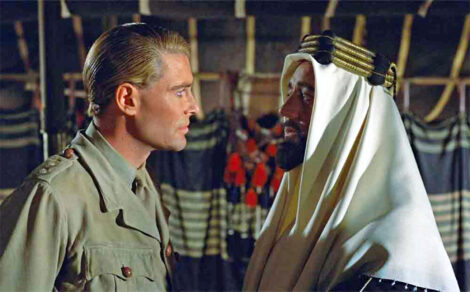
Specifically, it focuses on the efforts of Lawrence, played by Peter O'Toole, who was appointed as a liaison with the Arab Prince Faisal, played by Alec Guinness. Faisal dreams of uniting the various disconnected Arab tribes and winning their homeland from the Ottomans, which plays well with the British goals of defeating the Ottomans.
To achieve this, Lawrence launches a campaign with Faisal's support, producing various surprise attacks and unexpected successes. Along the way, he has to win the support of his Arab troops, among them his initial adversary and eventual chief lieutenant Sherif Ali ibn el Kharish, played by Omar Sharif.
I won't go much further into the plot than that -- it is nearly four hours long, after all, so there's a lot of plot -- but that should provide enough of an overview to discuss the pieces I want to get to.
First, returning to the glacial, sprawling desert shots: while it is true that they are rather boring and distracting, I would argue that they are critical to understanding one of the film's most important characters -- the desert itself.
Though it doesn't appear on the billing, make no mistake: the desert is as much the star of the film as O'Toole.
Lawrence sees a lot of character exploration throughout, with explicit attention paid to his relationship with violence as necessary during war, the amount to which he is regarded almost Messianically by some of the Arabs and his eventual fall and realization that as a tool of war, he has little to offer after the battles are won.
But none of those, in my estimation, are more lovingly portrayed than the relationship of Lawrence, a native of Britain, and his love of the deserts of Arabia. And for that portrayal to work, those plodding shots of nothing but empty sand blowing in a hot breeze are unfortunately important.
Second, the film is, overall, rather historically accurate. Some characters are amalgamations of multiple real-life people, like Sherif Ali, who represents a combination of many of the various Arab leaders Lawrence worked with during his time. Prince Faisal was a real-life figure, who eventually went on to become King Faisal I of Iraq -- his descendents were eventually overthrown by a coup in the 1950s, giving way to modern Iraq. An amusing piece of trivia about the film is that Alec Guinness's portrayal, mannerisms and wardrobe was so accurate that several people in Jordan who had actually met the real-life Faisal thought that Guinness was actually Faisal. As for Lawrence -- T. E. Lawrence was also a real person, and while the film's representation of him substantially plays up his deeds and attributes for dramatization, the real-life person was involved in some pretty wild events and is worth reading up on.
Finally, I wanted to touch on the geopolitical impact of the events portrayed in the film, because it was something that, as mentioned, I went in knowing little about and came out astonished that more on this subject isn't taught.
While I do not profess to be anything remotely approaching an expert on the intensely complicated subject that is the Middle East, I was still surprised to have never heard of the Sykes-Picot Agreement before.
In the film, Lawrence eventually becomes aware of this agreement and it is played as a catalyst for his growing disillusionment with his lot.
To put it briefly, the Sykes-Picot Agreement was a secret treaty between Britain, France, Russia and Italy on how to divide up the Ottoman Empire after a presumed victory in the Middle East -- with no accounting for the Arabs they led to believe were fighting for their freedom. The Russians and Italians merely signed off on this, with the actual division of territory to be between the British and the French.
There is not enough room in this article to go in-depth on this subject, so I will instead suggest doing research on it yourself, if the fancy strikes you. It's a fascinating subject in a region of history that I suspect many are oblivious to, and it seems to rather directly influence a surprisingly large amount of Middle Eastern politics, and Middle Eastern relationships with the west, to this day.
To wit, the current King of Jordan is Abdullah II. His great-grandfather, Abdullah I, was a brother of Prince Faisal who also fought against the Ottomans for the promise of a freedom that the British did not ultimately yield until 1946.
As for the film, much as I do not have room for a deep-dive on the Sykes-Picot agreement, likewise I do not have the room to list all of its accolades. If you are up to the challenge of its formidable runtime and the demands it places on your attention span, the film is rated PG, and is available for rent on Amazon Prime, Vudu, YouTube and more. When I watched it recently, it was on HBO Max via Turner Classic Movies, but it seems it has been taken off that platform at least for now.
-- -- -- --
Arianna McKee is the Design Editor for The Express.