
Students halt traffic, get water soaked
‘Day for Gray’ campaign starts lively evening
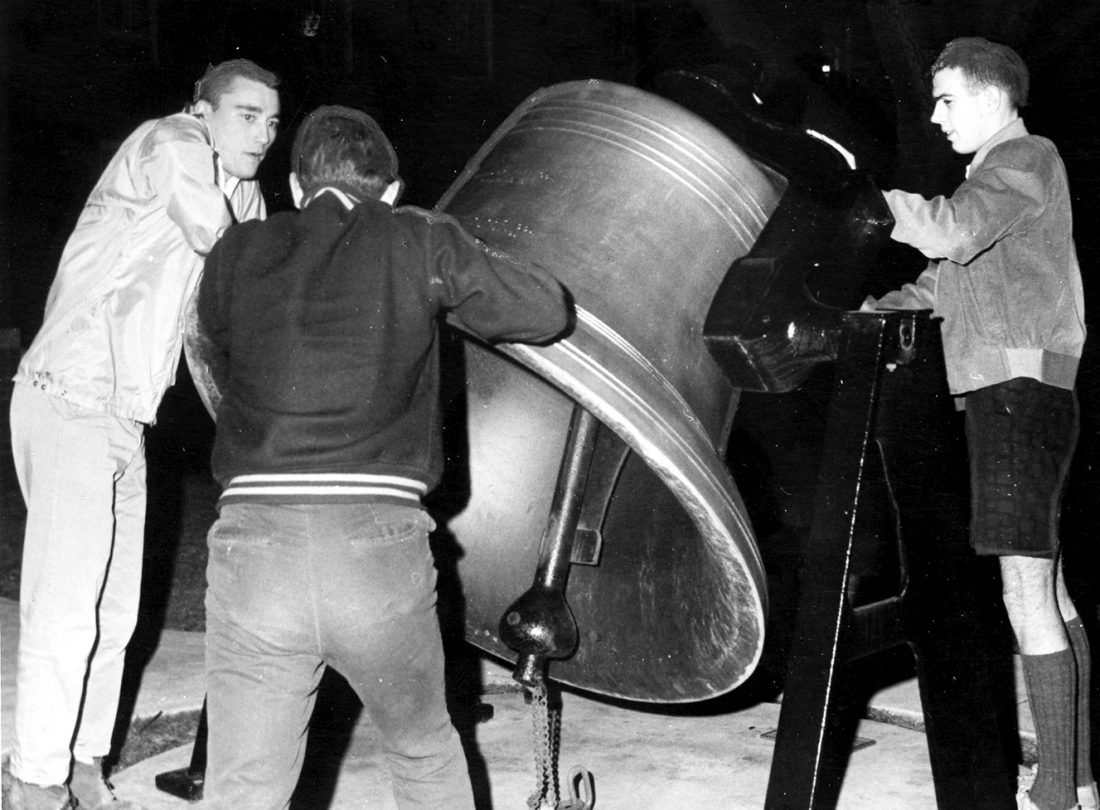
EXPRESS ARCHIVES Throughout the March of 1962 protest at Lock Haven State College, students rang the campus bell.
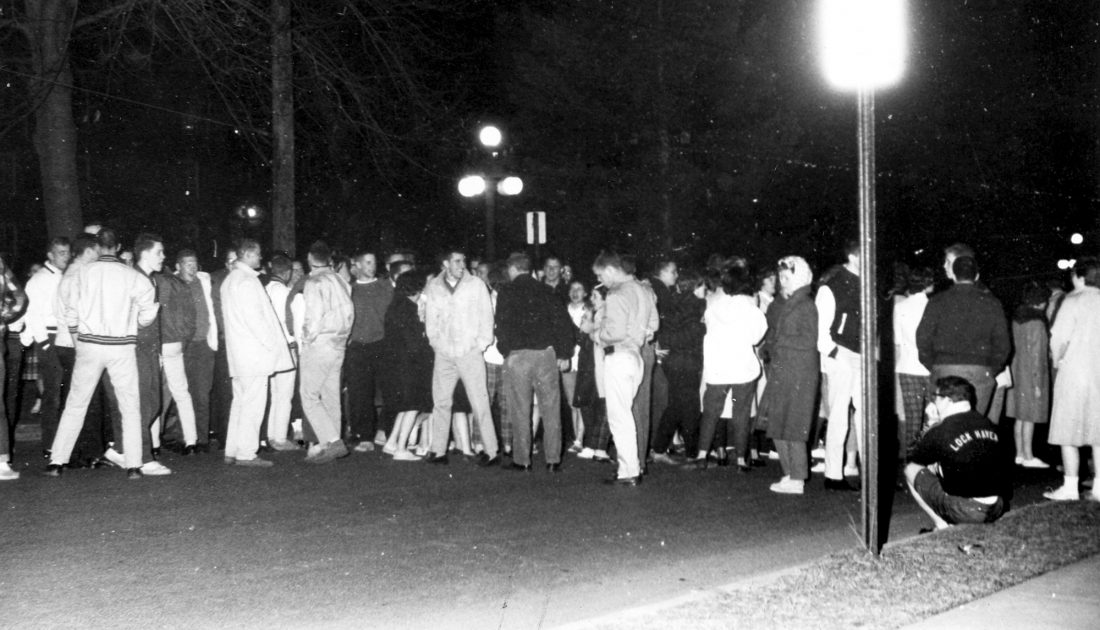
EXPRESS ARCHIVES Lock Haven State College students are pictured blocking the intersection of Route 120 and Water Street on March 28, 1962 during a protest regarding a day off.
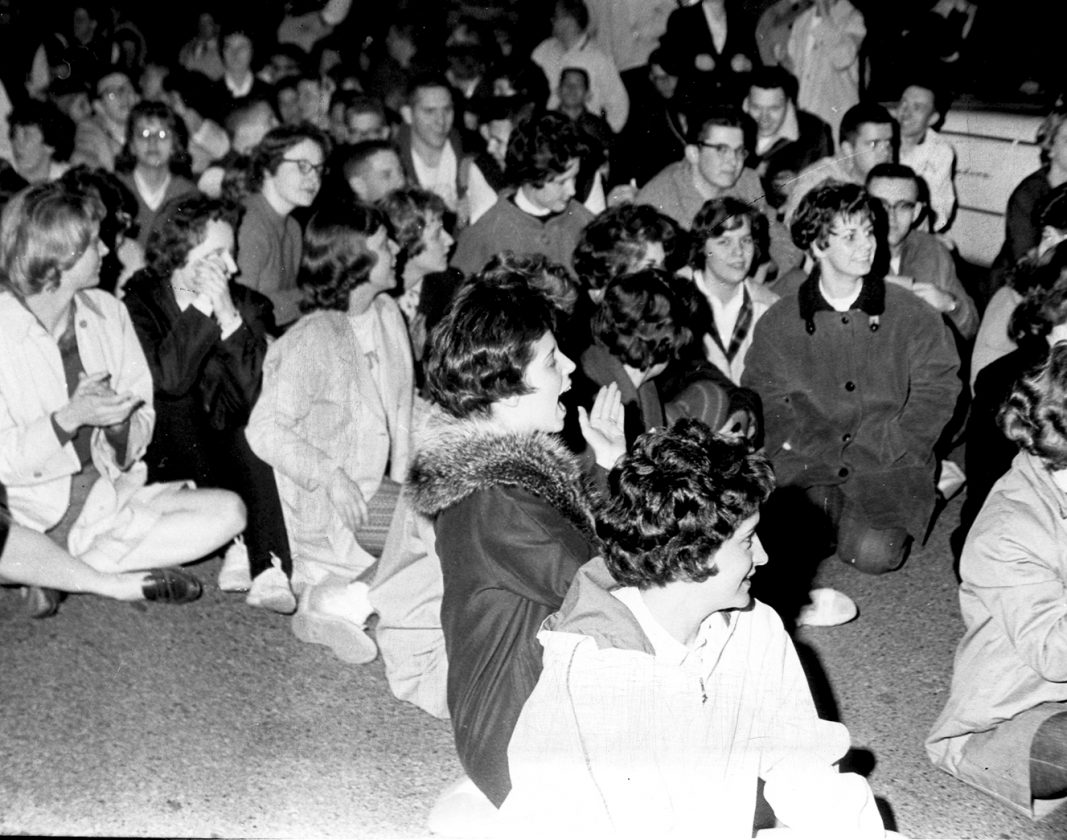
EXPRESS ARCHIVES A group of sideline demonstrators cheer at the large crowd during the protest.
EXPRESS ARCHIVES Throughout the March of 1962 protest at Lock Haven State College, students rang the campus bell.
EXPRESS ARCHIVES Lock Haven State College students are pictured blocking the intersection of Route 120 and Water Street on March 28, 1962 during a protest regarding a day off.
EXPRESS ARCHIVES A group of sideline demonstrators cheer at the large crowd during the protest.
Trending
(Editors Noted: The below article and photographs first ran in The Express on March 28, 1962 and detailed a protest held by Lock Haven State College students. Thank you Lou Bernard and Joby Topper for helping find the article to be paired with the photos.)
Several hundred students, clamoring "We want a Gray Day," demonstrated on the Lock Haven State College campus last night. The demonstration included a water battle with police and firemen, called out when students blocked the intersection of Water St. and the Renovo Road just off campus.
The demonstration resulted from the college administration's refusal to grant a day off school 'in honor of Gray Simons', who Saturday won a national wrestling championship.
Students milling on the campus from about 8:30 p.m. engaged in a water battle with firemen at 10:30, following attempts by police to clear the intersection. A few stones were thrown at the new city equipment truck, and a hose was turned on firemen at one stage.
Firemen were called by police when students threatened to set fire to a barricade which had been dumped in the middle of the intersection. Police feared toilet paper strung over telephone wires would endanger the wires if a fire was started below. Two trucks, from Citizens Hose Co. and the Hand-in-Hand Hose Co. responded. The city equipment truck was also called.
Little damage was reported by college authorities. Firemen reported some damage but no firemen were injured.
Some cars passing the scene, halted by the obstruction, were rocked by students; none were upset. The campus bell was rung at intervals and shrill police whistles from girls dormitories punctuated the noises of the demonstration.
Police were called to the scene by people who heard the demonstration and some whose cars had been rocked by the students.
Efforts by police to clear the intersection were resisted by students, and a barricade of benches, logs, a bed and mattress, and other objects, including a great quantity of toilet paper, was built in the middle of the intersection.
Police and students clashed at times, and Assistant Police Chief Paul Robb had a small cut over his left eye, although he denied any contact with students.
Firemen were called about 10 o'clock, when it was feared the barricade would be touched off. Several small fires had been set around the campus and on the practice football field.
Fire hoses were played on the fire, extinguishing it promptly; then the hoses were turned on the shouting students. When the water was turned off momentarily, students rushed firemen, and a short battle took place, but it was ended when the water was restored.
Later, students grabbed a free booster hose and turned it on the firemen, and a pitched water battle took place for a minute or so, until firemen managed to turn off the water. Students and firemen were both thoroughly soaked.
One student reportedly had his glasses and watch broken, and there were bumps and bruises on both sides, but no one was seriously injured.
Mayor Douglas Peddie arrived in the new equipment truck to reason with the crowd. His pleas and an earlier appeal for orderliness from Dr. Richard T. Parsons, president of the college, were lost in the noise of the shouting students.
An attempt was made by students to find Gray Simons to speak to the crowd, but he could not be located. Several students spoke over the loudspeaker, pleading for order, but the crowd was not responsive.
Girls in Russell Hall called the men mingling outside to a "panty raid," and officals estimated several men students actually went inside the dormitory. Two climbed in an open window to an unoccupied room and returned with various pieces of ladies' underwear.
Most of the men, authorities said, merely raced from one end of the girls' dormitory to the other.
The demonstration subsided about 11:30, although students remained outside for quite a while. At 1:38, a housemother called police from the college to report her fears of another outbreak, and a later call at 2:42 reported several men outside calling to girls to come out, but the group dispersed.
Several hundred students participated, although the college authorities felt only 200 or 300 had actually formed the core of the demonstration.
Dr. Richard T. Parsons, the college president, said, "They wanted a free day, but we don't believe in days off for athletic events."
Dr. Parsons said the college student council has planned an assembly tomorrow at 1 p.m. in Thomas Field House to honor Simons and the wrestling team.
Students reportedly met about 8 p.m. last night to form a protest group, but the report was unverified. Dean of Men Edward Young said he encountered a group of freshman women about 8:30, outside of the men's dormitory, agitating the men inside, but persuaded the girls to leave.
Students formed outside Dr. Parsons' home twice. The second time he spoke to them, reiterating his stand on the day off.
He said he had recently checked the grade reports, and had noted an unusual number of unsatisfactory reports for the first period of the semester.
He said he hoped the more mature students would look at the matter sensibly. He told the assembled students that they were using the wrong procedure, and that he, for one, would not listen to a mob.
The students proceeded to the intersection and when police arrived, became more belligerent and resisted the police efforts.
The college reported a bench, a door panel in Russell Hall, and one policeman's glasses had been damaged. Dr. Parsons said the college would pay for the glasses.
Firemen reported a bent license plate on the equipment truck, a broken hose coupling, and two missing coats as their damage.
Dr. Parsons said today that, essentially the demonstration was a display of student enthusiasm, probably complicated by the sudden appearance of spring, but that three serious mistakes had been made -- the obstructing of traffic, the throwing of stones, and the invasion of the girls' dormitories. He said he thought most of the students now realized that they had far exceeded the proper bounds of high spirits.