
Gardening sustainably in 2025
Trending
As environmental concerns increase, many gardeners are looking for ways to make a difference. Sustainable gardening is one option. Definitions of sustainable gardening vary, but in general terms, it is an approach to gardening that makes the most of what nature provides while minimizing the use of additional resources or "inputs." Sustainable gardeners still produce beautiful landscapes and bountiful vegetable gardens, but they do it in ways that do not harm the environment or the creatures that inhabit it. Let's take a look at some sustainable gardening practices to consider for 2025.
Improving soil with compost is an important component of sustainable gardening. Compost is simply decayed organic matter such as vegetable scraps, fruit peels, coffee grounds, leaves, grass clippings, garden debris etc. Once those items have decomposed, they can be added to garden beds to improve the soil. Rather than throwing them away, they can be put to good use and decrease expenditures for fertilizer, peat moss and other soil amendments.
Making compost reduces the volume of waste going into landfills. It decreases plastic pollution because leaves and other organic matter are often placed in plastic bags to be sent to landfills. Compost can reduce the need for supplemental watering because soil amended with compost is better able to absorb and retain moisture. Experienced gardeners sometimes refer to finished compost as "black gold" because it enhances the structure of the soil, attracts earthworms and other beneficial organisms, increases water retention and adds nutrients. Making compost can be an easy, inexpensive and sustainable way to improve soil, which is the foundation of any successful garden. Penn State Extension provides composting information at https://extension.psu.edu/home-composting-a-guide-for-home-gardeners.
Reducing the size of residential lawns is another sustainable gardening component. Traditional lawns are expensive and time consuming to maintain and often result in the overuse of both fertilizers and pesticides. Lawns require inputs such as purchasing mowers and fuel, water for irrigation, fertilizer and time spent maintaining them. A more sustainable approach is to reduce the size of lawns to only as much as is needed for outdoor living and play areas and utilize the rest for native trees, shrubs and perennials. The American Horticultural Society offers plenty of suggestions for lawn alternatives at https://ahsgardening.org/gardening-resources/sustainable-gardening/plant-selection/. Research has shown that lawns have very little value to pollinators and other wildlife, some of whom are declining due to lack of food and habitat. Reducing the size of lawns and planting natives can save resources, time and money while helping pollinators and other wildlife survive.
Even with smaller lawns, there are things that can be done to make them more sustainable. Raising the mower blade and allowing grass to grow taller will encourage the growth of deeper roots, which can decrease the need for supplemental watering. Grass with sufficient top growth and deeper roots tends to be healthier and better able to withstand drought and disease. Taller grass can shade out weeds, thereby improving the appearance of the lawn without applying herbicides. Allowing grass clippings to remain on the lawn instead of collecting, bagging and sending them to the landfill is another sustainable practice. As they decompose, the clippings return nutrients to the soil and decrease the need for fertilizer. While mowing grass to a height of no less than three inches is often recommended, the ideal height for a mower blade depends upon the type of grass. For more information on mowing heights and healthy lawns, visit https://extension.umd.edu/resource/mowing-or-grasscycling-lawns/.
Making use of fallen autumn leaves is another opportunity to make a landscape more sustainable. Fallen leaves can serve several purposes. They insulate plants and soil through the winter. As they decompose, they add nutrients to the soil. They provide overwintering sites for insects and nesting sites in the spring. Fallen leaves can also benefit lawns. A light coating of leaves can be ground up by running a lawn mower over it in late fall and allowing the ground leaves to remain on the lawn to add nutrients to the soil. Only a thin layer of ground leaves is recommended for lawns. Excess leaves can be gathered up and composted for use elsewhere in the landscape.
Incorporating native trees, shrubs and perennials into a landscape is a key component of sustainable gardening. Because they have evolved in an area over thousands of years, native plants are well adapted to the conditions in that area. That means they rarely need inputs such as fertilizer and supplemental watering, making them more reliable and easier to care for than non-natives. In addition, native plants are essential to the survival of pollinators and other wildlife. According to the US Department of Agriculture, "Three-fourths of the world's flowering plants and about 35 percent of the world's food crops depend on animal pollinators to reproduce." Clearly, protecting pollinators is in our best interest. The Pennsylvania Department of Conservation and Natural Resources provides facts and links to useful native plant information at https://www.dcnr.pa.gov/Conservation/WildPlants/LandscapingwithNativePlants/Pages/default.aspx.
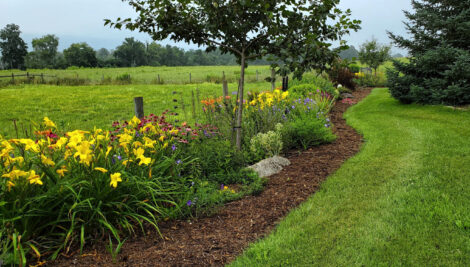
This is just a sampling of sustainable gardening practices. I've used many of them in my own landscape for years and have been very pleased with the outcome. Not only is it beautiful, it's alive with pollinators and other wildlife. I hope readers will consider giving sustainable gardening a try in 2025.
-- -- -- --
Debra C. Burrows, PhD, is a retired Penn State Extension Educator and a certified Master Gardener. She can be reached at dcb3@psu.edu.