
Rain gardens: Beautiful and functional
Trending
This column often focuses on gardening practices that are good for our environment and the creatures that inhabit it. One such practice is the creation of rain gardens, which until recently were not widely used in residential landscapes. They have the potential to help mitigate stormwater runoff, an often-overlooked and growing problem that affects all of us.
Prior to the extensive land development that occurred over the last century, much of the rain falling on undisturbed areas such as forests and meadows was slowed and filtered by plants and soils and soaked into the ground gradually. Today, our surroundings are filled with impermeable surfaces such as sidewalks, roof tops, paved driveways, patios and roads, just to name a few. Rainwater cannot penetrate these surfaces and so it runs off into streams, lakes and storm sewers, bringing with it pollutants such as road salt, pesticides, oil and gas residues, fertilizer, eroded soil, etc. It has been estimated that more than half, indeed as much as 70%, of the pollution entering waterways originates in our own yards and gardens.
Waterways polluted by runoff can harm fish, insects and mammals which depend upon them for both food and habitat. Pollution carried by runoff can also degrade sources of drinking water for humans and make lakes or streams unsuitable for fishing and swimming. Instead of soaking into the soil and recharging precious groundwater, high volumes of runoff contribute to flooding which can cause property damage and loss of life.
Rain gardens are designed to filter out pollutants and decrease the amount of runoff while adding beauty to the landscape as well as nourishment and shelter for wildlife. That sounds like a tall order, so let's see how it's done.
Rain gardens are shallow depressions dug into a landscape where water pools temporarily before soaking into the ground rather than running off. These pooling areas are filled with carefully selected plants, often native perennials, trees and shrubs that thrive in briefly submerged conditions. Sediments collect around the plants' top growth and the plants' roots help to draw water down into the soil, filtering it as it goes and trapping pollutants.
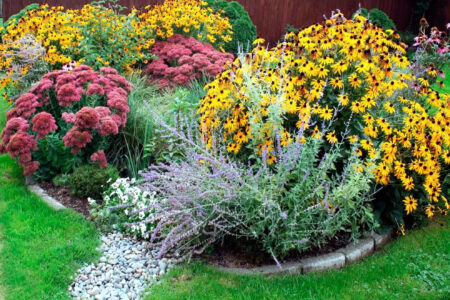
While a rain garden catches and filters runoff, that isn't the only benefit it provides. It can be a beautiful addition to a landscape because a wide variety of perennials, trees and shrubs thrive in a rain garden environment, giving the gardener plenty of choices. Many rain gardens resemble flower beds and can easily fit within or enhance the overall design of a residential landscape, whether it is formal in style or more casual. In addition, a rain garden planted with native plants provides pollinators and other wildlife with much-needed food and habitat.
To determine if a rain garden would be a good addition to your landscape, begin by making some observations during or immediately after a rainfall. Pay close attention to rooftops, sidewalks, paved driveways and other impervious surfaces. If you see runoff from those areas you might want to consider installing a rain garden to capture that runoff before it travels to storm drains or nearby streams.
Once you've decided to install a rain garden, it's time to learn as much as possible about the process. Penn State has an extensive collection of information for those interested in creating rain gardens at www.paenvironmentdigest.com/newsletter/default.asp?NewsletterArticleID=56470&SubjectID=
There you will find step-by-step instructions, videos, plant lists, recommendations and more. Additional information is available from University of Massachusetts Extension at ag.umass.edu/landscape/fact-sheets/rain-gardens-way-to-improve-water-quality.
Stormwater runoff is a big problem and one might wonder if a single rain garden on a small residential lot will make a difference. If enough of us take action and spread the word, it just might. As anthropologist and Pennsylvania native Margaret Mead said, "Never doubt that a small group of thoughtful, committed citizens can change the world; indeed, it's the only thing that ever has."
-- -- -- --
Debra C. Burrows, PhD, is a retired Penn State Extension Educator and a certified Master Gardener. She can be reached at dcb3@psu.edu.