
Don’t waste those autumn leaves!
Trending
In the coming weeks, nature will provide us with an abundance of fallen leaves. In the past, autumn leaves were often considered a useless nuisance that had to be removed. Research has shown just the opposite to be true. Fallen leaves are an important resource which can enrich and protect our landscapes and provide food and habitat for insects, birds and other wildlife.
Autumn leaves are part of nature's very efficient cycle of life. As they decompose, they add organic matter and nutrients that enrich the soil and improve its structure and capacity to hold water. The roots of plants grow into the soil, taking up nutrients and moisture to produce leaves. Leaves enable them to photosynthesize, a chemical reaction that produces food from sunlight, water and carbon dioxide. Plants use this food to grow. In autumn, the leaves fall to the ground, and the cycle begins again.
We can replicate this recycling process in our managed landscapes in several ways. Autumn leaves can be used as a mulch in beds and borders. It's important to shred large leaves to keep them from blowing away or matting down after rainfall. Small leaves need not be shredded. Leaf mulch will deter weed growth, moderate soil temperatures and protect soil from erosion. It will also help to shield plants from winter damage. As the leaves decompose, they improve the soil.
Leaves can also be used to improve lawns. This is one of the easiest ways to utilize fallen leaves and something I've been doing for years. Leaves that fall onto the lawn can be shredded in place with a lawn mower. A mulching mower is ideal, but a regular mower can do the job by running it over large leaves an extra time to chop them into smaller pieces. Blades of grass should be visible above the leaf mulch, not completely covered by it. Too much will smother the turf. The leaves will decompose over time, adding nutrients and organic matter to the soil, and making it easier for turf grass roots to spread and take up water.
Collecting leaves and digging them into vegetable garden beds in the fall allows the leaves to decompose over the winter, adding organic matter and nutrients to the soil and improving its ability to retain moisture. Leaves can be added to compost piles, increasing the amount of compost that will be available for the next season. As experienced gardeners know, adding compost is a very effective way to improve poor soil.
Equally important, but often overlooked, is the critical role that fallen leaves have in providing food and habitat for insects and other wildlife. While some butterflies migrate, many do not. They spend the winter nestled in tree bark, logs or piles of leaves, as do many moths, fireflies, beetles and the familiar wooly bear caterpillar. Ground nesting bees welcome the cover of fallen leaves to insulate their nests. Many pollinators native to Pennsylvania overwinter in layers of leaves.
According to the USDA, "Pollinators like honeybees, butterflies, birds, bats and other animals are hard at work providing vital but often unnoticed services. They pollinate crops like apples, bananas, blueberries, strawberries, melon, peaches, potatoes, vanilla, almonds, coffee and chocolate." (www.usda.gov/about-usda/general-information/initiatives-and-highlighted-programs/peoples-garden/importance-pollinators). The USDA goes on to say, "These and other animal pollinators face many challenges in the modern world. Habitat loss, disease, parasites and environmental contaminants have all contributed to the decline of many species of pollinators." (USDA)
We can help pollinators and other wildlife by allowing some leaves to remain undisturbed in our yards and gardens. To do this we need to avoid raking, shredding and blowing the leaves so as not to harm or kill the delicate creatures that are taking cover in them.
If leaves fall in a location where they cannot be left for the winter, they can be collected as soon as they fall, before insects have had an opportunity to settle into them. The collected leaves can then be placed in a wire enclosure, fence corner, flower bed or other out-of-the-way area where they will not blow away. They should be left undisturbed until at least mid-spring to allow the insects that overwintered in them to emerge unharmed.
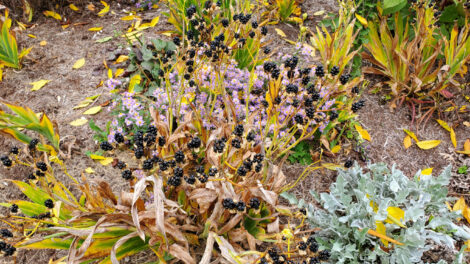
It may not be feasible to allow all the leaves to remain undisturbed where they fall and some compromises may be needed. That has been the case in my landscape. In the coming weeks, I'll mow sections of my lawn where leaves have fallen and leave the shredded leaves and grass clippings on the lawn. In other areas, I will allow the leaves to remain undisturbed where they fall. This works well underneath a large pussy willow because the leaves are small and will not mat down. I leave dogwood, viburnum, cherry and other small leaves undisturbed in flower beds as well. They provide good insulation for the plants in those beds and improve the soil as they decay.
One thing we should not do with leaves is burn them. Burning wastes valuable resources and kills small creatures taking shelter in piles of leaves. It can also be a fire hazard and a source of air pollution. Additional information is available from the Xerces Society at xerces.org/blog/leave-the-leaves and from Peace Valley Nature Center at www.peacevalleynaturecenter.org/the-hidden-value-of-fallen-leaves-nature-s-essential-ecosystem-players .
-- -- -- --
Debra C. Burrows, PhD, is a retired Penn State Extension Educator and a certified Master Gardener. She can be reached at dcb3@psu.edu.