
The upside of long nights and cold temperatures
Trending
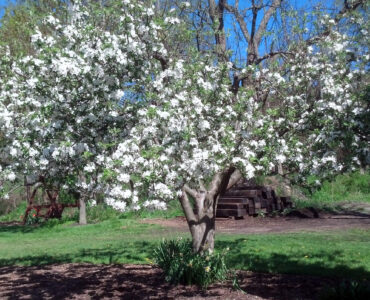
PHOTO BY DEBRA BURROWS
This apple tree in southern Clinton County was able to bloom and bear fruit because it experienced enough cold weather to meet its chilling requirement.
Winter in Pennsylvania, when temperatures drop and darkness falls around 5 p.m., is not my favorite season. But as a gardener, I have to acknowledge that it has its benefits, because some of the most beautiful flowering plants wouldn't flower at all without experiencing prolonged darkness and/or cold temperatures. Some species get their cues from light levels, others from temperature and still others rely on both. To make the most of another cold, gray, winter day, let's focus on some of the ways in which plants utilize darkness and cold.
A plant's response to the amount of light and darkness it receives is called photoperiodism. Through photoreceptors in their cells, some plants can track not only the amount of light or darkness in each day but also determine whether days are becoming progressively longer or shorter. The plant uses that information as a signal to start or stop bud formation, chlorophyll production, growth and other processes.
Generally, plants are divided into three categories to describe their responses to darkness and light. Short-day plants develop flowers as nights become longer. Long-day plants develop flowers as days become longer and day-neutral plants flower without regard to day length. For example, common garden chrysanthemums (Dendranthema x grandiflora), which bloom in late summer and fall as days are becoming shorter, are classified as short-day plants. The reverse is true for long-day plants such as coneflowers (Echinacea, spp.) and carnations (Dianthus, spp.) which receive cues to form buds and bloom as days become longer. Tomatoes (Solanum lycopersicum) and corn (Zea mays) are examples of day-neutral plants.
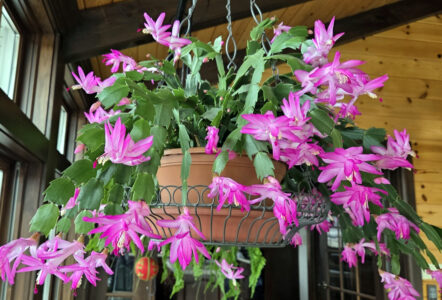
Photoperiodism is an important consideration with certain houseplants, such as poinsettia and Christmas cactus, both of which are short-day plants. I often get questions from people who received these plants as gifts but were disappointed when they failed to bloom the next year. Frequently, it's because the plants were in rooms where lights were turned on in the evening, making it impossible for them to experience the required days and hours of continuous darkness needed to produce flower buds. Turning a light on for just a few moments can disrupt bud formation, so special care must be taken to ensure these plants get the darkness they need. Detailed instructions are available from Michigan State Extension at www.canr.msu.edu/news/how_to_rebloom_your_holiday_poinsettia and www.canr.msu.edu/news/how_to_care_for_and_reflower_your_christmas_cactus .
Now let's consider the importance of cold temperatures. Some plants have a "chill requirement" and are unable to bloom until they have been near, but above freezing, for a sufficient period of time. A plant's chill requirement protects it from flowering during a brief mid-winter warm spell only to have the flowers freeze and die when temperatures fall again. The term "vernalization" is used to describe the process by which plants meet their chill requirements and then flower when the weather begins to warm sufficiently.
The temperature and duration of the chilling requirement vary substantially from species to species. Temperatures between 33 F and 50 F are generally considered the chilling range. Let's look at a few examples. Many apple trees (Malus, spp.) require approximately 800 to 1,200 hours of chilling, usually at around 47 F, before they can flower. Peach (Prunus persica) and pear (Pyrus communis) trees also have chill requirements, as do blueberries (Vaccinium corymbosum) and lilacs (Syringa vulgaris).
Daffodils (Narcissus, spp.) and tulips (Tulipa, spp.) generally need 12 to 16 weeks of temperatures in the 40's to meet their chilling requirements. During that time their roots and bulbs develop underground. Hardneck garlic (Allium sativum var. ophioscorodon), which is grown in Pennsylvania, needs six to eight weeks below 40 F for bulb formation. Once that has been achieved, the plant is able to form bulbs of garlic cloves as days lengthen and soil warms.
So, fellow gardeners, next time you feel like winter is getting you down, it might help just a little to remember that some of our favorite plants need cold and darkness to form the delicious fruits and beautiful flowers of spring and summer.
-- -- -- --
Debra C. Burrows, PhD, is a retired Penn State Extension Educator and a certified Master Gardener. She can be reached at dcb3@psu.edu.