
Keeping Valentine’s Day houseplants healthy
Trending
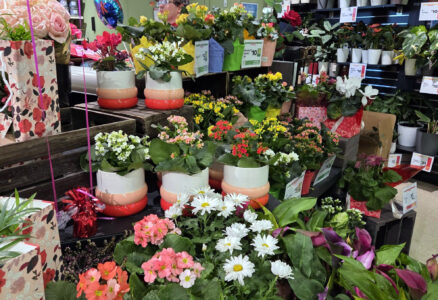
PHOTO BY DEBRA BURROWS
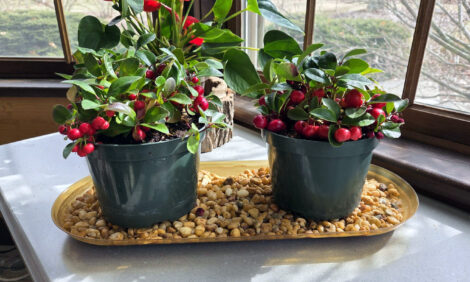
This display of potted plants in decorative containers was photographed during the week before Valentine's Day in southern Clinton County.
Houseplants and cut flowers are attractive Valentine's Day gifts that brighten homes and offices each February. While cut flowers will last a week or two, houseplants, with proper care, can stay beautiful and healthy for years if we pay attention to a few important details.
Keeping them healthy begins with inspecting their containers. Chances are, they arrived in attractive bowls, baskets, or pots. All too often, these containers lack one very important feature: drainage holes. While appealing to the eye, containers without drainage holes can be the kiss of death for houseplants placed in them. Plant roots need both air and water. A pot without drainage will hold water around plant roots, depriving them of the air they need and setting up conditions that cause roots to rot.
Often, houseplants received as gifts come in two containers-the decorative outer one and a less attractive pot or plastic insert placed inside it. If the inner container has drainage holes, the solution can be as simple as removing it and placing it in a saucer. The plant can then be watered and will drain freely. If there is only one container and it lacks drainage holes, or the inner pot lacks drainage holes, the plant needs to be repotted into a container with proper drainage.
Removing the outer container is especially important with orchids, which are frequently sold with two containers. Many orchids are epiphytes. In their natural environment, epiphytes attach themselves to tree trunks, fallen logs and other surfaces. Their aerial roots get moisture and nutrients from the air and from decaying organic debris around them, not from the soil. Orchid roots need plenty of air flow and will rot if confined to a pot that does not drain and provide room for growth.
Houseplants grouped together in one container can be an attractive gift, especially if they include blooms, variegated or contrasting foliage, and variations in height and texture. While they might look good together, it's important to check to see if they share the same light requirements. Some may need direct sunlight, while others, especially tropical plants, may need indirect light or partial shade. If that's the case, transplanting them into separate pots that can be placed in appropriate light locations will help to keep them healthy and attractive.
Another concern with houseplant groupings is moisture levels. Some popular houseplants, like kalanchoe (Kalanchoe, spp.) prefer dry conditions, while others such as peace lily (Spathiphyllum), prefer moist, well-drained soil and high humidity. To keep them healthy, they can be transplanted into separate pots and watered accordingly. Those needing high humidity will benefit from having their pots paced on humidity trays. Humidity trays can be created by selecting a saucer several inches wider than the pot, filling it with a single layer of pea or other small gravel, and adding water just to the top, but not over the gravel. As the water evaporates, it will increase the humidity level around the plant.
Keeping houseplants healthy and attractive means replicating their natural environment as much as possible. That includes paying attention to preferred light and moisture levels, drainage, soil conditions, temperature, nutrients, etc. The closer to natural conditions, the more likely the plant is to thrive. Additional information on types of potting mixes, indoor fertilizers, and caring for houseplants is available from University of Wisconsin Extension at hort.extension.wisc.edu/articles/houseplant-care/. Information on growing orchids indoors is available from Iowa State Extension at yardandgarden.extension.iastate.edu/how-to/growing-orchids-indoors.
-- -- -- --
Debra C. Burrows, PhD is a retired Penn State Extension Educator and a certified Master Gardener. She can be reached at dcb3@psu.edu.