
My summer with a reel mower
Trending
I decided to go old school this summer and purchase a reel mower. Yep, the old-fashioned mower that uses rotating blades and your own energy to cut the lawn. I have been preparing my garden and landscape for aging-in-place and in the process, I've reduced the size of my lawn, leaving more room for native plants or cultivars, while mostly eliminating the slopes that have grown more challenging to mow as I've gotten older. With a much smaller lawn, I started to wonder whether I could get away with a reel mower.
Growing up, I had two great-aunts, named Olive and Florence, who lived together in a small northwest Ohio community. Olive managed the local school cafeteria, planning the homemade meals and running the budget, while Florence ran their home and tended the garden. I have fond memories of heading to their house after school and finding Aunt Florence out mowing with a reel mower well into her 70s and 80s. I would often volunteer to mow, as I wasn't allowed to use the gasoline-powered mower used at my own house until I was older. I'm sure the dime they gave me afterward, which I'd run down to the local ice cream shop to spend, didn't hurt my persistence either.
Fast forward 50-some years, and while I toured the gardens of Winterthur, the guide discussed the pollution produced by gas-powered lawn mowers. Research varies, with some estimates suggesting that operating a typical gas mower can generate as much smog-forming pollution as driving a modern car 100 to 300 miles. A typical household mower may emit between 20 and 90 pounds of carbon dioxide (CO2) per year. Unlike modern automobiles, small mower engines often lack the sophisticated emissions controls found in newer vehicles.
The carbon story becomes more complicated when lawns themselves are considered. Grass absorbs carbon dioxide from the atmosphere as it grows, but it also releases carbon dioxide through natural processes in the plant and soil. Researchers continue to debate whether lawns ultimately store more carbon than is generated through mowing and other maintenance activities. What became clear, however, is that gasoline-powered mowers produce significantly more operational carbon emissions than battery-powered mowers, while a reel mower produces no direct emissions during use.
Convinced that a reel mower was better for the environment, I moved on to whether a reel mower would provide a healthier cut for my lawn. I learned that the horizontal blades cut like scissors; the grass is cut with a shearing action versus the tearing action of a gas or electric rotary mower--think cutting your lawn with scissors instead of a dull machete. The shearing action lets grass heal faster after a cut and lowers the risk of fungal infection.
Another benefit of reel mowers is safety. Because they lack an engine and use a slower scissor-like cutting action, they are less likely to throw sticks, stones or other debris than a conventional gas-powered mower. While any mower should be used with caution, reel mowers generally pose a lower risk of serious injury than their gas-powered counterparts
And finally, I already knew that I could expect health benefits from using a reel mower as there is obviously a greater physical investment in the activity. And more broadly, numerous studies have linked gardening to greater longevity and slower cognitive decline. Whether it is science of coincidence, Aunt Florence lived to be 96 and family lore is that she mowed up until she went into the nursing home.
So, between the nostalgia, a much smaller lawn and research that informed my choice, I decided to buy a reel mower. Since I wasn't ready to invest in a top-of-the-line model, I went for the mid-range and picked one up for around $125 at a local box store. Prices can vary from $60 to over $250, making them a reasonably priced option, particularly for those with smaller lawns.
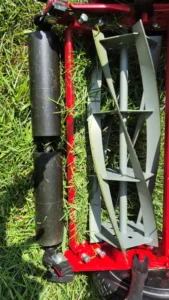
After a quick assembly, I gave it a test run. On my first go, I learned that mulch and small twigs would get caught in the blades, and I had to keep stopping to pull debris out of the reel. As I went along, I started scanning ahead for twigs and clearing them from my path. The mulch was harder to avoid, and eventually, I figured out that a quick jiggle and pull-back motion could free a jam without much fuss. I was a little discouraged at first, but as I grew wiser about what to look for and how to handle the jams, I was determined to continue.
On my second mow, armed with my tricks for avoiding jam-ups, things went much more smoothly, and I finished up the lawn in under an hour. With less time troubleshooting, I had more time to notice how the mower handled edges and realized I'd need the weed whacker to tidy up where the lawn meets the sidewalks and mulched beds.
It was now early July, and I was on to my third mow with the reel mower, and I asked my husband to weed whack the edges while I mowed. That backfired as the weed whacker threw mulch into the lawn, which jammed the reel, and after a moment of frustration with my husband, I remembered that I was the one who asked him to weed whack. A lesson was learned: weed whack after mowing, not before, since loose mulch is far more likely to get picked up by the blades and cause a jam.
Reel mowers are wonderfully quiet, which neighbors tend to appreciate if you mow in the evenings or early mornings. The lack of noise also means you can skip the ear protection and listen to music or your favorite gardening podcast instead. On the downside, reel blades aren't removable and need professional sharpening, whereas rotary blades on a gas or electric mower can be maintained at home. So what mower is right for you? That depends on your lawn, your environmental and health goals and your own preferences.
I remain committed to mowing our lawn bordering our house, but we have a perimeter area that is far more challenging to manage. With our smaller lawn, we can handle the main yard mowing ourselves, and while we do have help with the tougher perimeter, we've cut that mowing back to every other week and, by doing so, cut the gas-mower emissions in half.
Just like my Aunt Florence, I hope to keep mowing my own lawn well into my 80s. Only now, the post-mowing trip to the local ice cream shop costs me $3.75.
-- -- -- --
Carol Lugg became a Penn State Extension Master Gardener in March 2022. She can be contacted at clintonmg@psu.edu or through the Master Gardeners of Clinton County Hotline at (570) 858-0198.