Happenings from the Heisey
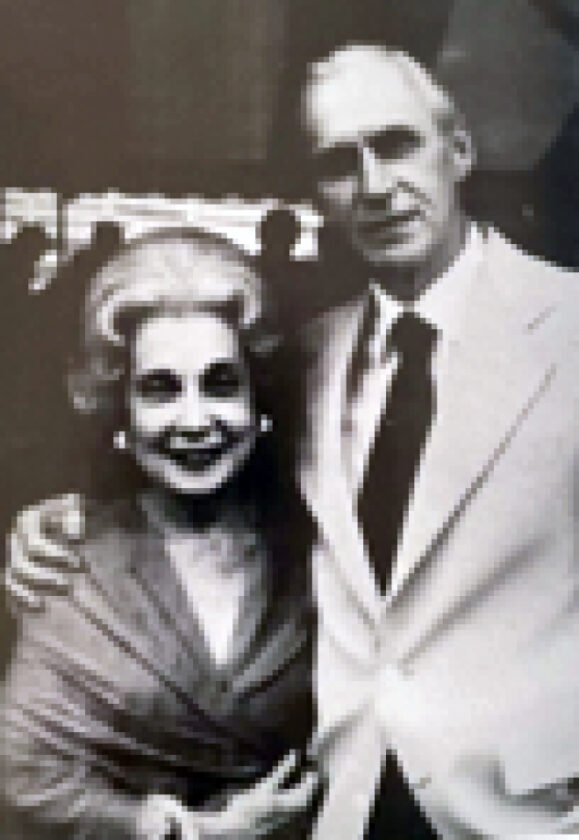
PHOTO PROVIDED Bee and Abe Lipez are pictured.
We have a wonderful day planned for Sunday, Dec. 14 from 12-5 p.m.! The Heisey House is decorated for the holidays and the ever-popular self-guided Holiday House tour of 10 properties is planned. Dogwood Circle Garden Club is again providing fresh and artificial arrangements as door prizes, so be sure to drop your name in the jar! Tickets, $20, are for sale now at the Heisey and on our website www.clintonpahistory.org. Come to the Heisey at 12 p.m. to get your house tour wrist band and descriptive pamphlet, and visit our “sale” of holiday decor at the Heisey and Poorman Gallery for the price of a donation before you head out for an enjoyable afternoon.
On Nov. 2 we thanked John and Joyce Gummo, Steve Poorman, Luther Jette, Jim Berkebile, Jersey Shore Steel and Allison Crane and Rigging for the placement of the “Yard Jockey” engine at the Castanea Train Complex.
From the
Collection
By Kathy Arndt
Once again, as in 2023, these paragraphs are going to be about the Christmas/Chanukah cards sent by Judge Abraham (Abe) and Bee Lipez in the 1960s and 1970s. First, however, I have to correct some information about the family in that 2023 column. While I was correct in writing that Abe was born in Russia in 1903, he did not immigrate to the US until 1907 with his mother Ellen and his little sister. It was his father, Max, that came to the US and settled in Lock Haven where he had friends and relatives in 1905. Max started his life here as a peddler with a backpack for his wares. After a year, he was able to buy a horse and wagon and expand his sales territory to cover Clinton, Potter and Tioga counties. By 1910, he had established a shoe store at 44 Bellefonte Avenue which soon expanded to a larger shoe and clothing store at 42-46 Bellefonte Avenue. In 1929 after the crash of the economy, Max Lipez went out of business. He later served as an alderman, a member of the school board, and the president of the Beth Yehuda synagogue.
Like Max, Abe and Bee were devoted to community service. In a thank you note written to those who signed his petitions to serve as President Judge of the County he assured his supporters that he considered it his “deepest obligation…to safeguard, without partisan or political influence, the rights of every individual who came … before him” in the court.
Their holiday messages were of peace, tolerance, caring and hope for the future. In 1961, they wrote about the passing of Will Davis, a man known to many around town as the “Judge’s handyman.” A tall, slender, dignified religious black man, Davis was described by Bee as being a member of their household who loved his bible and cared about the plight of the children who were growing up with the threat of Khrushchev in the world. In 1968, Bee wrote about reviewing the cards from the previous year’s holidays and having good memories of the places and people but also feelings of sadness. There was grief for the loss of friends and the “loneliness one senses when the card always familiarly signed by two names bears the signature of only one.” Her eloquence and empathy are quite apparent as she expresses her appreciation for the friendship shown to her and Abe over the years.
In 1969, Bee’s card had a pen and ink drawing of the Statue of Liberty surrounded by immigrants. She acknowledged that the world currently felt far away from “Peace on Earth” but the names in their address book reflected the different ethnic and religious backgrounds of their many friends. This reminded her that we live in a “melting pot where it is possible for us to worship in our own faith.” The holiday card also contained a letter to her three grandchildren recounting the story of their great grandparents (Max and Ellen Lipez). Nana Bee wrote that the most prized possession of their great grandparents was their citizenship papers that allowed them “to live here in freedom forever, as could their children and their children’s children.” In 1970, Bee wrote of being called by name on Main Street by a young lady with long hair, worn dungarees and bare feet. The girl told Bee that she was the daughter of some old friends who no longer lived in the area. She had become curious about the place where she had been born and spent part of childhood. Bee and Abe had a wonderful conversation with the young woman and her partner, who were both teachers in New York, and were both “searching for answers — why poverty and misery continued and social injustice persisted in a land of plenty.” Bee concluded “that the warmth and honesty of her radiant friendliness blotted out the superficial nonsense of hair and clothing and our friendship was sealed.” The fact that the young people were “reaching out to replace materialism with humanitarianism” gave Bee and Abe hope for the future once again.
The last card in our collection was from 1974. Bee delayed sending her holiday cards until after the first of the year so that she could include Martha Zeigler’s article in the Express about Abe’s retirement dinner. Abe retired on Dec. 31, 1973 after spending 21 years on the bench. Bee wrote that the men who came to honor Abe were all dedicated to improving the quality of justice and, like Abe, knew “that in a democracy the courts did not belong to the judges or the lawyers, but to the people. The card was signed “Abe’s love and mine, Bee.”
Health and Home

Final supermoon of 2025 casts a blue hue in the December sky
Happenings from the Heisey
Parents under pressure offer creative tips for moving Santa’s spy Elf on the Shelf

They relied on marijuana to get through the day. But then days felt impossible without it
Tackling food insecurity, one garden at a time
STATE COLLEGE — About 1.7 million Pennsylvanians — including nearly half a million children — face food ...