
Lock Haven meets the killer Amasa Winchester
Trending
D. EVERETT SMITH/FOR THE EXPRESS
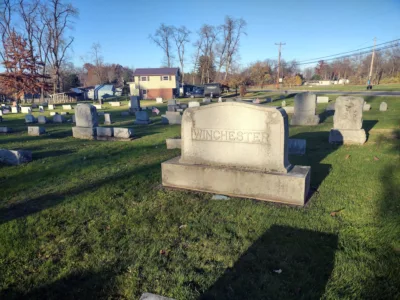
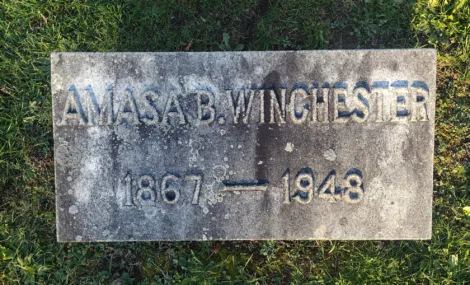
Amasa Winchester’s tombstone is pictured.
LOCK HAVEN – Lock Haven Jail, 1894, and it’s the day before Thanksgiving.
Two criminals were locked in a cage, one was a killer and the other was a robber.
The robber tried to recognize the letters on the page in an open book, while the killer continued to teach.
The killer’s name was Amasa Winchester, and the fear of a rope around his neck as it carried him into eternity was very real.
Let’s go back two months to Wednesday, Sept. 19, 1894.
At 5:30 p.m., Winchester played pool at the Opera House with another man named Joseph Moore. There had been a lot of liquor and this led to an argument that started and became physical.
Winchester pulled a knife on Moore and took a swipe and the ill-fated peacemaker named William Reeder stepped in.
Winchester became incensed at Reeder’s interference and “at once whipped out an ugly looking dagger and savagely attacked” him, the Columbian newspaper of Bloomsburg, said on Friday Sept. 21, 1894.
Reeder was cut “in seven different places about the head” but it was the fatal blow in the throat that did him in. Reeder’s "throat (was) cut and the blood spurting from it in a perfect stream, at once (Reeder) dropped to the floor, when the excited spectators reached his side his form was limp and lifeless. Death had been instantaneous.”
A crowd gathered and Winchester was “arrested shortly afterward and locked up.” Moore’s condition was considered “very serious.” Winchester was arrested and charged with first degree murder.
The Sept. 10, 1894, issue of the Williamsport Sun reported that Winchester was brought before Alderman Anthony in Lock Haven, but he “waived the hearing and was remanded to jail for court.”
Winchester feared for his life because he "appeared much distressed during his brief stay in the squire’s office,” the writer said. “He still remains non-communicative regarding the tragedy…District Attorney Hall…will make a strong effort to indict and convict the prisoner of murder in the first degree” which could bring the death penalty.
Winchester’s victims did not fare well. In a brief mention in the Sept. 7, 1894, issue of the Williamsport Gazette and Bulletin, Reeder was laid to rest at 2 p.m. that afternoon and “Joseph Moore…is getting along as well as could be expected.”
It was during this time that Winchester went from killer to tutor. Whatever the reason, cynical or altruistic, Winchester was “teaching a fellow prisoner, who was held for robbery, to read and write.”
“It is claimed (Winchester’s) pupil, who could neither read nor write, is making rapid practice,” said a report from the Reynoldsville Star, Nov. 28, 1894.
In the early part of the new year of 1895, Winchester was brought to trial, and the prosecutors did not fare well.
“(The) Prevailing sentiment in Clinton County’s Capital seems to indicate that the Commonwealth has made out a weak case,” the headline, for The Williamsport Evening News, Jan. 10, 1895, issue said, "It is likely that Judge Mayer will make his charge to the jury tomorrow morning. The sentiment here is decidedly in favor of Winchester and it is considered that the Commonwealth has made a very weak prosecution.”
The article explained that a “large number of witnesses have been heard for both sides, and the last evidence was presented” on the morning of Jan. 10.
As an almost commentary to the trial it was said that “Winchester is on trial for his life” because this was the “result of a quarrel that originated in a pool room…Winchester was considerably under the influence of liquor” and Reeder was killed when "acting as a peacemaker.”
The verdict was reported in the Lock Haven Evening Express on Sat. Jan. 12, 1895.
“The closing scenes in the trial of Amasa Winchester for the killing of William Reeder were as exciting as those of any of the murder trials of previous years,” the writer said.
It was in the courthouse when the jury left at 4:30 p.m. to deliberate. Two hours later, the courthouse bell “began to ring announcing to the judges, attorneys, prisoner and people” the jury had made a decision.
The bell ring also attracted “men and boys from all parts of the city ... (rushed) towards the court house.” Within moments the court was “packed to suffocation.”
About 7 p.m., the jury announced Winchester's fate... “found the prisoner guilty of manslaughter.”
Immediately, the “prisoner was congratulated by his council and relatives and the attorneys shook hands with the jurors.” Winchester’s lawyers had convinced the jurors though "the killing was admitted,” the “deed was done in self defense.”
On the following Monday, Winchester was sentenced to eight years in jail, the Williamsport Gazette and Bulletin Jan. 16, 1895. issue said. “(He) was removed to the Western Penitentiary today by Deputy Sheriff Hoover.”
Nothing is mentioned about his time in jail in any of the publications, but In the years following his sentence, he appeared a handful of times in the pages of the local newspapers.
According to the Williamsport Sun's edition of Nov. 4, 1904, Winchester, along with two brothers named Shur from McElhattan, were written up because they “got a four pronged buck at Chathams Run.”
In 1906, it seems Winchester started a new life of public service. It was noted in the Feb. 23rd issue of the Lock Haven Express that Winchester was chosen to be an auditor for the town of Wayne.
Later that same year, the Lewisburg Journal, on April 27th, noted that Winchester was a “fish warden of Wayne Township, Clinton County,” and was on patrol near the water when he spied a pile of fish. He caught two men, Elmer Williams of Pine Station and Hayes Lyman of Avis, with “41 undersized trout in their possession.” Winchester brought them before the Wayne Justice of the Peace and, together, both men were fined $410.
“(It was a) penalty of $10 a fish,” the Lewisburg Journal writer said.
The story indicated that Lyman paid his share of the fine, but Williams could not.
“(Williams) was taken to Lock Haven and placed in jail, where he will remain until the fine is paid or the case is settled,” the article said.
Interestingly it was the same building Winchester was taken to when he stabbed William Reeder, here he was bringing a Williams.
Once again, Winchester's name in the newspapers went quiet until after World War II.
On May 5, 1948, it was noted in the Daily Gazette and Bulletin that “Winchester died at 2:30 o’clock Tuesday morning, May 4…at his home in McElhattan on his 81st birthday.”
It said his only surviving relatives were two nieces from Sunbury. He was laid to rest with his mother and father in the Linwood Cemetery in McElhattan.
Despite his actions, Winchester’s life could be considered most fortunate. He made it to his eighties.
In reflection, this Thanksgiving season, not having one’s life end via a rope, on a scaffolding with several onlookers is something (albeit an unusual something) to be thankful for.
Just ask Winchester.