
Looking at the histories of Bellefonte’s 19th-century churches
Trending
BELLEFONTE -- Bellefonte has a rich history with its Victorian churches, with many nearing or having passed their 200th anniversary.
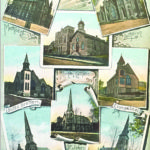
One individual, Karen Arnold, concert chair for Trinity United Methodist Church, has spearheaded a collaborative effort to raise awareness of the rich history of the area's still-active congregations that date back to the 19th century. In collaboration with the churches and Bellefonte Historical and Cultural Association, a 42-page brochure has been made to showcase these histories. With heroic pastors, fires and falling steeples, a variety of mishaps, and ties to the Underground Railroad, these eight churches have a lot of stories to tell.
This effort, which began in the summer of 2016, took a lot of research through library and historical resources, Arnold said. The idea to do this came about when Arnold was doing handouts to generate interest in concert performers at Trinity last year. She said she realized they were missing a lot of information about Trinity's history and she wanted to make sure that all of the information was correct.
"I decided it would be nice to spend some time expanding the history, but in the process, realizing that this is a Victorian congregation issue; it's not just this church that is underrepresented," Arnold said. "There's essentially no historic presence from any of the eight still-active Victorian congregations."
So, Arnold started out with the clippings file from the library, which she realized did not have enough information. Next, she said she sought out information from the Centre Furnace Mansion and histories from the individual churches, some of which had lengthy written histories from anywhere between 30 to 60 pages.
"It turns out everybody's got a really interesting history," she said.
Just taking a peek into the histories of these churches is enough to spark one's curiosity.
The first church to be established in Bellefonte was the First Presbyterian Church, which is 215 years old today. The town of Bellefonte was laid out by Col. James Dunlop and James Harris in 1795, and the First Presbyterian Church is historically documented to have been established shortly after, in 1802.
One could say that the First Presbyterian Church had a lot of good luck in its early days, as it had only two ministers in 80 of its first 100 years. Its congregation included Bellefonte's original founders, Dunlop and Harris, and several prominent members of government, including United States Senator Andrew Gregg, Pennsylvania governors Andrew Gregg Curtin and James A. Beaver, and Supreme Court justices Charles Huston and Thomas Burnside.
The second-oldest congregation in Bellefonte is Trinity United Methodist Church, which is celebrating its 200th anniversary this year. Established in April 1817 in a home that once stood where the historic Cadillac Building is today, the church's second of three buildings was used for court proceedings for a year as the Centre County Courthouse was being reconstructed between 1854 and 1855.
The courthouse, which was built in 1805, had fallen into a state of disrepair by 1854 and the entire courthouse, except for its front porch, had to be dismantled and repaired. Trinity UMC had been considered a suitable home during repairs due to its proximity to the courthouse at the time and Pennsylvania legislature had passed an act allowing for the holding of several courts in the church building until the new courthouse was complete. Throughout some of the churches' histories, the Centre County Courthouse would come to serve as a temporary home.
Not having any money does not mean that all is lost, especially in the case of St. John Evangelist Catholic Church. The church, which is believed to have had its first mass in 1824, held its services in a private home for several years since the majority of its early parishioners were poor Irish and German immigrants who had made Bellefonte their home.
In 1828, the church received its first permanent pastor, the Rev. John O'Reilly. O'Reilly had transferred from Lewistown and soon took over plans to build the congregation a physical church, even though the task was challenging with lack of funds, but he took no money from the parishioners to build the new church. Within three years, the parishioners of St. John's had their first physical church in the form of a small Gothic building that stood for 120 years.
Another church that had a heroic minister in its early days was St. John's Episcopal Church, which was founded in 1837. St. John's first minister, the Rev. George Washington Natt, went above and beyond for the church, despite his ailments. Natt, who at the age of 18 suffered from a severe case of smallpox that left him physically weak with permanent lung damage, traveled all over the area on horseback to conduct weekday services. The determined pastor rode on horseback to various towns, from Lewistown to Lock Haven.
Natt continued to serve Bellefonte and other towns for thirteen years. Afterward, he conducted services in his native town of Philadelphia, as his health allowed him, until his health declined further and he passed away at the age of 48.
One church that is a documented stop on the Underground Railroad is St. Paul African Methodist Episcopal Church. Quaker William A. Thomas, known for providing the land on which the first and current church building for St. Paul A.M.E was built, used his home as a way-station for runaway slaves. Thomas also purchased the freedom of one fugitive family who was personally acquainted with William Hutchinson Mills, who was a child at the time the original St. Paul A.M.E. congregation had been formed.
Mills, who spent 26 years as St. Paul A.M.E.'s Sunday school superintendent, wrote an in-depth history of the church in 1909 after speaking to members of its original congregation. He was also the grandfather of the internationally-known Mills Brothers Quartet.
One of the heros for St. John's United Church of Christ was John Wetzel, a builder and member of the church. The church, which was formed in 1836, would have its first services in the Centre County Courthouse. After a newly-installed furnace in the church building malfunctioned and started a fire in 1880, the old church building was deemed unrepairable.
It took Wetzel two years with less-than-desirable winters, but in the end, Wetzel completed what is now the current church building for St. John's UCC. The building, made of gray sandstone with brown stone trim, was built to coordinate with its surroundings, which were some of Bellefonte's largest, elegant 19th-century homes.
Many of these Victorian-era churches in Bellefonte experienced fires, and St. John's Lutheran Church was no exception. In July 1888, the congregation's second church building, which had been newly-renovated at the time, was destroyed by fire, along with most of the right side of the first block of East High Street that stretched from Allegheny Street to South Penn Street.
Between July and November of 1889, the foundation was laid for a new church building for St. John's Lutheran Church and the building was dedicated in September 1893. The third, but not the last, church had been designed with 31 of what were deemed to be extraordinary, high quality stained glass windows.
The last 19th-century church with a still-active congregation is the Faith United Methodist Church, which was established in 1822 when a group of parishioners began meeting in a private home for Bible study, worship and prayer. By 1825, the parishioners were able to purchase a lot where they would erect a log church that served as home for worship until the congregation outgrew it by 1855.
After a fire destroyed the church's second building in 1945, the congregation purchased what is today the Reynolds Mansion, a luxury bed and breakfast. The mansion at the time was used for Sunday school and served as an administrative complex, and the mansion's carriage house served as a sanctuary and parsonage. For 20 years, the congregation of Faith UMC was housed in the mansion.
To read more in-depth about these eight Victorian Bellefonte churches, copies of the brochures can be printed for purchase at M & M Copy Service, located at 137 W. High St. in Bellefonte. Printing cost is $3.95 per copy for glossy paper and $3.49 per copy for plain paper. Bellefonte Historical and Cultural Association will also be selling the brochures at $5 to benefit the nonprofit organization's efforts in the local community, and anyone wishing to purchase a copy can contact Romayne Naylor, organization president, at rbnaylor@veri zon.net.