
Benninghoff talks LHU integration, Bellefonte Red Raiders and more
Trending
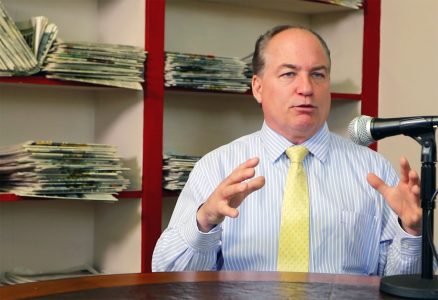
LOCK HAVEN -- On the eve of Primary Election Day, Rep. Kerry Benninghoff (R-Bellefonte), made a visit to Clinton County and sat down for a nearly hour-long exclusive interview with the editorial board of The Express.
Benninghoff, the Pennsylvania House Majority Leader, represents the 171st legislative district.
What follows is the question and answer session. Some portions of the interview have been edited for length.
EXPRESS: There has been a lot of talk about integration at Lock Haven University. What are your thoughts on the topic?
BENNINGHOFF: It's a wonderful school … I wish I would have had a little more encouragement when I was younger; that's about the size (of) school I would have liked to have gone to. We're very cognizant of what this university means to the community. The job employment it provides. The spinoff businesses. The integration system that is being proposed by the chancellor is about trying to keep the system and make it grow stronger. You see this in private businesses at times, where they will have shared services in their administration and I really think that's what the chancellor is talking about. He's trying to strengthen the system. I know sometimes change is fearful for people, but I think we only need to look at recent history. If we do nothing or let things go, what will be the end result? We may end up having some of these schools that will not have enough students enrolling and they will not have the financial resources. I think trying to 'buddy-up' some of the different schools and share responsibilities -- whether it's administrative or billing departments or whatever else -- some of the administrative roles will hopefully provide needed services but will allow some autonomy here on a local level for the actual physical plants but have some of administrative things done on a larger global level.
At the end of the day, we want to sustain the system. We know the value of it. I personally value the smaller schools like this, I think they're more intimate. It gives young people the opportunity to get an education and sometimes get an education that's closer to home. For those who do not have the financial resources, they can stay at home and still go to school.
There are those who can choose to come to a different community. A friend of mine was actually headed to IUP and happened to come through this area. Stopped in, loved the community and ended up being a graduate of Lock Haven University. He never even thought about going there. It's those kinds of experiences we want future generations to be able to enjoy.
EXPRESS: The House and Senate will be approving a budget with a funding for higher education. What's going on there? Do you see some reasonable increases coming for the fiscal 2021-22 school year?
BENNINGHOFF: Our goal is to make sure that we fund people to the best of our ability. I tell people to plan for the budget right now as if it's going to be level funding from where you were last year and then we'll kind of see where we may have the opportunity to provide some additional funding. I would personally say that if we want to help our state-owned system and we want to help the chancellor -- who I believe very strongly wants to see this be successful and is trying to make some very tough decisions. He is in a very tough position. He's telling people what we need to hear, not necessarily always what people want to hear, it's kind of like being a parent. We need to be helping them financially to do that. If there is some additional financial needs, which I believe there are for the state system, we need to pony up and make sure they're there because we want to sustain great schools like Lock Haven.
EXPRESS: Since the beginning of the pandemic, you've been very outspoken about the restrictions put into place by Gov. Tom Wolf. What would you have done differently?
BENNINGHOFF: As I have said from the beginning, the concern was that these decisions were being made strictly by the administration. When pushed, we asked 'what science?' or 'who is making these decisions?' That's still an unknown. Fourteen months later, we don't know if the decisions were being made by the Governor or then Secretary of Health Dr. (Rachel) Levine. We were all concerned about the pandemic. We all want people to be protected and healthy. But at the end of the day, we have a General Assembly for a reason.
It was frustrating for us to be called an hour before a press conference would happen and be told 'Oh by the way, we're going to do X, Y and Z.' If you look at simple decisions like trying to decide who was essential and who was not essential, that seemed to be what I called darts in the dark. You just shut your eyes and throw a dart and all of a sudden this person or this business was determined. It was very frustrating for many of our smaller businesses when the decision to shut them down happened so abruptly. Whether it was a church or a restaurant, they had very little time to prepare. We had weddings that were planned, people had a large amount of supplies purchased. All of a sudden -- boom -- a week from now, you can't have this wedding.
I think if we had a more combined relationship between the administration and the general assembly, I would have wanted that input. Tell me what's going on in Tioga County? What's happening in Crawford County? What's best? I think Sullivan County had 479 COVID cases. So to pass a blanket order across the Commonwealth whether it was businesses closing or something else that would be the same in downtown Philadelphia and to implement the same thing in Sullivan County seemed to be ridiculous. It was very hurtful for some of those small communities to be shut down. Quite frankly, we just would have liked a little more flexibility.
EXPRESS: Gov. Wolf wants to raise the minimum wage. You have been quoted as saying the wage is "taking care of itself." Can you clarify what you mean by that?
BENNINGHOFF: Yes. If you look at the free enterprise system, when there's a demand for labor and less labor available, people offer higher wages. I can quote you multiple businesses right now that are paying $15 an hour if not more. There's probably more sign-on bonus signs around than I have ever seen. You pull up at a local McDonald's. There's different types of convenience stores. I was at a Wal-Mart and there was a sign hanging in the restroom the other day -- overnight stockers $14 an hour with a differential pay of $1.50 for being there overnight. That's $15.50 an hour. We've seen advertisements over $20 an hour for people just to be dishwashers. Demand for manpower is so great right now that different businesses are paying higher wages. For government to artificially set some base rate generally only tells a business that you have a certain amount of dollars to pay for wages and you have to pay everybody this certain amount. While that sounds good on the front, it really doesn't necessarily give these people that much buying power. Prices will go up accordingly.
Our goal is to let people strive to earn as much as they possibly can. I would like to see everyone become a millionaire. We can do that if we provide them with opportunities. Provide them with a proper education. In a free enterprise system, it shows how this has already happened organically and does not artificially need to be done by the government, setting a particular rate. Suppose we were to do it at $12.50. Now we have businesses that are already offering more than that. Would that have kept them from offering more dollars. This is a business owner showing the value of you by offering you more because I need you. That is what I think the American Dream is about.
EXPRESS: The Gov. Wolf administration has said they want to see the legalization of marijuana. As states bordering Pennsylvania begin to legalize it, what are your thoughts on the matter?
BENNINGHOFF: Well, I am not one to copycat other states. There are some elected officials who model their own decision-making by modeling neighboring states. As a Commonwealth, we did vote -- and I was part of that study committee -- for allowing medical marijuana to see what effectiveness that is with that in treating certain symptoms. I have nominal experience in healthcare. I knew it was something that was not going to cause cures, but I was willing to allow people, patients to make decisions with their physicians to deal with ailments, side effects of other treatments by utilization of medical marijuana. Well, that's still somewhat in its infancy. We really have not had an opportunity to see the effect of that. One of the things that I put in that particular proposal was basically some type of study that as a physician that you could put documentation in there that was almost a case study that would be non-identifying for a patient. But another doctor who may think about doing this a year or two later could look at this and say 'this doctor treated five patients with these types of ailments and had these types of successes.'
One of the things that people don't realize is we're hindered that the federal government still has marijuana scheduled as the No. 1 drug. The lower the number, the higher the regulation. It has not even gone through clinical studies. The piece that we put in the legislation would basically operate as a clinical study here in Pennsylvania to get that data so that future physicians could look into that. We're still in the infancy. At the end of the day, there are those who will advocate for it. Two things I would say to you -- No. 1, if you are a state that is still losing 14 to 15 people a day from opioids, that's 300 people a month dying in Pennsylvania. Do we really want to legalize another substance until we get this other problem under control? There are those who get into using opioids through a legal manner, there are prescriptions. Subsequently, when they get shut off and some of the laws have been changed, they turn to the streets. No. 2, I don't like these types of things being used as a means to generate cash. A lot of people will use it as an excuse. 'Well, the government can make a lot of money off it.' Well, the government can make a lot of money off a lot of things. But I'm just not ready to go down that road. I know that's not popular with some people, but I think we can sustain Pennsylvania's economy and grow it in a much better and effective manner than legalizing marijuana.
EXPRESS: It's Election Day. During the pandemic, we saw mail-in voting and drop boxes throughout the state. As we begin to get out of the pandemic, do you want to see those things stay or disappear?
BENNINGHOFF: At the end of the day, we want to have an election system that people are comfortable with and that people feel are secure. I think the frustration of last year's election cycle regardless of what stripes you wear and who you may support was the ever-changing rules almost up until Election Day. Former Secretary of State, Ms. Boockvar, made some different decisions throughout the election process. In some cases, people had already voted and they were trying to determine whether or not we would accept ballots where someone did not sign the outside of it. The mail-in system is designed to be a ballot you call for, it's mailed to you, you fill it out and you mail it back. You can argue about drop boxes and they were a little more convenient, obviously, during a pandemic, but your drop box is really the mailbox at the end of your driveway, if you're talking about a mail-in system. We've had absentee ballots for people to vote by mail. We want people to feel secure about the system.
We had passed House Bill 2828, which did not get through the rest of the chamber, which would have at least required cameras on those drop boxes or required them to be manned. At the end of the day, I think most voters were frustrated by the inconsistent rules. I want a system that people are comfortable with, whether it be a mail-in ballot or going to the polls. It's got to be secure. If people don't have faith in the election system, they're not going to have faith in their government.
EXPRESS: With the rate of vaccination slowing rather dramatically, to the point of incentives being offered by state governments -- for example Ohio and their vaccination lottery -- what would you say to anyone who is still on the fence about getting a vaccine or who has refused one? Are there any plans being developed to provide education or incentive to help get us to herd immunity?
BENNINGHOFF: We are pushing those numbers. This is America. People have to decide what's comfortable for them. There some people with some health issues that are uncomfortable with that. I think the majority of people are heading (down) that road. They'll make decisions not just for themselves, but for their own families. We are doing better and there will be a percentage of people who may not necessarily do it. The herd immunity helps to make things safer for our community. You can say that with just about any illness. This one just happened to be hyped up a lot more. We had a lot more information thrown at us because we were able to see what was happening in other countries. As you know, the media played it over and over and over.
We lose a lot of people every year to the flu and there are those people who choose not to get vaccinated there. I think we're going to get there. We're seeing better compliance on a day-to-day basis. I would encourage people. The vaccine doesn't cost you anything. It's one of the few things in life that doesn't cost you anything. We're providing it. You can get one shot (Johnson and Johnson) or you can get two (Pfizer, Moderna). Centre Volunteers in Medicine just tipped over 22,000 vaccines that they provided. We really put a shout out to these volunteers who are helping in the different clinics throughout our community.
EXPRESS: The Bellefonte Area School District recently endured a year of back-and-forth about the school's mascot and nickname. What are your thoughts on how that played out?
BENNINGHOFF: I think you're going to maybe get your answer (Election Day). There are a lot of people who are very frustrated over it. You saw a lot of signs up in support. As you know, during the pandemic, we were pushing back a little bit against the Governor because parents were told that they couldn't even go to their own children's events. We even had the PIAA who came out in support of that. These are rallying points for people.
Sometimes, I think we get a little too caught up in some of these symbols. For Bellefonte, the Red Raider was something people had grown attached to for generations. I think about the time I was at a graduation ceremony and they had three World War II Veterans come back. These are young men who were plucked out of high school at 17 years old. They didn't get to graduate. They were still proud Red Raiders and that night, they finally got the diploma, 60 years later. That night, they were Red Raiders. And everyone who stood in the stands, who stood for these men who fought for our country and our freedom, we were all Red Raiders. It's tough. It's a challenge for people to see these things change. There are also the concerns of the economic impact of having to change all these things at the school.
You hate to see a school spend a year on that. I hope we put as much emphasis on academic success. I measure academic success by how many of these children are employed five years later in good family-sustaining jobs. How many of them went on to higher education after that? There's a lot of things to be considered. At the end of the day, these boards are independently elected by the public. The public has to decide whether or not they support that decision.