
Trending
EXPRESS ARCHIVES
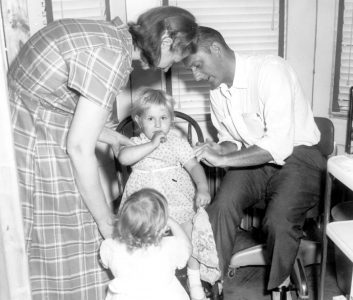
A young blonde tenses in her chair as she receives the polio vaccine from Dr. Richard S. Clover, of Lamar, on July 28, 1959. The Nittany Valley Firemen's Auxiliary sponsored a vaccine clinic to strengthen immunization among Nittany Valley Residents. Clover gave shots to 132 people that day.
(Editor's Note: This is part two in a three-part series dedicated to the history of immunizations.)
The Rotary Club of Downtown Lock Haven is happy to offer Express readers the second part of the three-part series "A History of Immunization" during World Immunization Week.
The club will also raise funds at Wine in the Wilds to continue Rotary's fight against polio. Wine in the Wilds (sponsored by the Clinton County Historical Society) is set for 2-6 p.m. Saturday, April 30, at the Clinton County Fairgrounds in Mackeyville.
A HAPPY
ACCIDENT
In 1879, an accident lead to a revolution. That was the year French microbiologist and chemist Louis Pasteur wanted his assistant to inject some chickens with the germ that causes cholera, and to do it while Pasteur was on vacation. The assistant forgot and left for a vacation of his own. He didn't remember until he returned. He quickly injected the birds using the same germ culture, which was a month old by then. Both men were surprised when the birds became sick but didn't die. Pasteur discovered the birds also were immune to additional doses of live bacteria.
Pasteur called the resulting method "attenuation" or intentional lessening of the germ's strength before inoculation.
Over the next 50 years, attenuated or inactive bacteria lead to the creation of vaccines for the plague, tuberculosis, typhoid, pertussis, and many other diseases.
BREAD CRUMBS
In 1925, Gaston Ramon, a French veterinarian, was working on a vaccine for diphtheria and tetanus. He found that adding substances such as bread crumbs or starch oil helped increase the vaccine's effectiveness. The following year, British immunologist Alexander Glenny found that adding aluminum salts to the diphtheria vaccine also made it more effective. These additives (called "adjuvants") are still an essential ingredient in vaccines today, as they help boost effectiveness and allow for more dosages to be produced.
IN MORE MODERN TIMES
In 1952-53, a University of Toronto microbiologist named Leone Farrell found that gently rocking vials of poliovirus stimulates its growth. Her method enabled Jonas Salk and other researchers to mass-produce poliovirus for vaccine trials and revolutionized the production of vaccines. Called the Toronto method, her discovery is still used today.
In 1955, after field testing 1.8 million Americans with the Jonas Salk polio vaccine, it was announced that the vaccine was safe, effective, and potent. That lead to many more vaccinations and the defeat of polio across our country.
But polio hasn't been the only dreaded disease of our times.
In 1961, the seventh known cholera pandemic covered the globe, affecting 117 countries and infecting 1.7 million people before it was stopped 14 years later. Cholera still continued to terrorize multiple nations until at least 1989.
The United States largely escaped this pandemic. And in Italy, 1 million people were vaccinated against cholera in one week in 1973, with only 12 cholera deaths reported then.
In 1966, the World Health Organization (WHO) launched the Smallpox Eradication Program to stop the spread of that disease, with 60 percent of the world still not vaccinated against it.
In 1980, the WHO announced that smallpox had been eradicated everywhere on Earth.
What about polio? It spreads differently than smallpox did, so it is taking longer to eradicate. But the end seems to be in sight. As Rotary likes to say, "We are THIS close!"
-- -- --
Diahann G. Claghorn, a retired educator, is Rotary Area Governor and a member of the Rotary Club of Downtown Lock Haven. For more information, find the club on Facebook or visit endpolio.org.