
Borowicz, Dush speak, answer questions at CCEP breakfast
Trending
BREANNA HANLEY/FOR THE EXPRESS
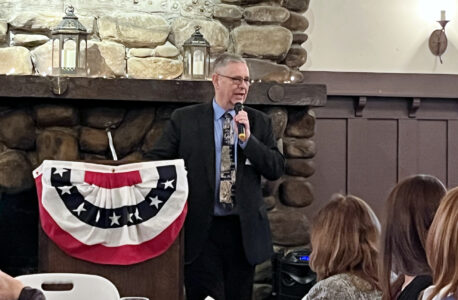
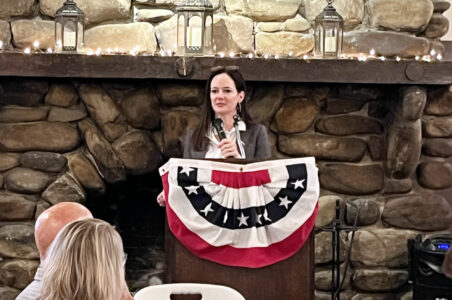
State Representative Stephanie Borowicz and Senator Cris Dush were among the speakers at this year's CCEP Legislative Breakfast.
MILL HALL -- The Clinton County Economic Partnership hosted their first Legislative Breakfast since 2019, welcoming county officials and state representatives to talk about topics relating to the area.
The event was held at Haywoods On the Green at the Clinton County Country Club.
Clinton County Economic Partnership President Mike Flanagan introduced the speakers to the audience after a brief introduction on the event, inviting State Representative Stephanie Borowicz, Senator Cris Dush and Cindy Kunes (in attendance on behalf of Congressman Glenn Thompson) to speak very briefly on their stances and what they've been working on.
The highlight of the morning, however, was when Flanagan read out prepared questions for a rapid fire question and answer session. Borowicz and Dush took to the podium once more to answer the questions presented.
The questions and the highlights of the legislators answers are as follows:
Q: With UPMC Lock Haven transitioning to an emergency room only operation, is there anything that can be done to save/assist rural healthcare for the Lock Haven, Bucktail and Jersey Shore hospitals of the world?
SB: Cris can probably speak more to this, but we were all involved... worked really hard to ensure the best case scenario for UPMC and keep at least the ER open. We see this happening all across the state with rural hospitals possibly closing. We do not want that. We do not want to consolidate our hospitals. They're vital in our areas... It's a very hard thing to solve right now.
CD: UPMC was trying to keep me to be the only elected official to be a part of this whole thing, I wasn't going to put up with that. There was a huge mistake with Obamacare and the regulations that followed it allowing these so-called nonprofits to start taking over healthcare... I spoke with some chief medical officers around the commonwealth. What they fear is the chief financial officers and chief CEOs of some of these private hospitals are being courted by large corporations to steer the boards towards selling. That's something we've got to come against. There's a huge fight ahead... It's going to take a team effort.
Q: With cutbacks, declining enrollment and financial burdens for most of our state's schools -- Lock Haven University included -- are we eventually looking at three or four major state school hubs? Is that one solution?
SB: Possibly. Again, it's best case scenario. They were basically saying that Lock Haven University was going to go out of business and no longer be there. I try to meet monthly with four professors at (LHU) to get their perspective. They didn't want to consolidate. We're being told that this is unsustainable -- with enrollment going down and the cost of tuition. Lock Haven luckily kept its sports program, mascot and logo, all of that stayed the same. The cost is a huge problem, kids are walking away with $60,000 in debt and getting a job for $30,000 a year. That's their personal responsibility, I believe. If you take out the loan, you pay the loan back. These kids need to be educated on that. You take out ($80,000) and they're not graduating as doctors or getting a different degree that they can't get a job to pay for those debts. Colleges really need to get back to reading, writing, arithmetic, teaching the basics and not indoctrinating our children... Career and tech programs are huge.
CD: Actually, we need to get reading, writing and arithmetic back to primary schools. We're facing a decline in enrollment... Our best export in rural Pa. has been our working class kids... Our population is aging and we're not replacing kids. We don't have families raising six, twelve and eighteen kids... College enrollments are declining. Education is a business. If they're not there, you can't just keep the people there if it's not sustainable. We have to look at things like consolidation. The management of those universities right now, that's the best case scenario for them. If we don't start doing things that track people back into the commonwealth, we're fighting to try and get things in place there, those are key elements.
Q: It doesn't say this, but I think this has something to do with the Renovo Power Plant Project. When a community overwhelmingly wants a project, local and state officials 100% support it, permits have been achieved, why does our system allow groups from out of state to delay or stop it?
SB: Dark money from evil people that come in from outside of Pennsylvania that try to influence Renovo. It's very sad. I wish I knew how to stop that -- it's evil. (They're) preventing a power plant from coming that would help that area. I would say that's where it's coming from.
CD: We need to work reform in a huge way. These guys have weaponized the courts -- that's what's holding us up. We have the ability. They're weaponizing environmentalism through the courts. I love our conservationists -- there's a difference between a conservationist and an environmentalist. Our people are conservationists, they take care of their environment. We have people who live in these other areas who are weaponizing the courts against us.
After the prepared questions were answered, the floor was opened for those in attendance to ask their own questions and give their legislators feedback on the issues they see in the community.
Q: EITC allows industry to invest in education, why can't we have an HITC that allows industry maybe a double write-off when they invest in rural healthcare... Why can't we institute HITC equal to the EITC program?
CD: Brandy (Reiter, Field Representative for Dush) is already writing that down.
Q: NPDES (National Pollutant Discharge Elimination System) permits hurt us a lot. It should go back at least three acres, not one acre.
SB: It was five acres. Now it's down to an acre. I was trying to have a bill written to put it back to five. There's two other reps that have something similar. I just co-sponsored their bill. It's just common sense.
CD: Secretary Negrin is looking at doing a reformation of the whole system… That's something you're hearing all over the place. I have hopes for him, I really hope it works out. The things he says he wants to do are significant, and I hope he uses it.
Q: Young people aren't having children. By looking at the last census, Lock Haven is going to go down probably 4,000 people. You can't sustain a hospital or university if young people aren't having children.
CD: God created us to have relationships. We've gotta get back to having family and understanding that right at our core, we were built for relationships. Right now, the media and everyone else is like, "do your own thing, don't take on the responsibility of kids." We need to start having families realize they need to have families. Anything you can do to encourage young people, it's a blessing.
SB: It's a breakdown of our morals, principals and values in this society. You see that in the fire companies. You don't have younger kids willing to lay down their lives. It's a great cost. We're losing that in our society, we've gotta get back to those principals, morals and values. I hope my kids have a lot of kids so I have a lot of grandkids. Getting back (to those values) is a harder question.
Q: Regulations (are in place) everywhere for the spotted lantern fly, I assume they were developed to prevent them from spreading but they're spreading anyway. Is this an unneeded regulation? What are the long term plans?
CD: I know they're using that to slow it down. If you have anything specific please get it to me through Brandy and we'll take a look. The whole point of what they're doing right now is to stop them from spreading and causing more rapid damage to the hardwood industry. Those things are very attracted to vineyards. They're trying to slow that until they can come up with solutions. There is some research being done on a species of wasp to try and kill them off, and some birds are realizing they're something to eat. The U.S. Department of Ag used to have inspectors of foreign ports. They did away with that program a couple of decades ago and all these invasive species we've never seen before... we're starting to see them. The federal government is allowing that stuff to come in.
Q: It's a topic that hasn't been addressed here today, but for our community specifically it comes up in many areas. Education, employers and in the community as a whole. Mental health. We lack the resources. We have one crisis counselor in the county right now, our suicide calls or domestic violence calls have gone up extremely high in our 911 centers, we often have to ship folks out of our county or state to get resources they need. We're putting folks in incarceration because we have nowhere else to put them. I'm asking if there are conversations happening to help rural Pennsylvanian people that need help, whether it's for addiction or mental health to receive those resources?
SB: I know in the budget that's a huge chunk that was talked about. That is being discussed. Through the budget, through funds, through everything that's going on.
CD: We are seeing a huge increase -- I'm going to go straight back to Jesus Christ and the Bible, if we're not working on bringing a good moral foundation we're going to see an increase in this... We need our churches to step up. We need them to get into homes and to their neighbors and to the lives of the people. We are on a serious downhill trend. Alexander Solzhenitsyn said (in more than one) of the books that he wrote, he was asked, "How have we gotten here?" "It's because we have forgotten God." The churches need to start working together, forget the denomination stuff. This country will change.
SB: I will quote Reagan, "If we're not one nation under God, we're going to be a nation gone under." That's almost where we're at. I've never been so scared for my country… We're on the cusp of losing it.