
Historic US investment in urban trees underway
Trending
While Ameen Taylor feels fortunate he has a cooling tree cover in the front and back yards of his Detroit home, he knows it’s a different story for many residents of his hometown where neighborhoods often have little to no shade.
"To me, 70 degrees is fair weather, but when you're walking somewhere or you're around a neighborhood that don't have trees, it will feel like it's like 87, 90 degrees. That's what it feel like," said Taylor. "You're exposed to more sun than you are shade.”
Like many cities in the U.S., parts of Detroit are packed with large amounts of impervious surfaces and heat-absorbing infrastructure like roads and bridges. Coupled with low levels of cooling tree cover, or canopy, it can make them dangerously hotter than the suburbs.
Such an inequity of tree cover is behind the historic $1.5 billion in President Joe Biden’s Inflation Reduction Act that’s set aside for the federal Forest Service Urban and Community Forestry Program to fund tree-planting projects over the next decade. With a focus on underserved communities, the initiative marks a massive increase from the roughly $36 million distributed annually to the program. Millions more for tree projects have also been available from Biden's infrastructure law and COVID-19 relief funds.
Urban forestry advocates, who've argued for years about the benefits of trees in cities, see this moment as an opportunity to transform underserved neighborhoods that have grappled with dirtier air, dangerously high temperatures and other challenges because they don't have a leafy canopy overhead. Advocates also predict this is the beginning of a long-term financial commitment to trees, especially amid dire warnings from scientists about global warming.
"City trees are not just having a moment. In many ways, this is more than a moment in the sun. This is, I believe, the new normal," said Dan Lambe, chief executive of the Arbor Day Foundation. Lambe said the massive federal investment recognizes trees are essential for communities, "not just a nice-to-have, they're a must-have."
Trees help suck up heat-trapping carbon dioxide from the atmosphere and reduce erosion and flooding. They’re also credited with helping to save lives, considering heat is the leading cause of weather-related deaths in the U.S., according to the Centers for Disease Control and Prevention.
Connecticut Gov. Ned Lamont has proposed spending $500,000 in remaining COVID-19 relief funds, money he hopes to be complemented by the new federal funds, to pay for plantings in underserved urban neighborhoods.
"I just drive around the state, I drive around Hartford, I see places where -- imagine if we had just 30 trees in this empty lot -- what it means for clean air, what it means for beauty, what it means for shade," said the Democrat, referring to Connecticut’s capital city, where there’s tree canopy in just a quarter of its 11,490 acres.
Historically redlined cities like Hartford, where banks denied or avoided providing loans because of the racial makeup, are up to 13 degrees hotter than neighborhoods not redlined, said Lauren Marshall, senior manager for program innovation at the Arbor Day Foundation. With less access to nature, she said many residents in these communities didn’t have the option to escape the heat and socially distance outside during the pandemic to a cooler, shaded area.
"I remember the summer of 2020 spending a lot of time outdoors because it was the only way we could see the people we loved. And I live in a neighborhood with a ton of tree canopy,” she said. "And for a lot of people, that wasn't the case."
Marshall said the pandemic, coupled with the racial reckoning sparked by the murder of George Floyd, brought a lot of attention to the tree canopy inequity issue. Many cities and towns are now using a Tree Equity Score Analyzer developed by American Forests to target tree plantings in neighborhoods most in need.
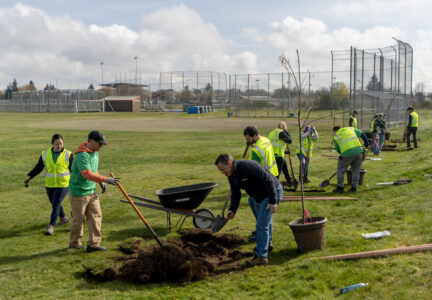
"Across the board, in every state and in our state, we have underinvested in our urban tree canopy,” said Hilary Franz, Washington’s commissioner of public lands. Seattle is planting 8,000 trees over five years on public and private property and 40,000 in parks and natural areas, an initiative partly financed by federal funds.
Seattle also plans to require three trees be planted for every healthy site-appropriate tree removed from city property.
Some communities plan to use the federal funds for tree maintenance and to develop a tree care workforce, especially in places where workers have barriers to employment, such as a criminal record. Joel Pannell, vice president of Urban Forest Policy at American Forests, said the nation’s current tree care labor pool is aging and needs more workers. It’s also dominated by mostly white men.
"As folks are retiring and getting out of the workforce, there's a tremendous need to get a new cadre of people who represent the communities where the work needs to be done,” he said.