
Local officials discuss federal energy policy
Thompson, others hold roundtable
Trending
NORTH BEND -- In April of this year when the Bechtel Corporation backed out of its plans to develop the Renovo Energy Center, they left behind a town ready to move forward.
After nearly a decade of planning, the development of the 1,000 megawatt natural gas-ultra-low sulfur, diesel-fired combustion turbine power plant in the former rail yard was discontinued due to the appeals from environmental groups.
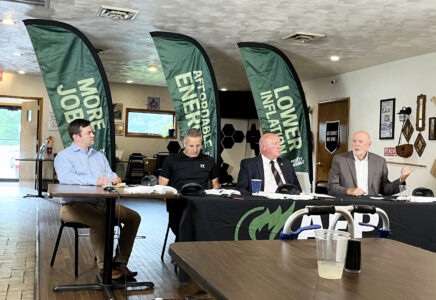
Renovo Mayor Gene Bruno, Congressman Glenn "GT" Thompson and KeyState Energy representative Perry Babb held an informational round table to discuss federal energy policy -- referencing the loss of the powerplant and the impact that has on the rural community.
The roundtable, hosted by Americans for Prosperity at Good Neighbor Craft House, spoke about aspects of federal energy policy in light of the energy plant reversal.
Marc Marie, with Americans for Prosperity, was the moderator for the event, prompting discussion between the three panelists.
Marie first prompted Bruno, asking him to speak about the canceled project.
Though Bruno had only been involved in the project for a year and a half, he took time to thank those who had stayed with the project for the long haul, citing the Clinton County Economic Partnership, Community Trade Association and the many other people who put in hard work.
Bruno's main concern was for the wellbeing of his community, speaking about the impact the project -- if completed -- would have had on Renovo.
"One of the saddest things is... the town is seriously shrinking. Our kids are graduating in June, grabbing their diploma and moving out. We were looking at the possibility of a ray of hope," said Bruno, referencing the potential jobs that could keep young adults in the area.
Marie opened a discussion to all panelists regarding the opportunity for Pennsylvania and for this region of it to be a driver for energy solutions, not just for these communities but for the entire country.
"My vision that I have with the work that we do on a federal level is that we restore a robust rural economy and create the conditions by which we regrow our population," began Thompson. "As the mayor talked about, our number one export for too long has been our young people. We raise them, great education and loving families, and off they go in search of opportunity. The fact is, the opportunity is right here."
"(The canceling of the power plant) is probably the most egregious example of activists seizing off of political science," said Thompson. "The people who are pursuing this in a responsible way checked all the boxes, they did all the right things... It's death by deliberate stalling."
"The stalling of this project -- and I prefer to talk about it as stalling, not that it's dead, because I think it has tremendous potential. We have some work we need to do to get over these attacks... It's a negative impact on the future of the economy," said Thompson.
According to Thompson, the attack on the project was also an attack on the environment and climate, "Utilization of natural gas reduces the carbon presence dramatically. It's clean. What they've done is made the climate worse."
Babb said he was heartbroken and saddened by the loss of the power plant, knowing first hand what an impact it could have made on a small community such as Renovo; he cited his own experiences in his small home town in Virginia.
"We wouldn't have much of an economy if it wasn't for the Marcellus Shale revolution ten years ago -- where would we be? We'd be getting all of our natural gas from the Middle East. We thought we had reached peak natural gas in America, but innovation solved it. Is policy the solution, or innovation the solution?" asked Babb.
Babb also referenced KeyState's work on a 7,000 acre natural gas plant in West Keating Township where they separate methane into carbon dioxide and hydrogen.
"When you combust it, there's no emissions," he said. "The combination of natural gas that Appalachia has and geological storage... is going to make Pennsylvania and Appalachia a hydrogen superpower."
"America is a country of both/and, not either/or," Babb continued. "It's always environmental, or jobs. The climate, or industry. Innovation allows us to be both, and our project is an example."
Marie spoke about the Regional Greenhouse Gas Initiative (RGGI). RGGI is described on rggi.org as "a cooperative effort among twelve Eastern states to reduce carbon dioxide (CO2) emissions from power plants within each participating state."
"Virgina just got out of RGGI... (Their) move to do that helps Pennsylvania, and if Pennsylvania can get out of RGGI it will help Virginians," said Marie.
The discussion was dominated by bill H.R. 1 -- the Lower Energy Costs Act. Simply put, this bill aims to lower energy costs by increasing American energy production, exports, infrastructure and critical minerals processing. For a more detailed look at the bill, visit: www.congress.gov/bill/118th-congress/house-bill/1
"(H.R. 1) started out very partisan at the beginning of the year... Unleashing those domestic energy resources in this country is our top priority -- H.R. 1 every 10 years is reserved for whatever your top priority is. Energy security is national security, (it's) prosperity, it's opportunity -- it's a world of possibilities that you can build on," said Thompson.
The floor was opened for questions from the audience for the short time they had available. The first question was by Kurt Smith, Clinton County Republican Party Chair, who asked, "We're being pushed to all electric by 2030, they just shut a coal plant down.. What's going to happen? What do we do?"
Thompson answered, "There will be a number of outcomes. California announced they would be all electric, and they sent something out later in the day asking people not to charge their cars because the grid can't handle it. It would crush rural America. The petroleum industry is a big part of the rural economy and agriculture is a big part of the rural economy."
Clinton County Commissioner Jeff Snyder asked, "What can be done to delay the process in which the hearing can take place so this doesn't happen again in a future project?"
Thompson explained that the process involves multiple things including applications and administration on a state-level, "If our new governor is serious about innovation, this is a good opportunity for him to show that."