
Council votes to use supplemental wells
Move to combat low water levels in reservoir
Trending
LOCK HAVEN -- Lock Haven City Council held an emergency meeting with Suburban Water Authority and members of the Central Clinton County Water Filtration Authority to discuss options for emergency water supply, deciding that Gwin Dobson & Foreman Engineers should move ahead with a temporary fix.
The city was required by the PA Division of Dam Safety to upgrade the dam to current standards regarding the spillway capacity. In order to do this, the city had to lower the level of the reservoir by five feet. In doing so, they reduced the capacity of the dam by 33 percent.
"That was in February," said Mark Glenn of Gwin Dobson & Foreman, the city's engineering firm. "All throughout the year we have consistently seen it drain. It never restored itself in terms of run-off. We are now at about 172 million gallons, when you translate that to usage we're basically at 74 days available storage."
To combat this shortage, the city is planning to use supplemental water wells located in Wayne Township to allow for the overnight build-up of water storage.
The wells will be connected via a temporary above-ground pipeline. Later, when permanent construction is approved by DEP and Susquehanna River Basin Commission, the pipe will be saved and installed underground.
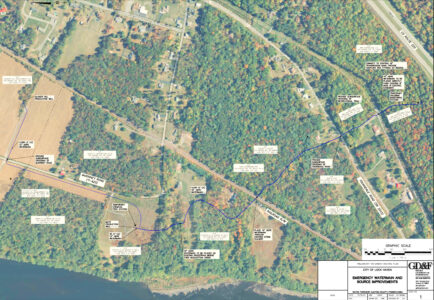
James Balliet, of GD&F, described for council and the audience how the pipe would be laid, indicating an 8,000 foot connection between the Matz and Quaker Farms wells to the existing line.
"We would bring a 12 inch line from the Quaker well to the Matz well, and then join those two wells together and run a 16 inch line all the way up to the Rails to Trails on Youngdale Road just below (state Route) 220," said Balliet.
Sizable pumps will be placed in the wells so that they can run 24/7 and each pump at 500 gallons per minute.
"During the day when people are using that water it will go right into the system. At night when people are sleeping and they're not using a lot of water, it will go back up and fill the tanks at the treatment plant. We'd be able to utilize all 1.5 million gallons a day," said Balliet.
The well water they're going to tie into the existing system is "excellent quality" according to Balliet. The water pumped from the wells does not need to be sent through the filtration plant, but will need to be chlorinated before it is mixed into the system.
"(The water filtration plant) is putting out 3 million gallons of water a day. These wells are capable of about a million and a half a day. The sooner we turn those wells on you're going to cut your demand on Keller reservoir in half. Instead of having 30 days or 60 days left you're going to have double that. The longer we can go, the better," said Balliet.
The cost for these items will include $350,000 spent on 8,000 feet of pipe and $200,000 in additional expenses such as pumps and the temporary sheds required to chlorinate the water.
These expenses would be paid for through the city's Series A debt note and through the use of a PennVEST loan.
With council's approval on Monday, GD&F have been given the greenlight to get pipes ordered and the project underway.
"We have a pretty good plan in place, but it's going to take time. The pipe is three weeks out, the pumps are three weeks out... if we started today ordering everything we're not going to have everything out there for at least a month. Assuming 2-3 weeks to put everything together, we're a month and a half pushing two months to get everything up and going," said Balliet.
Balliet stressed that waiting too long for this process to take place could result in stricter guidelines to be put into effect.
On Friday Oct. 13, Mayor Joel Long issued an emergency proclamation declaring a state of emergency for the water supply of the city's and suburban's water customers due to depleting levels in the city's reservoirs.
This proclamation prohibited non-essential uses of water, such as:
-- The use of hoses, sprinklers or other means for sprinkling or watering of shrubbery, trees, lawns, grass, plants, vines, gardens, vegetables, flowers or any other vegetation.
-- The use of water for washing automobiles, trucks, trailers, trailer houses or any other type of mobile equipment.
-- The washing of streets, driveways, parking lots, service station aprons, office buildings, exteriors of homes, sidewalks, apartments or other outdoor surfaces.
-- The operation of any ornamental fountain or other structures making a similar use of water.
-- The use of water for filling swimming or wading pools.
-- The operation of any water-cooled comfort air-conditioning which does not have water-conserving equipment.
-- The use of water from fire hydrants for construction purposes or fire drills.
-- The use of water to flush a sewer line or sewer manhole.
-- The use of water for commercial farms and nurseries other than a bare minimum to preserve plants, crops and livestock.
-- Bulk water sales for non-essential uses, including Marcellus Shale Drilling operations, will be terminated.
Though the prohibition of these items is currently in effect, if the water does not build back up more harsh water rationing could be implemented.
"If nothing was done we would need to start rationing water -- it would be a hard ration. It would be a set limit that would be allocated to each homeowner. That's something no one wants to get to because it's an extreme measure," said Glenn.
The next meeting of city council will be Nov. 6 at 7 p.m.