
Lock Haven’s ‘most pressing problem’: Homelessness here is real, and apparently growing
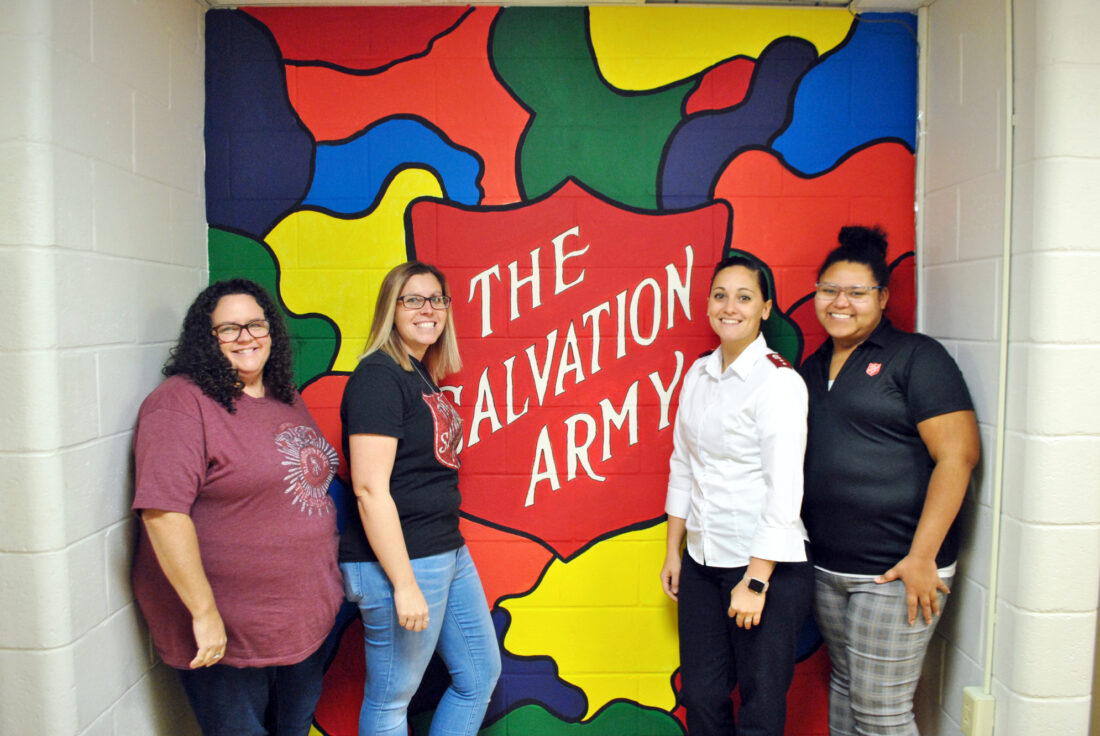
BREANNA HANLEY/THE EXPRESS Pictured are some of the friendly faces who are helping to combat the growing food insecurity in Clinton County, from left, Tabitha Hayes, Kirsten McKinney, Captain Kendall Stout and Madison Leister. These four, along with numerous volunteers, serve an often-overlooked portion of the population.
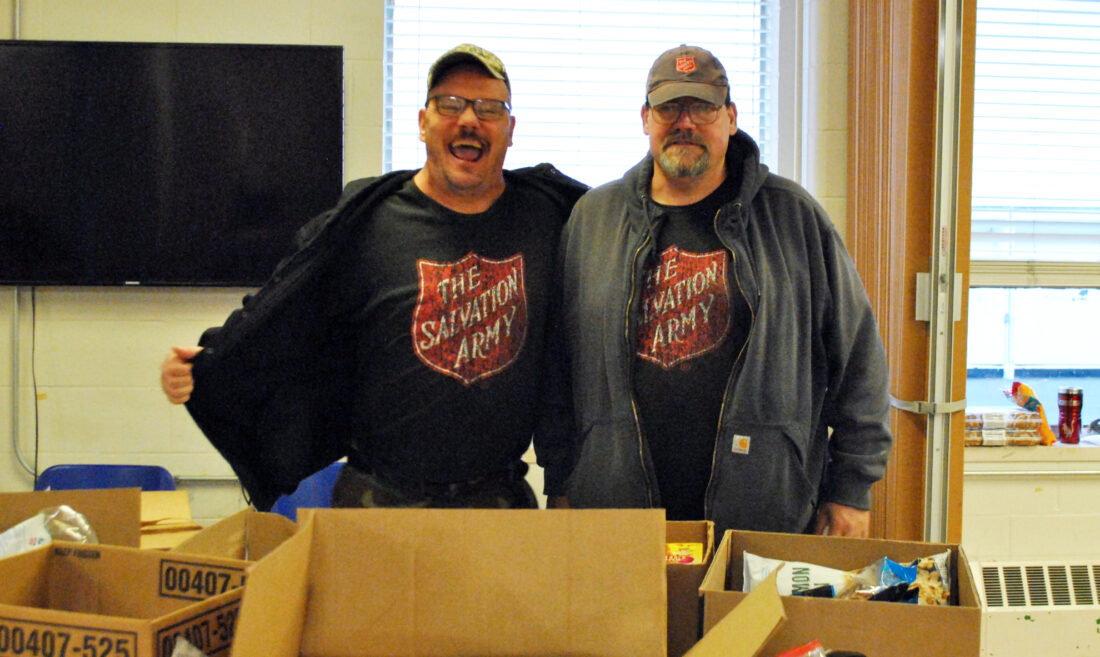
BREANNA HANLEY/THE EXPRESS William “Billy” Powers, left, and Clarence Pepper, right, are ready to welcome and help those in need with big smiles and their Salvation Army gear.
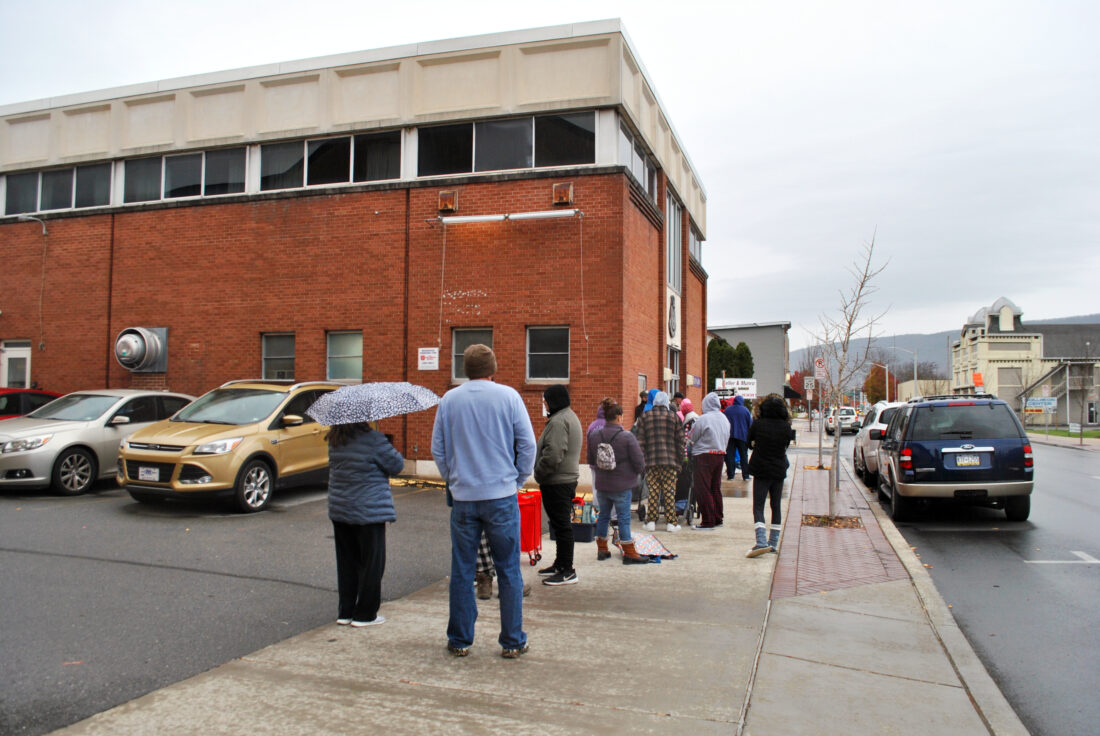
BREANNA HANLEY/THE EXPRESS Folks line up outside of the Salvation Army in Lock Haven during their typical free food distribution held Tuesday morning where friendly staff members and volunteers are ready to offer what resources they can. The Salvation Army and the Housing Coalition are working to challenge the stigma associated with the growing issue of homelessness and food insecurity in Clinton County.
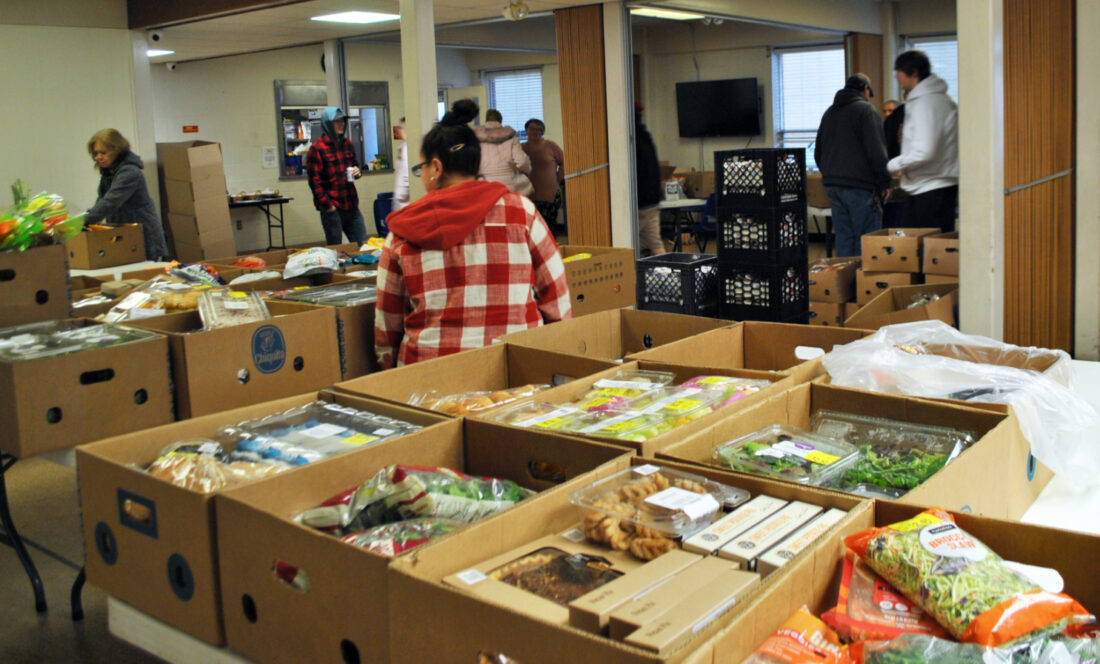
BREANNA HANLEY/THE EXPRESS Volunteers are seen at the Salvation Army in Lock Haven during their typical free food distribution held Tuesday morning.
BREANNA HANLEY/THE EXPRESS Pictured are some of the friendly faces who are helping to combat the growing food insecurity in Clinton County, from left, Tabitha Hayes, Kirsten McKinney, Captain Kendall Stout and Madison Leister. These four, along with numerous volunteers, serve an often-overlooked portion of the population.
BREANNA HANLEY/THE EXPRESS William “Billy” Powers, left, and Clarence Pepper, right, are ready to welcome and help those in need with big smiles and their Salvation Army gear.
BREANNA HANLEY/THE EXPRESS Folks line up outside of the Salvation Army in Lock Haven during their typical free food distribution held Tuesday morning where friendly staff members and volunteers are ready to offer what resources they can. The Salvation Army and the Housing Coalition are working to challenge the stigma associated with the growing issue of homelessness and food insecurity in Clinton County.
BREANNA HANLEY/THE EXPRESS Volunteers are seen at the Salvation Army in Lock Haven during their typical free food distribution held Tuesday morning.
Trending
LOCK HAVEN -- He looks to be in his early 20s.
A quiet but friendly and neat-looking young man overall, dressed in jeans and wearing a ball cap.
On most days, he can be found at the Salvation Army helping the staff when asked, organizing his belongings or just hanging out.
He -- and we won't use his name -- is homeless.
And he represents what Salvation Army Capt. Kendall Stout says is "the most pressing problem in Lock Haven."
"On any typical day at the Salvation Army, you can expect to encounter six to 10 homeless men and women, and their numbers tend to increase during the summer months. This does not account for the many phone calls we receive from many others struggling with homelessness in the community," Capt. Stout says. "Since they cannot access the local shelter until 6 p.m., a considerable portion of the homeless population remains at the Salvation Army until its closing time at 4:30 p.m."
Jeff Rich also knows about homelessness and a lack of affordable housing here.
Jeff is head of the Clinton County Housing Authority and the county Housing Coalition, which works to find affordable housing for people.
In a recent report to county commissioners, Jeff was blunt and echoed Capt. Stout's assessment: Homelessness here is edging upward.
"These are folks who are living in their cars, living in the streets and the ones who are bouncing around to friends. Then there are those that are just on the cusp. If something happens with their car tomorrow they're probably not going to be able to pay their rent next month," he said. "Those folks are important to consider along with the other's we've talked about."
Rich and his team are applying for Fair Housing funds to create the Hope Mitchell House, named after a beloved social worker who recently passed. If it becomes a reality, the Hope Mitchell House would create six, one-bedroom units and would be the first of its kind in the community.
But it won't just provide a roof over one's head; it will offer "supportive services to households with at least one adult household member living with a disability," according to Jackie Condor, northern tier regional manager who spoke to the commissioners with Rich.
She noted the individual who qualifies would have to sign a lease or something similar and it would be treated like a normal housing situation.
Capt. Stout, meanwhile, agrees that one of the primary challenges is the shortage of affordable housing.
But, she qualified, "numerous factors contribute to (homelessness), with a significant portion tied to the insufficient availability of mental health resources."
As a small, rural community -- almost a throwback to the past -- Lock Haven, she says, also has one attribute that many residents would mutually agree upon: Safety.
"We have a large percentage of homeless individuals settling here because in their own words, it is safer here," Stout said.
There are two shelters locally that work to help people who are homeless: The Life Center Shelter and the Merit House Shelter.
Keisha Conway and her staff at the shelters are fully aware of homelessness here.
She is the shelters' senior care navigator.
Both shelters, she says, "are continuously full."
The Life Center Shelter is a Coalition program that shelters up to 14 people consisting of single women and families. The Merit House Shelter also is a Coalition program that shelters single men only. More on the shelters can be found in a story on Page A3.
Some, if not most, of the shelters' residents are familiar with the Salvation Army building here.
A couple of days each week, a line forms outside of the Salvation Army's front doors, consisting of people who seek the agency's assistance.
They are not freeloaders, Capt. Stout says adamantly.
They come for some help in stocking their own cupboards and refrigerators.
Which brings another issue facing the community: Food insecurity, or hunger.
"The Salvation Army acts as a warm and safe place for homeless individuals when they are unable to access a shelter. Every day we provide food, coffee and snacks. Additionally, we offer clothing and shoes to those in need and have frequently assisted many in job application processes," Capt. Stout explains. "When funding permits, we also extend the opportunity for a night or two in a hotel."
Back to the idea that people getting help may not necessarily need it.
"Due to receiving state funding, there are income guidelines for our pantry program on Tuesdays. Total household income is based on 185-percent below poverty level. An example is a household income of one needs to be at or below $25,142 annually, $2,095 monthly, or $484 weekly," she says.
Separately, the Salvation Army does offer a free food giveaway.
"On Thursdays, we give away donations from Walmart, Sheetz, KFC and any other donations we are given. This program is for anyone. There are no stipulations or guidelines," she says.
Capt. Stout also offers a frank assessment of the need here.
"I see food insecurity being one of the major crises for these individuals. Frequently, the meal they receive at our feeding program is their only meal that day. To address this issue, we provide them with additional food to take home for their evening meal. Another challenge they encounter is the limited cooking facilities in the shelter, where they can only use a microwave, restricting their food options to items they can microwave."
While acknowledging that homelessness is certainly not unique to Lock Haven, Capt. Stout said it is a problem that has not seen an adequate response.
"I could discuss the issue of homelessness at length, as I am convinced that it is the most pressing problem in Lock Haven. I say this because we at the Salvation Army witness the daily struggles of homeless men and women in our community. Unfortunately, the nature of homelessness here doesn’t always manifest in visible ways, like panhandling or people sleeping on street corners.
"For this reason, the community often fails to acknowledge its existence, even though it does exist. Homeless individuals in Lock Haven tend to remain hidden, seeking shelter under bridges, in makeshift tents in the woods, under pavilions, or any place that provides shelter," she says.
Why is the crisis manifesting itself here?
Capt. Stout offers some answers:
-- Lock Haven lacks sufficient shelter space, with only one men’s shelter accommodating a mere four individuals.
-- A significant contributing factor is the lack of affordable housing, leading to lengthy waiting lists for housing placements.
-- Additionally, a substantial portion of the homeless population deal with mental health issues, and our community lacks the necessary resources to address these challenges.
How is Lock Haven and the greater Clinton County addressing homelessness, food insecurity and mental health?
Not so well, she says.
"In my view, the community’s response to this issue has been inadequate. There is a tendency to either deny the existence of homelessness in Lock Haven or to redirect homeless individuals to other counties, which, without a transportation system, hinders their access to essential services back in our community. The question then is, is this approach genuinely beneficial to our homeless population? -- and the answer would be no.
"We must acknowledge and recognize the homeless individuals in our community. We should regard them as fellow human beings who may simply need a helping hand. So in my opinion, expanding shelter capacity or building a new shelter in Lock Haven is imperative," Capt. Stout believes.
Indeed, there is a stigma against homelessness, Capt. Stout affirms. Like in many communities.
But everyone deserves to be treated with respect and dignity.
The Salvation Army and Housing Coalition are on the front lines of these very real challenges.
And so far as Capt. Stout is concerned, they are up for it.
"I have heard numerous individuals make derogatory comments about not wanting 'those people' in our community. This mindset unfairly stereotypes the homeless as 'drunk, lazy, mean, mentally ill men and women.'
"In reality, the homeless in our community often exhibit kindness, generosity and a strong work ethic. We need to stop these stereotypes and focus on providing support. We have the space, resources, and funding within our community to do so.
"All we need is the willingness to act."