
‘We were just out there’: LH Kiwanis welcomes pilots
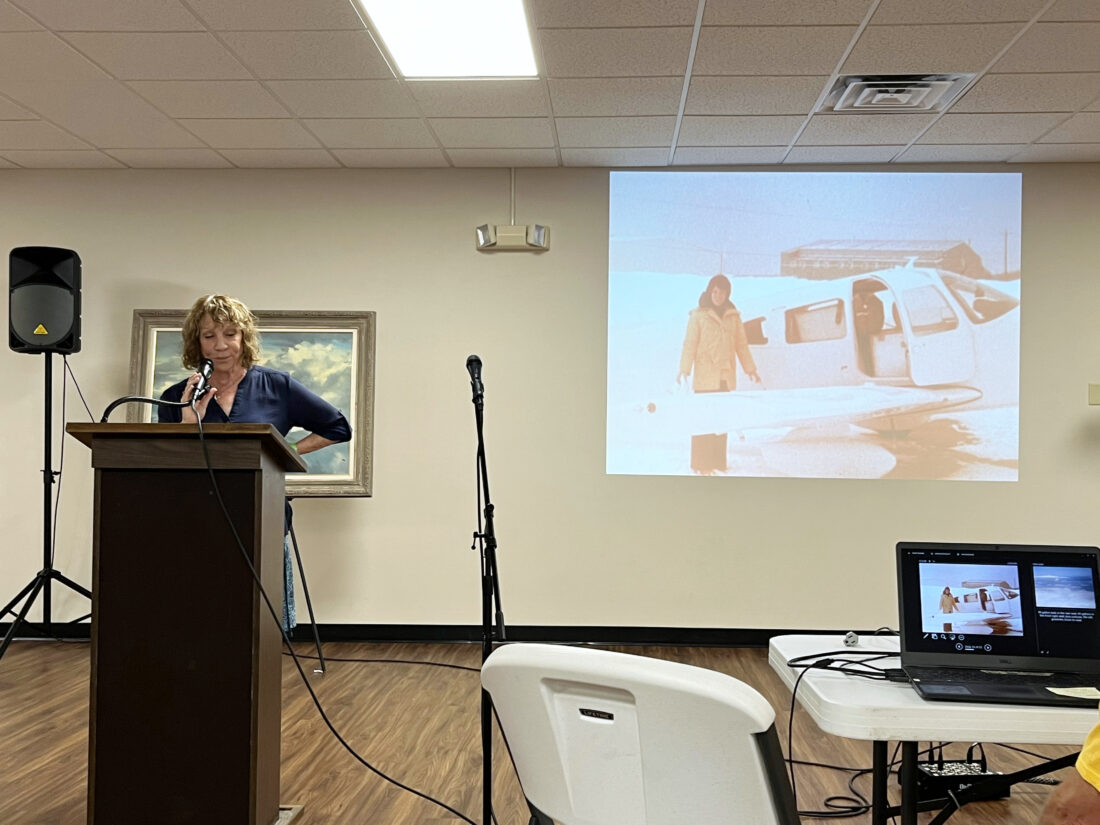
BREANNA HANLEY/THE EXPRESS Lynn O’Donnell, who worked as a ferry pilot during a time when female pilots were rare, gives a presentation to Lock Haven Kiwanis members during the Fly-In on some of her experiences.
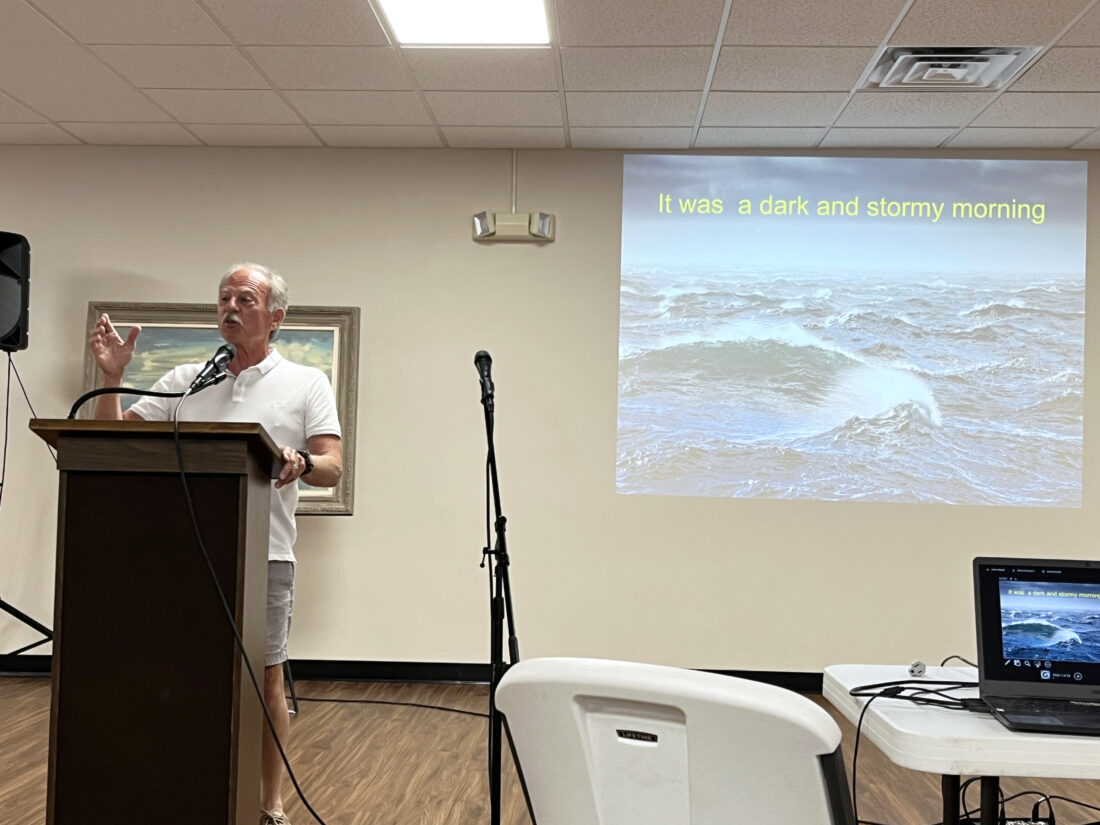
BREANNA HANLEY/THE EXPRESS Nils Mantzoros is pictured as he begins to tell the story of when he was a “Young Pilot Lost Over the Ocean.”
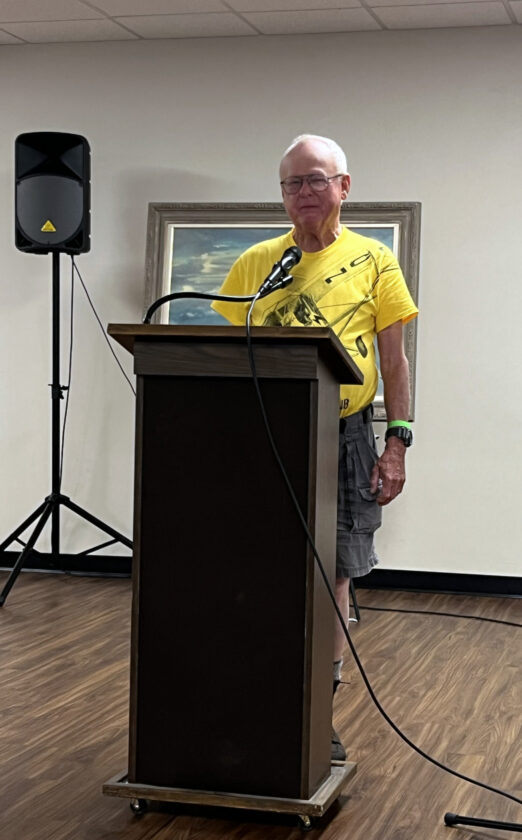
BREANNA HANLEY/THE EXPRESS Ted Miller is pictured at the podium, where he shared the story of meeting William T. Piper, Jr. and Max Conrad, inspiring a lifelong passion that would see him flying across oceans.
BREANNA HANLEY/THE EXPRESS Lynn O’Donnell, who worked as a ferry pilot during a time when female pilots were rare, gives a presentation to Lock Haven Kiwanis members during the Fly-In on some of her experiences.
BREANNA HANLEY/THE EXPRESS Nils Mantzoros is pictured as he begins to tell the story of when he was a “Young Pilot Lost Over the Ocean.”
BREANNA HANLEY/THE EXPRESS Ted Miller is pictured at the podium, where he shared the story of meeting William T. Piper, Jr. and Max Conrad, inspiring a lifelong passion that would see him flying across oceans.
Trending
LOCK HAVEN -- Lock Haven Kiwanis members were treated to a presentation by three different pilots who shared their individual experiences at the Piper Aviation Museum.
Ed Watson with the Piper Aviation Museum introduced the day's speakers and gave a brief background on the history of ferry piloting.
"The little-known career of ferry piloting was a fascinating niche in the field of aviation during the 20th century," he began.
Ferry piloting was an incredibly dangerous profession. The pilot flies a new aircraft from the manufacturer to the customer -- both across the United States and sometimes internationally. When flying internationally, pilots have an increased chance of experiencing maintenance malfunctions, extreme weather conditions and even running out of fuel -- these dangers often caused pilots to ditch their aircraft in the ocean.
"In exchange for such risky services, you would expect to receive a salary of only 7.5 cents per mile, and typically these payments would mostly be used up for the pilot's travel expenses," Watson said.
According to Watson, Globe Aero was one of the largest companies in the aircraft ferrying business during the 70s and 80s. It was founded in 1964 by Walter P. Moody and was originally located in Lock Haven before moving to Florida under the ownership of Phil Waldman.
"The company hired dozens of employees, tasked with safely transporting aircraft worldwide -- many of which were Piper models," said Watson.
The first speaker was Pilot Lynn O'Donnell, who shared her unique experience of being a female ferry pilot.
O'Donnell learned to fly as an employee at Piper Aircraft Corporation where she was a systems analyst. She flew everything Piper built.
She said she grew tired of her desk job, and started to search for opportunities to fly as a profession. O'Donnell had to fight to be a pilot.
"I was a woman who wore glasses. This was 1977, airlines at the time were not totally enamored with hiring women yet. I started knocking on (the doors of the ferry companies). They knew me, because I'd been flying around here," said O'Donnell.
According to O'Donnell, the general consensus of the companies was simply, "Lynn, I would love to give you an airplane to fly, but what would the customers think if a woman brought their airplane?"
"I said, 'the customer could care less if a monkey brings the airplane. They want their airplane.' They don't want it coming on a ship in 3-6 months, they want it next week," said O'Donnell.
O'Donnell's first flying job was with ASI, ferrying planes to Piper dealers in Europe and the United States -- making 52 transatlantic crossings during her time as a ferry pilot.
She described how pilots would craft a flight plan and how they would use a whiskey compass to hold a heading.
"We depended on a whiskey compass which is subject to variation subject to configuration on the airplane. That compass was your only real navigation... We could use radio signals but that was only good for 80 or 90 miles. The rest of the time you were just holding a heading based on wind correction angle. (You'd) hope when you got 1500-1600 miles later you would pick up the right radio signals," she said.
"Once you got a little too far off shore they had no idea where you were or who you were. There was no law out there, there was no radar out there, we were just out there," said O'Donnell.
After the ferry business slowed, O'Donnell found jobs as a charter pilot, chief pilot and check airman for a small commuter airline and for a cargo airline.
O'Donnell worked for Eastern Airlines, PanAm and finally United Airlines from which she would retire as a B-767 captain.
Since retirement, she has been flying her Stinson Voyager -- "Tootsie" -- and in April received her Master Pilot Award.
Next was Nils Mantzoros, who spoke on a different facet of overseas flight.
Mantzoros first learned to fly at Warrington Airport and was waiting for the Air Force to give him a class date when he learned about pilots that delivered planes to Europe.
After three years he was hired by Piper as a corporate pilot, and three more years later he was hired by U.S. Airways where he flew for the next 40 years.
He spoke of ocean stations and how the employees at those stations would spend months at sea without contact to their loved ones on the mainland.
"These ships were stationed in different spots across the North Atlantic and (every few hours) would send up weather balloons and get more accurate weather... They also had rescue capabilities if an airliner was having trouble," said Mantzoros.
Pilots would fly as close as possible to communicate with the men on the boats, which had to be constantly moving.
"They would be out there for three months at a time. They had no real communication with the rest of the world while they were out there. When we got close to the boats -- within 100 miles -- you could talk to them on a VHF radio. What we would do is they would give us an address and relay a message to their girlfriends or wife, and when we got back to Europe or in the country we would write a postcard and send it off for them," said Mantzoros.
Mantzoros also told a story about experiencing troubles with his plane mid-air.
"I noticed my air speed was starting to fall off and my plane was starting to slow down. I got out my flashlight -- all this is in the dark -- and there was no sign of any ice on the wings. Then I notice that I'm getting a landing gear unsafe light come on, (then it) got extended. With the landing gear down, it slows you down, and it increases power and reduces range because you're burning more fuel," said Mantzoros.
He explained how the magnetic compass he was relying on began to point towards the electric motor that puts out the same magnetic charge as polar north.
"Now my magnetic compass was pointing at the nose of the airplane, which really didn't help me out because I knew where the nose of the airplane was," said Mantzoros.
Mantzoros used quick thinking to snip a wire -- entirely blind, as the wire was tucked in an area he could not easily access while flying the plane -- that would help to avert that crisis. However, he realizes he was in trouble where fuel was concerned.
"I started out with three hours of reserve fuel, and it was going to take me maybe three and a half hours to get to Ireland," said Mantzoros.
He did not declare his issue as an emergency when calling out on a radio frequency, but updated those monitoring the frequency about his problem and to alert a nearby ocean station.
Long story short, Mantzoros finished the flight and went home, not hearing anything from anyone. When he returned home to his wife, she asked him how the trip had been.
"I said 'it was just another trip, couple of crises, no problem.' She wasn't happy with that answer. What I didn't know at the time was, The Associated Press got a hold (of the story) and there were hourly reports, 'Young Pilot Lost Over the Ocean.' Moral of the story, you can't bull—- your wife," said Mantzoros.
Last but not least, Ted Miller shared his life-long love of flying and how he'd once met two prominent figures in the aviation community.
For Miller, it all began in Lock Haven 64 years ago. Though he grew up as an "airport kid" with a flight instructor father, it was meeting with William T. Piper, Jr. and Max Conrad that was what inspired an interest in becoming a ferry pilot and someday flying airplanes across the ocean.
At age 15 he bought his first plane, a 1945 Taylorcraft that he still flies to this day.
He told the story of how he happened to meet Conrad, and had dinner with him in an airport diner.
"He told me to come back to Lock Haven in the Spring when school was out, and he would put me to work as a domestic ferry pilot," said Miller. This position would allow him with room to grow to international deliveries.
However, Conrad's business apparently went bankrupt before the spring; Miller moved to Lock Haven anyway in hopes of still becoming a ferry pilot or a flight instructor for the summer.
Eventually he got hired as an instructor and ferried Pawnees and Super Cubs across the country on the side. Eventually, he became a full time ferry pilot. His career as a ferry pilot was cut short when he was hired by United Airlines in 1965.
He still longed to fly across the oceans, however, and purchased a 1962 Beech B33 Debonair in which he and his boyhood friend, Emil Tedeschi, flew to New Zealand, Australia and New Guinea and made plans for their next grand adventure -- a flight around the world planned for 1971.
Unfortunately, Tedeschi made a fatal mistake and lost his co-pilot seat.
"He introduced me to Diane," said Miller, grinning as he explains how he would meet Dianne -- a young biochemist doing a post doctoral fellowship at the University of California Medical Center in San Francisco -- and would eventually teach her to fly in his Taylorcraft.
They married in July 1971, and left for a honeymoon flying around the world.