
‘Historic Bellefonte’ lives up to its name: Beaver Farmhouse saved
Trending
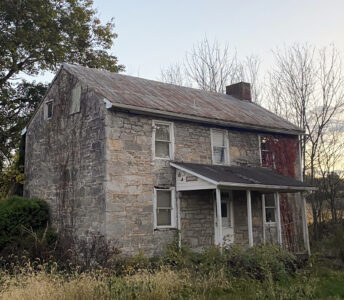
BELLEFONTE -- Bellefonte Borough Council, at its Monday night meeting, rejected the Bellefonte Area School District's permit to demolish a historic farmhouse that could be among the oldest structures in Bellefonte.
The 8-1 decision followed a groundswell of local opposition, spurred by community members and preservation advocates determined to save the Beaver Farmhouse, citing its historic significance and potential as an educational resource for students.
"We as council members are elected by the citizens of this borough to represent their concerns and make the best decisions possible on their behalf. Considering that our borough is known as 'Historic Bellefonte' ... how can we explain to our residents that we voted to demolish this obviously historic property, especially since there are parties interested in its preservation and willing to donate time, money and services to do so?" read Borough Council President Baraba Dann from a note submitted by another council member. "It appears at this point it could cost the district, and ultimately Bellefonte Area School District taxpayers, nothing to preserve it, but $12,008 to demolish it."
BASD officials, for their part, have framed the issue differently, calling the pre-Civil War farmhouse an "active and growing liability."
Superintendent Roy Rakszawski said the building costs the district $2,100 per year in insurance alone and lacks basic utilities such as power, water and sewer, making any effort to secure or repurpose the property dependent on costly new utility installations.
He also noted that the district could be fined $300 to $1,000 per day by the borough if the building is not weatherproofed.
"It is an untenable position to be fined for a structure the borough will not permit us to demolish," Rakszawski said.
Though both the Bellefonte Historical and Cultural Association (BHCA) and the Bellefonte Historic Preservation Foundation have expressed interest in taking over the farmhouse, Rakszawski said a donation isn't feasible because the hollow where the house sits, beneath the new elementary school, is planned as the school's stormwater basin.
"This decision was not made lightly, but it is driven by our core mission and our responsibility as stewards of taxpayer funds," Rakszawski said.
He went on to say that every dollar they spend must be justifiable in support of their mission, before emphasizing that "the farmhouse is not part of our educational program."
He said resources should instead be directed to active facilities and addressing deferred maintenance.
"We cannot afford to renovate a farmhouse we don't need," said Rakszawski. "The district is not and cannot be in the business of historical preservation."
Even so, he emphasized that the district is sensitive to its history and willing to work with the community where possible.
"This action will allow us to redirect all related costs back into our educational budget, eliminate the threat of daily fines and proceed with our necessary stormwater management plan," Rakszawski said.
Materials from the building, he added, could be reused to create a memorial wall, walking path, or other commemorative feature to honor its history.
However, as Joseph Griffin, president of BHCA, pointed out, "the people of Bellefonte want it preserved."
In a Facebook poll conducted by the Tor Michaels Show, a popular local radio segment, respondents favored preserving the farmhouse by a 20-to-1 margin.
Reflecting that support, without being solicited, BHCA received three $1,000 pledges to help preserve the farmhouse on Monday alone, adding to earlier commitments from Congressman Glenn Thompson and Bellefonte Building Supply.
"The community is already offering more money to preserve the building than it will cost the district to demolish it," Griffin said. "We can save this building, and it won't cost the district a dime."
At the conclusion of his remarks, Griffin formally requested a one-year stay of demolition to allow time to explore reuse options, secure the building and raise funds.
Councilwoman Joanne Tosti-Vasey proposed an amendment to honor the request, but council ultimately rejected it 7-2.
The matter of demolition then went to a vote, where a few council members voiced opposition.
"I am opposing the main motion," said Tosti-Vasey. "This house is a historic farmhouse, most likely built in the early 1800s -- making it one of the oldest structures in Bellefonte... These types of historical properties tell stories of our often overlooked neighbors, creating a fuller picture of our past."
Tosti-Vasey also pointed out that the borough had received no correspondence supporting demolition beyond the district.
She warned, "demolishing the farmhouse diminishes our history," citing its cultural, historical and educational importance.
Dann also spoke, saying, "I would hate to see this amazing building be destroyed."
"I have learned so much over the past couple of weeks just reading and learning about it, and I will also be voting 'No' on having it demolished," she said.
In an uncommon contribution, Junior Council Member Jalyn Meckley spoke in support of preserving the building.
"As a student, I do believe there could be educational benefits in keeping this building," she said.
"Alongside agriculture students, I think science students, math students, and art students could all learn something important from it," Meckley added. "I would like to weigh in as a student and say no to the demolition."
When the vote came, only Councilman Kent Bernier voted in favor of demolition, maintaining his position from Nov. 5, when he was also the sole council member to support it.