
Shapiro, Utah Gov. Cox discuss political violence and civility in D.C.
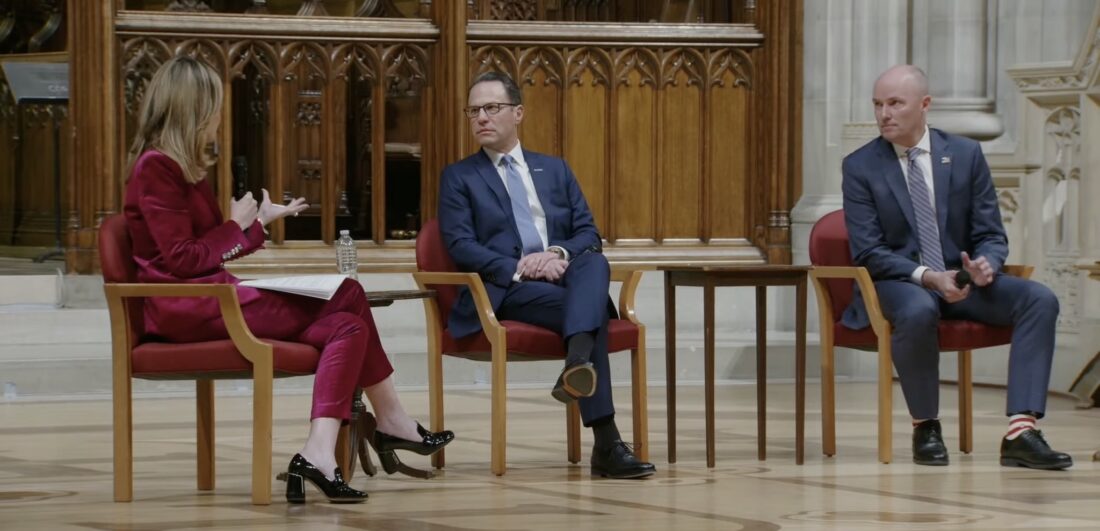
Screen capture/Penn Capital-Star Pa. Gov. Josh Shapiro and Utah Gov. Spencer Cox talk with moderator Savannah Guthrie at the National Cathedral in Washington, D.C. on Tuesday, Dec. 9.
Pennsylvania Gov. Josh Shapiro and Republican Gov. Spencer Cox of Utah belong to different parties.
But the two sat down for a conversation moderated by NBC News anchor Savannah Guthrie at the National Cathedral in Washington, D.C. Tuesday to discuss partisanship, political violence, and how to respectfully engage with political opponents.
Both agreed that Americans need to find ways to recognize one another’s humanity, and disagree civilly. And both agreed the stakes were high.
“We’re passing all the checkpoints towards ultimately failed states and civil wars,” Cox said. “I hate using that phrase, but if we don’t make a course correction, that’s where this leads.”
Both, however, were hopeful.
“The answers to so much of the darkness that we see in America today is the light that ordinary Americans bring each day, oftentimes grounded in faith and in our shared humanity,” Shapiro said. “I think politicians would do well to take cues from the people we represent, to listen more to them, to see our shared humanity.”
The governors began their conversation by noting their commonalities: both are members of Generation X, fathers of four, married their high school sweethearts, and are known in their states for working across the aisle.
Both have also had to address some of the nation’s highest profile acts of political violence within their respective states in recent years.
In April, Shapiro and his family were the targets of an attack. On the first night of the Jewish Passover holiday, Cody Balmer of Dauphin County set off multiple molotov cocktails in the Governor’s Residence while Shapiro and his family slept inside.
The previous year, he also took the national stage to call for calm following the 2024 assassination attempt on then-presidential candidate Donald Trump in Butler. While Trump sustained a mild injury, one rally attendee and the shooter were killed, and two others were critically injured.
In September, Cox earned bipartisan praise for his response to the assassination of conservative activist Charlie Kirk at an event at Utah Valley University. Cox repudiated political violence across the partisan spectrum, and his calls for civility struck a stark contrast with some Republican politicians who blamed a “radical left.”
Cox said his words were shaped by a call from Shapiro following the shooting.
“He told me to speak with moral clarity and to speak from the heart,” Cox said. “At that moment, we were two Americans who were deeply sad and struggling.”
Their conversation probed the roots of political violence and polarization in America. Though the two did not always agree on the causes or how to address it.
When discussing the role of politicians in shaping the national discourse, Shapiro focused directly on Trump.
“Here’s what we can not allow: for leaders who don’t act with moral clarity, remain silent about certain violence, or give a pass to others, because that is insidious, that is gasoline on the fire, and that leads to greater violence,” Shapiro said. “When you’re a governor, when you’re a president of the United States, you are looked to for that moral clarity. And we have a president of the United States right now who fails that test on a daily basis.”
Shapiro pointed to Trump’s response to the June killing of the former Democratic House Speaker of Minnesota, Melissa Hortman.
Asked after the shooting whether he called Minnesota Gov. Tim Walz to discuss it, Trump said it “would be a waste of time” and called Walz “so whacked out.”
Months later in September, Trump was asked by a reporter why he didn’t order flags flown at half-staff for Hortman, like he did for Kirk. Trump said he wasn’t familiar, and suggested Walz never called him to ask.
Trump also pardoned more than 1,500 people accused or charged for their role in the Jan. 6 riot at the U.S. Capitol in an attempt to overturn the results of the 2020 election in his favor. That included 170 people charged with using deadly weapons, and dozens who plead guilty to assaulting police officers.
Cox acknowledged Trump’s combative political style, but said there are factors that go beyond the president for the rise in political violence in America in recent years.
“I’m not trying to play down his divisive rhetoric at all. I’m not going to do that,” Cox said. “But I am going to say this: If we think that a president of the United States or a governor is going to change where we are right now, we’re fooling ourselves. I truly believe that the people of our country are the ones who are going to have to change this. Our elected officials are a reflection on us.”
Cox also noted that, in private, Trump praised his calls for peace and bipartisanship following Kirk’s assassination.
“When I talked, when I shared so passionately about bringing our country together, he called me and he thanked me,” Cox said. “He said, ‘I appreciate that you said that and I liked that part.'”
When Cox discussed Trump, it was one of four points in his conversation with Shapiro that was interrupted by shouting audience members.
The other three all yelled, individually, when Shapiro was speaking, and at least one mentioned Gaza. Guthrie, the moderator, said interrupters would be removed.
Shapiro, the highest-ranking Jewish politician in the commonwealth, has faced particular scrutiny over his views of the war between Israel and the Palestinian militant group Hamas, and his involvement in quelling protests on Pennsylvania college campuses.
Balmer, the man who was sentenced to 25 to 50 years after pleading guilty to firebombing the Governor’s Residence on a Jewish holiday, also said he was motivated by Shapiro’s views of the conflict.
“I’ll just thank the Cathedral for these amazing acoustics,” Shapiro said as one of the shouting audience members was removed. “I can’t hear a word of what these people are yelling about.”
The governors also discussed the role of social media in enabling partisanship and insulating people from those who disagree with them politically.
“These are the opioid companies of the early 2000s,” Cox said.
Cox, whose state is suing several social media companies, including Snap and Meta, alleged social media products are designed to addict users, overrepresent polarizing content, and trap users in ideological echo chambers.
The Utah governor said he supports a ban on social media use for children under 16, modeled after a new law in Australia.
Shapiro, however, disagreed on the approach.
“I think the approach we’ve tried to take in Pennsylvania, led by our first lady, is to ensure that digital literacy is taught in our classrooms,” he said.
Though he did say special media companies should be “held accountable,” noting their products are addictive and are vectors of misinformation.
Cox said the disagreement on stage could be a model.
“I didn’t say he’s an evil person because he doesn’t want to ban social media,” Cox said. “The Constitution forces us to disagree within a framework, that we have to be able to build a coalition to pass a law.”
Near the end of the conversation, Cox discussed studies that have found Democrats and Republicans believe members of the other party are more likely to hold extreme beliefs than in reality.
Cox said the phenomenon is called the “perception gap.”
“That’s really dangerous,” Cox said. “It’s more dangerous when you put yourself in a cocoon surrounded by people who only agree with you, and then talk about people that you don’t really know … we have to find ways to be in a room together, to look each other in the eye, to have a conversation. Because when we do that, what we find out is we’re not as far apart as we thought we were.”
——
Pennsylvania Capital-Star is part of States Newsroom, a network of news bureaus supported by grants and a coalition of donors as a 501c(3) public charity. Pennsylvania Capital-Star maintains editorial independence. Contact Editor Tim Lambert for questions: info@penncapital-star.com. Follow Pennsylvania Capital-Star on Facebook and Twitter.
Local news

Christmas events planned across the community
Shapiro admin subpoenaed for records detailing use of public funds to upgrade gov’s private home
HARRISBURG — A Pennsylvania Senate panel has taken the rare and dramatic step of subpoenaing the Shapiro ...
Rocking for a Cause: Local bands combine for benefit concert at Moose Lodge
Centre announces $1.2M grant for Eagle Creek Sewer Project
BELLEFONTE — Last week, the Pennsylvania Department of Community and Economic Development (DCED) awarded Centre ...
Shapiro, Utah Gov. Cox discuss political violence and civility in D.C.
Centre County food allocation surges under new formula
BELLEFONTE — Centre County’s food banks are set to receive nearly $196,000 through the State Food Purchase ...