Jury finds Nicholas Meat liable for damages in civil suit
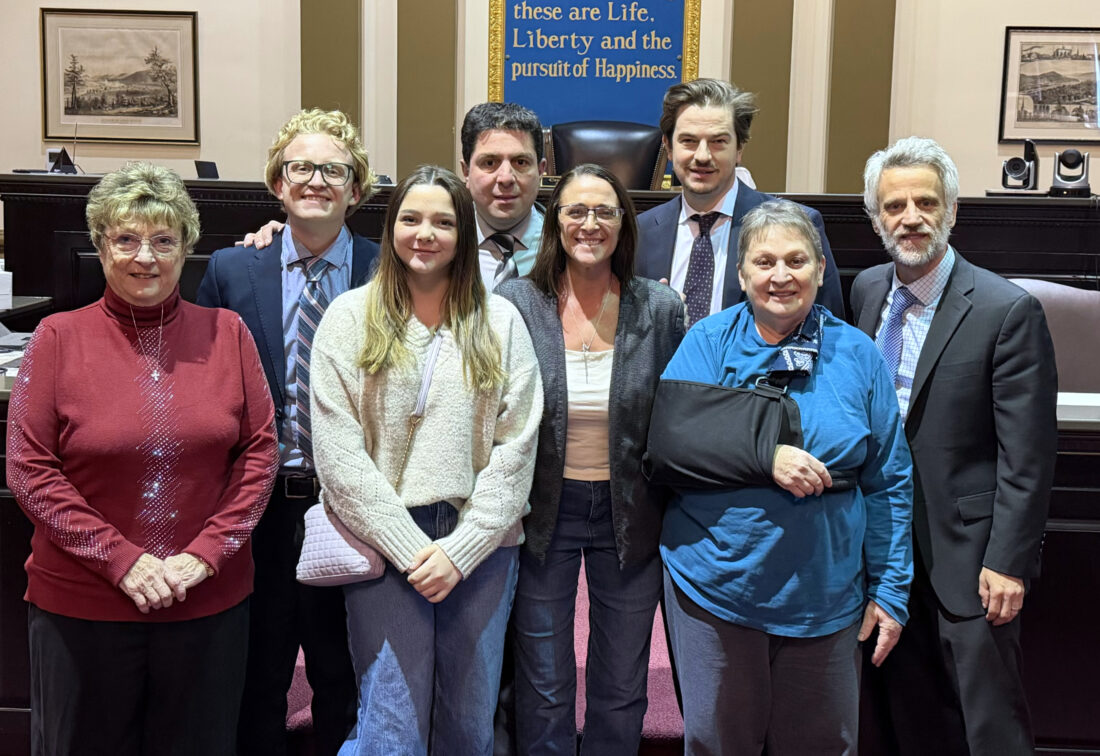
PHOTO PROVIDED The plaintiffs and legal team involved in the civil suit filed against Nicholas Meat, LLC, Nicholas Farm, Gene Nicholas and Heidi L. Warner, whose jury returned guilty verdicts on all charges in December are pictured above. They are, from left, Leanna Rockey, Attorney Zachary Kelsey, Allaina Rettew-Leigey, Attorney John Kotsato, Patricia Leigey, Attorney Will Cowles, Carolyn Leigey and Attorney Chris Nidel.
LOCK HAVEN — A civil suit filed in 2022 by residents in the Sugar Valley area against Nicholas Meat, LLC found the meat processing plant liable for damages sought related to its application of Food Processing Residuals (FPR) on agricultural fields near their homes.
According to the Pennsylvania Department of Environmental Protection (DEP), FPR is a “type of residual waste that is produced in animal and non-animal food processing” such as slaughterhouses and food packaging facilities.
Nicholas Meat, LLC is a beef harvest and fabrication plant located along East Valley Road in Loganton. The FPR it produces is used as an agricultural field applicant within Sugar Valley, including at owner Gene Nicholas’s property, listed in court documents as Nicholas Farms. The FPR produced by the business is also used as an applicant in other areas of the Clinton/Lycoming region.
The application of FPR is common throughout Pennsylvania, but in other cases has led to court filings and public outrage due to the smell it produces and ecological impact it may have on adjoining properties.
Issues like these led to the lawsuit and jury trial, held before Clinton County Court of Common Pleas President Judge Craig Miller, in mid-December. The trial included Nicholas Meat, LLC and Nicholas Farms, along with Gene Nicholas and Heidi L. Worden as defendants.
The plaintiffs included Patricia Leigey, on behalf of herself and her minor child, along with Carolyn Leigey and Leanna Rockey.
All defendants alleged the spreading of FPR on farmland adjoining their properties created a nuisance and, through runoff, was a form of trespass and contaminated their water supplies.
The verdicts
According to court documents, the verdicts were broken down into the following:
— Count I: Minor Child v. defendants for private nuisance: The jury found the plaintiff showed, through evidence, the land application of FPR on the farm fields created a private nuisance. With this verdict, Nicholas Meat, LLC was assigned 100 percent of the cost for damages inflicted on the minor. The company must pay $7,500 for the “loss of use and enjoyment of her property as a result of the nuisance resulting from” the FPR land application operations. It also assigned another $7,500 to the company for “annoyance and discomfort as a result” of the FPR operation.
— Count II: Patricia Leigey vs defendants for trespass: Similarly to count one, the jury found the defendant was guilty of trespass through its land application of FPR on adjoining farm fields. Ultimately, Nicholas Meat, LLC was assigned 100 percent of the cost for damages totalling $10,000.
— Count III: Carolyn Leigey v. defendants for trespass: Similarly to count one and two, the jury found the defendant was guilty of trespass through its land application of FPR on adjoining farm fields. Based on provided evidence, Nicholas Meat, LLC was assigned 100 percent of the cost of damages, totalling $60,000.
— Count IV: Leanna Rockey v. defendants for trespass: Just like the other counts brought against the defendants, the jury found them guilty of trespass in this case. Just like with Count III, the jury awarded $60,000 in damages to the plaintiff, with Nicholas Meat, LLC assigned to pay 100 percent of the cost.
The Express contacted Nicholas Meat, LLC to see if it would like to comment on the verdicts.
According to a representative of the business, the company does not “discuss a matter that is in active litigation.”
Multiple sources told The Express the company is seeking an appeal of the verdicts brought forward in December.
Verdict goes against
precedent set by Pa.
Right-to-Farm law
The verdict returned on count one in this civil suit marked a change in precedent regarding Pennsylvania’s Right-to-Farm law, which often leads to agricultural operations not being found guilty of a public nuisance.
The act was initially created in the 1980s by the state legislature as a method to avoid discouraging “the continuity, development and viability of agricultural operations” and states “every municipality that defines or prohibits a public nuisance shall exclude from the definition of such nuisance any agricultural operation conducted in accordance with normal agricultural operations so long as the agricultural operation does not have a direct adverse effect on the public health and safety.”
The law only allows a nuisance to be filed against an agricultural operation within one year of its beginning operations.
However, the law does not restrict the Commonwealth from “protecting the health, safety and welfare or the authority of a municipality to enforce state law.”
It also states it would not defeat the right of a person, firm or corporation to recover damages sustained by a business.
Many cases, including one brought against Nicholas Meat, LLC in 2013 in Lycoming County, end in a company not being found liable of a public nuisance.
Fox Rothschild, the legal firm which represents Nicholas Meat, posted a statement in 2016 following the dismissal of the case as one involving the right-to-farm law.
“A Fox Rothschild, LLP litigation team led by James C. Clark and John J. Haggerty won a complete dismissal of a lawsuit against Nicholas Meat, LLC and Camerer Farms, Inc., in a closely watched right-to-farm case,” the release stated.
However, the jury’s decision in the civil suit filed in 2022 in Clinton County marks a change of verdict in a common practice.
Particularly in regards to Count I, which alleged a public nuisance against Patrica Leigey’s minor child.
Leigey told The Express the charge was brought against the company and its owners because the spreading of FPRs near her property caused her daughter to feel ill often.
“My daughter is extremely sensitive to the odor, she gets nauseated,” she said, noting she couldn’t even open her bedroom window in the summertime.
Leigey said the odor makes it impossible for residents like herself to lay out in the summer, spend time outside or hang their clothes out.
“It smells like death. It doesn’t smell like a regular smell. You’ve got turkey buzzards and coyotes everywhere,” she alleged.
However, in many cases such as this, because the complaint was filed more than a year after farming operations began in farmfields near Leigey’s home, the Right-to-Farm Law often finds a plaintiff’s complaints unfounded. That wasn’t the outcome in this instance.
Plaintiff shares years of struggle leading up to
filing civil suit
In a phone interview with The Express, Leigey spoke about years of foul odors, runoff and a contaminated well which lead to the civil suit in 2022.
Leigey said she purchased her home in 2006 before Nicholas Farm began operation across the road from her own home.
Nicholas Meat was not in operation at the time due a fire at the business prior to her purchasing her home.
The business was re-established in 2010 with roughly 50 employees and the company killed about 120 head of cattle a day.
In 2009, Leigey said she had her groundwater well tested and it showed no signs of contamination.
Years later, after Nicholas Farm began operation in the home across her property, and began spreading FPRs on nearby fields, that changed.
“In 2017, the USGS (United States Geological Survey) came out and did water testing. They were doing it all over the area. They said that I had bacteria in my water,” she said.
USGS recommended she shock the bacteria out of the system by dumping Clorox in her well, running it through her pipes and purchasing an ultraviolet light.
Between this option and spending thousands to drill a new well, Leigey said she chose to try and remove the bacteria.
“I’ve been basically a single mother most of my life, and I don’t have all this lavish money to be spending. So I thought, okay this will work,” she said.
However, in 2019 when her water was tested again, the bacteria was back.
She contacted Kent’s Water Works.
“They said, ‘This is very bad,'” she recalled.
The company told her she could use a reverse osmosis water system, which would take up a large part of her basement and involve a lot of upkeep or drilling a new well. She said the company told her it would be the same cost either way.
She contacted Steel Drilling to find out if she would be able to have a new well drilled.
A representative came to her property and noted her current well wasn’t collapsed and was just contaminated. They told her they would be able to drill a new well into a different aquifer.
For Leigey, who works three jobs and cares for her kids and, now, a grandchild, the cost to replace a well was extremely daunting. Particularly because the issue came to light near the holidays.
However, she said the owners at Steel Drilling offered her a payment plan.
“It’s close to Christmas, you have small children, we’re not going to let you like this,” she recalled them telling her.
So, she signed a contract and made $200 monthly payments.
The new well was drilled 347 feet down and cost her about $10,000.
At this point, Leigey said she wasn’t aware of FPRs and the complaint process to the Department of Environmental Protection (DEP) to try and have this issue resolved.
Because she suspected her well water was contaminated by the spreading of FPRs at nearby Nicholas Farms, Leigey said she began to document it.
“Thank God (I did that) because people were telling me to contact DEP, the EPA (Environmental Protection Agency) and other people — people I’d never even thought about,” she said.
Also during this time, Leigey said she filed Right-To-Know requests to gather more information about Nicholas’s operations at the farm and the meat plant.
She said Fox Rothschild leveled her with a lawsuit, alleging defamation of character in the meantime.
Leigey said she agreed to remove some social media posts but didn’t plan to stop pursuing the issue.
“I kept monitoring, I kept calling if there were violations,” she said.
Leigey is not the only member of the public to submit complaints to DEP regarding the spread of FPRs from Nicholas Meat’s plant by area contractors.
The Express obtained the record of complaints filed by DEP, which included roughly 63 pages and included issues with odor at the plant in Greene Township and fields where FPR was spread, the transportation of the FPR and how it was being spread on fields in area municipalities.
Many of these complaints were listed as closed after field officers visited the area and detected no violations. Some of the complaints were also forwarded to higher level management.
Leigey expressed frustration with DEP and its lack of enforcement regarding the regulation of the FPR being spread in the area.
DEP monitors the spreading and management of FPRs as it falls under the state’s residual waste program and, in 1994, was included in the department’s Food Processing Management Manual.
Some examples she shared included FPR being spread in early 2022 on frozen ground. She said she contacted DEP, noting there were tributaries nearby Fishing Creek.
“It wasn’t near my home but it was in my community,” she said.
With multiple individuals reporting complaints to DEP, the company said it was taking enforcement action “within its authority” to ensure the state’s guidelines were being followed in relation to FPR application on frozen and snowy ground.
At the time, Nicholas Meat shut down the processing facility, alleging it was due to DEP issuing a compliance order “with little warning and no explanation.”
Leigey said, however, the plant was up and running and the FPR was being spread again.
She said, even with this, she continued to monitor.
“I was on DEP constantly because they’re supposed to be protecting the public,” she said. “They’re just giving him endless amounts of notice of violations.”
She further alleges, though the company says its FPR is in compliance, there’s still the potential of chemicals from cleaning agents along with possible urine, fat product and other run off that could come through the plant.
“This stuff isn’t treated before being put on their fields,” she alleged. “Most other industrial places treat it before it’s land-applied.”
When Leigey said she finally chose to file the civil suit, she said she was lucky enough to find Chris Nidel, of Nidel & Nace P.L.L.C. The firm offers legal assistance regarding toxic injuries, consumer protection, prescription drugs, environmental laws, pesticides and industrial disasters.
“This man went to bat for complete strangers that he had nothing to gain from. He put together an amazing team, one from Pennsylvania, one from Washington, one from Maryland and one from New York,” she said. “These strangers came here, and I’d never even met them physically until the day the jury was selected.”
During the trial, and part of why she believes the jury provided the guilty verdicts, was because of underground diversions that exist in the fields near her and the other plaintiffs’ homes.
“It (FPR) comes down and goes right into the sink holes. We have roughly three to four sink holes in this area. It’s very easy for things to get into the water,” she said.
She said when Nicholas had FPR spread in the areas, it was getting into the sink holes and entering underground aquifers connected to wells.
She noted Nicholas could elect to create a digestor, which would process the FPR onsite. She further noted DEP said the business — which according to the department processes about 600 or more cattle a day and generates 150,000 gallons of residual waste — should construct a domestic treatment facility.
In its statement in 2021 when the plant shut down it “recently issued permits to Nicholas Meat for the construction of a waste digester, which is hoped to provide a long-term, sustainable solution.”
Following this, the Greene Township Supervisors said it would not issue permits to move forward until the facility was built. The board also offered the company to provide financial security, meaning they would hold onto the money related to the cost of the build and then provide the permit, at which time it would be returned.
Because of this, the digester construction has not moved forward.
Even with ongoing issues, Leigey said she was grateful for Nidel and his team for providing the help to receive the verdicts they did in December.
“They could see the truth. It was black and white what was going on,” she said of the jury.
She said she was grateful for their honesty, truthfulness and integrity when delivering their verdicts.
She further thanked Judge Miller.
“He was phenomenal. He stuck it out every inch of the way,” she said.
Overall, she was thankful the two-week trial — which often was a great stressor on herself and her teen daughter — turned out the way it did.
“I was very happy we had won. We were able to win all three trespass claims and my daughter is the first in the state of Pennsylvania to win a nuisance claim against the right to farm law,” she said.
Leigey said the money itself didn’t matter as much to her.
“It’s made everyday,” she said.
She hopes this shows Nicholas Meat, the defendants and other similar facilities and owners are “not untouchable.”
Leigey said she will continue to advocate for residents in the area and beyond impacted by FPR applications.
“He tried to make it feel like we were against farming. My mom grew up on a dairy farm. My pap, we had an Old McDonald farm — some chickens, pigs, cattle. I grew up where you raised your own animals,” she said.
She said what she was fighting against was industrialized farming instead.
“When your work is negatively impacting the environment and people who live around it, that’s not cool. That’s exactly what we’re dealing with,” she said.
Leigey encourages those dealing with similar situations as hers to not be afraid to make an impact.
“I want everyone to know that you do have a voice, you have a choice and you don’t have to live like this. There are laws that need to be changed, and I have no problem fighting the good fight with people if I have Chris (Nidel) on my side. We’ll make a change,” she said.
Local news
Jury finds Nicholas Meat liable for damages in civil suit
Federal ag secretary asks struggling Pa. farmers for patience

What are food processing residuals and how is it regulated in the Commonwealth
Motion fails 3-3 to appoint Ferrara to open seat; KC Board opens short window for interested applicants in Region IV
MILL HALL — The appointment of Kevin Ferrara — the only candidate interviewed for the open seat in Region IV ...
Police misreporting 100s of rapes ‘didn’t make any difference’ to how cases were handled, oversight board says