Western Clinton County sportsmen clubs end corn distribution to membership; sight new info from game commission
-
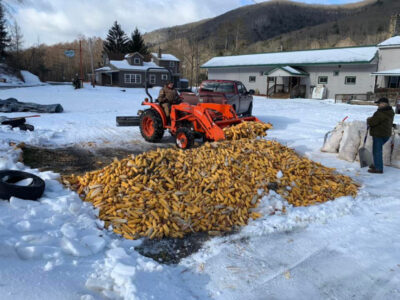
- PHOTO PROVIDED Members of the Cross Fork Sportsman’s Club are pictured distributing corn during the 2022 season. The club, among others, will no longer be doing this distribution as it follows PA Game Commission guidelines.
-
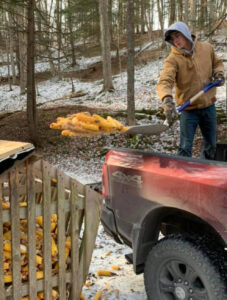
- PHOTO PROVIDED A member of the Cross Fork Sportsman’s Club tosses ears of corn into a feeder during the club’s 2022 distribution. The club, among others, will no longer be doing this distribution as it follows PA Game Commission guidelines.
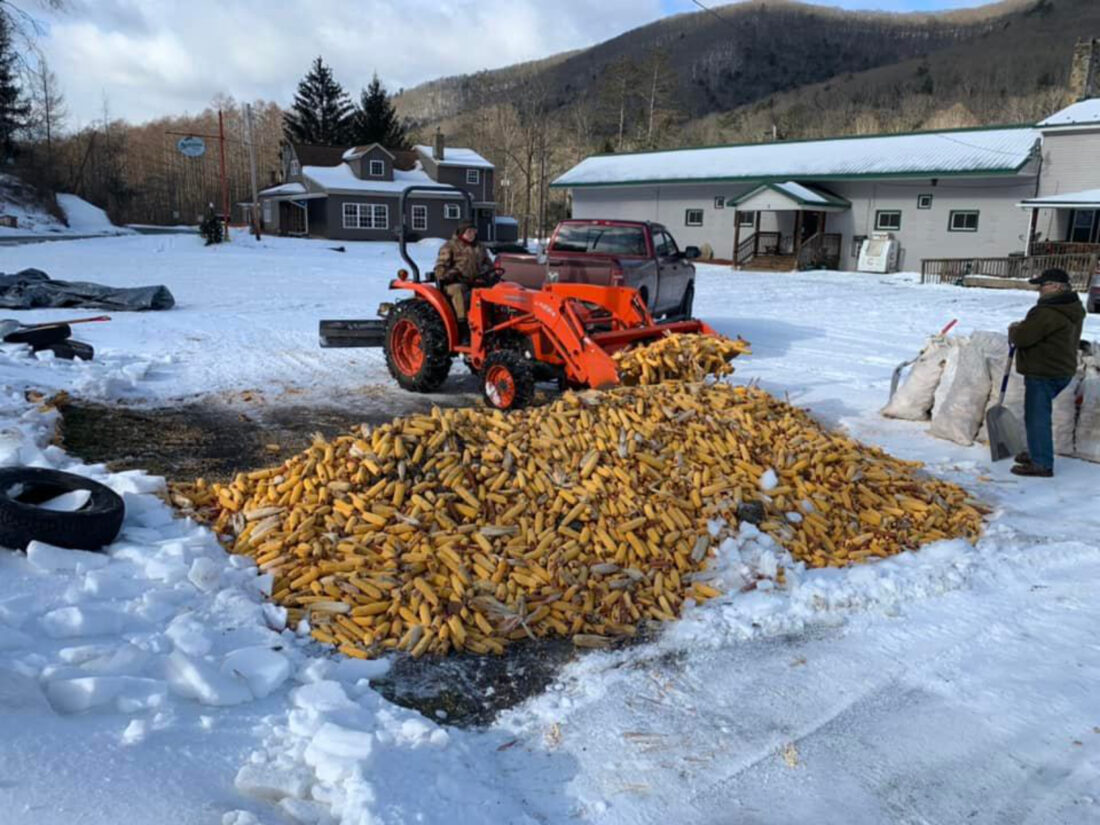
PHOTO PROVIDED Members of the Cross Fork Sportsman’s Club are pictured distributing corn during the 2022 season. The club, among others, will no longer be doing this distribution as it follows PA Game Commission guidelines.
RENOVO — With many decades old traditions, new discoveries and realizations typically lead to changes that are meant to make things better and safer. That has become the case with area sportsmen’s clubs as they opted to accept the PA Game Commission’s guidance to no longer hold their annual corn feeds. This event typically saw the clubs provide members with tons of corn to place in feeders throughout the area’s vast woods.
The Kettle Creek-Tamarack Sportsman’s Association, as well as the Cross Fork Sportsman’s Club, have both agreed to forgo the annual corn distribution, a decision that they are aware will initially be met with skepticism from many of their members. Between education as well as laws, they really were met with little choice.
Although it is legal to feed corn to deer, it is not the case with bears and elk. Of course, once a feeder is filled, it is then left alone, presenting an equal opportunity for any passing animal to get into.
PA Game Warden Blaine Groshek has spent years working with and helping to educate local outdoorsmen, including area clubs. He explained that for the area in which he patrols, including Clinton County, corn should not be a first option to feed deer.
“Through research and further understanding the effects of feeding corn, specifically on elk but also deer in our area, we now know it’s not the most ideal thing to do for a food source,” said Groshek. “There’s a couple of diseases they can get. We all know about CWD (Chronic Wasting Disease). Luckily it’s not up here quite yet, but to slow the spread we recommend not feeding corn for that aspect.”
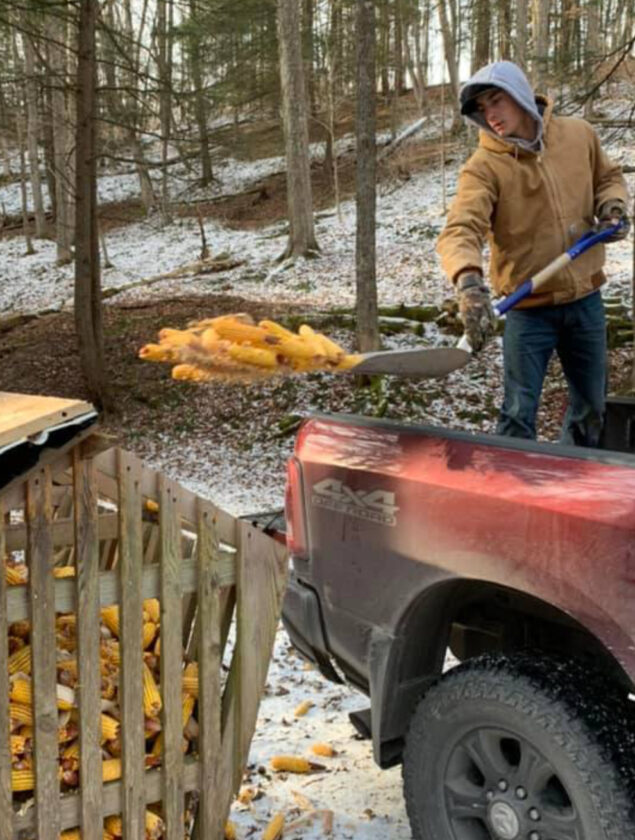
PHOTO PROVIDED A member of the Cross Fork Sportsman’s Club tosses ears of corn into a feeder during the club’s 2022 distribution. The club, among others, will no longer be doing this distribution as it follows PA Game Commission guidelines.
“Then for elk and deer they can get a disease called Ruminal acidosis, it’s a sudden shock where they add a bunch of sugar to their stomach,” he continued. “They have a complex biota in their stomach of different microorganisms, once you put that much sugar in it changes that. It can cause lesions, stomach issues, diarrhea and eventually lead to their death.”
Groshek understands this decision from the local clubs has put them in a difficult spot with their members, referring to it as “controversial.”
He explained that decades ago the PA Game Commission encouraged such corn distributions, but more recent education has made the act a dated concept.
“I do know that individuals in the public are doing it (dropping corn in the woods) on their own and I’ll try to get them on board as well,” the warden offered. “It’s a pretty controversial topic. They’ve been doing it for a very long time and the game commission used to even promote it way back when.”
Groshek detailed plans that he would love to see avid sportsmen adopt — things that are safer, more beneficial and offer longer assistance to the PA wildlife.
He pointed out that dropping a big pile of corn in the woods offers a quick, unhealthy, short-lasting food source. He offered alternatives such as the forest stand improvement project, pruning apple trees and other good forestry practices that line up with wildlife improvements.
He suggested that something such as food plots are cost effective, long term minded and are spreading food across a large area, not as much concerned about spreading diseases, the food is more available over time as seeds grow into plants, no shock of high sugar consumption.
“You also have the habituation aspect. A lot of times feeders are near people or roads and animals of all kinds are getting used to people and traffic, we’ve all seen scenarios where that leads to unfortunate situations,” he said.
Due to the corn feeding being such an anticipated event for hundreds, likely even thousands of members of local sportsmen’s clubs, the decision taken by the Kettle Creek-Tamarack Sportsman’s Association as well as the Cross Fork Sportsman’s Club to no longer distribute corn was not taken lightly. To a degree, however, it has gotten to the point where the decision was being made for them.
The mutual respect between Groshek and CFSC membership drive and raffle Secretary Ed Halerz was offered by both men towards the other. Still, Halerz said he wasn’t on board until things started to take on a legal aspect.
Halerz explained if they put corn in a feeder and if even an elk hoof print is found at the feeder, that could be grounds for a warning or even a demand to remove the feeder.
Progressive discipline could even get to the point where officers of sportsmen’s clubs could be fined personally.
“Blaine certainly didn’t threaten us by explaining that to us. But, once we realized it was even a possibility, we held a vote and decided to end the corn feeding,” Halerz said.
Halerz said that the Cross Fork Club has for years already put around $3,000 a year towards food plots, while $5,000-$7,000 went towards their corn program. He said it would be a safe assumption that the majority of those corn funds would be reallocated towards food plots next year.
Halerz added they have also given money to DCNR who, in turn, hires a company to browse cut — a practice that often takes aspen trees for example and shreds them to the point that the bark and shavings become a natural food source.
Halerz said there have been discussions with the Kettle Creek-Tamarack Club into combining funds for more of that practice, in hopes that a larger amount of dollars would lead to a discounted price.
“The sportsmen’s clubs made a very good move and decided to be in compliance with our law and not feed corn this year. I was in a tough spot of doing my job and enforcing the law and they realized that they made a decision that likely won’t be that popular, but we will continue to work together to make this a success for both of us and then ultimately the PA wildlife,” summed up Groshek.
Local news
Out-of-state reinforcements from Pa. and others help Rhode Island dig out after blizzard

Partnership looks to set the record straight regarding incomplete audit
Trump says he is ‘not happy’ with Iran but indicates more time until conflict
TEL AVIV, Israel (AP) — U.S. President Donald Trump said Friday he’s “not happy” with the latest talks over ...
Commissioners hear from new library director; Encourage public participation in comprehensive plan update
Sugar Valley Lions honor Students of the Month