
CMHS senior educates about mental health impacts of immigration
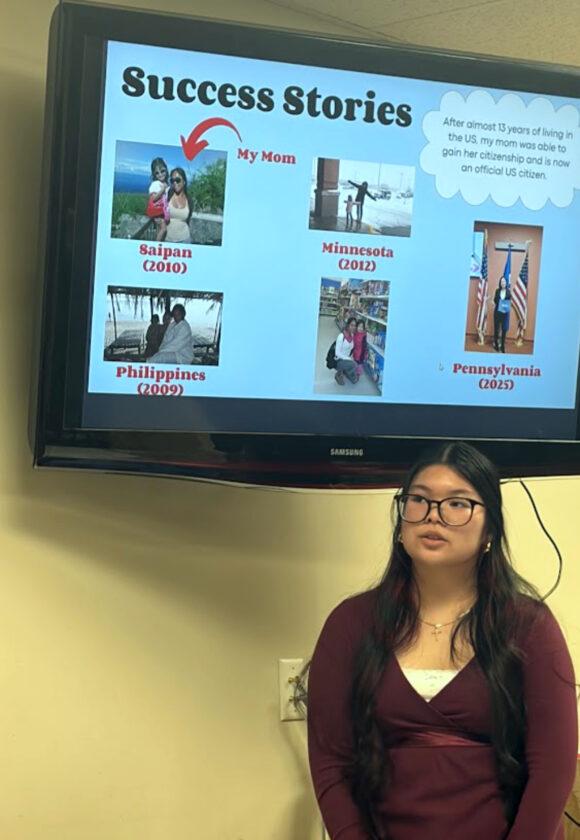
HUNTER SMITH/THE EXPRESS Alecsandra Cepeda is pictured while delivering a talk at Avenue 209 on the mental health effects of immigration.
LOCK HAVEN — Inspired by her mother’s journey, a senior Keystone Scholar at Central Mountain High School highlighted the mental health effects of immigration during a public presentation of her senior project.
The talk, delivered by Alecsandra Cepeda and hosted at Avenue 209 Coffee House, marks a milestone toward her graduation and becoming a Gold Award Girl Scout.
Her presentation examined how immigration can affect emotional well-being, explored the stigma surrounding immigration and outlined coping strategies for individuals and families navigating major transitions.
“This is a very sensitive topic that isn’t talked about much,” Cepeda explained at the outset of her presentation.
She said watching her mother, who immigrated from the Philippines in 2009 and later became a U.S. citizen, navigate the immigration process and its emotional strain led her to center her senior project on the little-discussed topic. The project also supports her pursuit of the highest Girl Scout honor, the Gold Award, which requires scouts to design and carry out a sustainable Take Action project addressing the root cause of a community issue.
“She inspired me to do this project since she’s an immigrant,” Cepeda said. “I’ve seen the challenges that she’s faced firsthand, seeing as we moved here when I was very young, and I had to help her throughout all of that.”
While mental health is important for everyone, it is particularly relevant to the immigrant community.
“It’s important because good mental health helps people cope with stress, build relationships and make healthy choices,” Cepeda said. “Its just as important as physical health, so taking care of it should be your top priority.”
In her presentation, she highlighted how immigration itself can detract from mental wellness, as moving to a new country often poses emotional and psychological challenges.
“Immigration is a major life transition with significant emotional impacts,” she said.
According to Cepeda, these impacts stem from a variety of challenges immigrants face, including language barriers, cultural differences, difficulty integrating into a new society, financial struggles, separation from family, discrimination and stigma, limited access to services and stress from displacement.
She noted that there are many types of immigrants, and the challenges they face can vary widely depending on their circumstances.
While some leave their countries voluntarily to pursue better opportunities, education or family reunification, others are forced to migrate because of traumatizing experiences like conflict, persecution or environmental disaster.
Though most immigrants follow legal channels to move, some are unable to do so because pathways are often extremely limited, expensive and can take years if not decades. Those who migrate without legal status — called undocumented immigrants — often face even greater obstacles, including limited access to healthcare and legal protections, Cepeda explained.
“Research has shown that there’s been a link between these stressors and mental health challenges like anxiety, depression and PTSD,” she said.
In one study she cited, researchers found that 68 percent of Mexican immigrants met the criteria for anxiety or depression. That figure is nearly double the rate among Mexicans in Mexico, according to a study publicized by Mexico Business News, which reported that 36 percent of Mexicans acknowledged struggling with at least one mental health condition.
Stigma, which she said is the force behind this phenomenon, is often rooted in societal fears, such as concerns over cultural change, national security or perceived moral inadequacies, and can lead to shame, exclusion or discrimination among immigrants.
To address these challenges, she outlined several strategies for mitigating the effects of stigma. These include building social support, maintaining connections to cultural heritage, practicing stress relief, engaging in creative expression, prioritizing self-care, pursuing self-improvement and seeking professional support.
“We can address stigmas around immigration by challenging misinformation and stereotypes,” she said. “We could also advocate for humane policies — by supporting policies that protect immigrant rights and promote access to resources like healthcare and mental health — as well as promoting understanding and empathy by listening to our immigrant neighbors, sharing personal stories and connecting with immigrant communities.”
At the end of her presentation, Cepeda shared mental health resources, including the national suicide prevention hotline (988) and directed attendees to local support groups such as Cornerstone Counseling and Central Keystone Counseling in Williamsport, Crossroads Counseling in Lock Haven and La Puerta Abierta in Philadelphia.
Cepeda is part of the Keystone Scholars Program, which helps guide students into a successful career path.
“The Keystone Scholars Program is geared toward helping students who are first-generation college students start and pursue their chosen careers,” said Melissa Bottorf, executive director of the Keystone Central Foundation. “Alex has been one of our Keystone Scholars from the very beginning.”
Bottorf, who Cepeda thanked for her guidance, said she has flourished in the program.
After graduation, Cepeda plans to study to become a clinical lab technician at Lycoming College in Williamsport.
Local news
Woodward supers talk Riverview Park events
LOCKPORT — Woodward Township Board of Supervisors met this month and discussed approval for Riverview Park ...
Treasury officials question whether taxpayers can legally pay for security upgrades at Shapiro’s family home
HARRISBURG — Late last year, Pennsylvania’s top law enforcement agency revealed taxpayers would pick up the tab ...
CMHS senior educates about mental health impacts of immigration
Sons and Daughters of Italy contributes over $113K to local organizations
LOCK HAVEN — The Sons and Daughters of Italy of Lock Haven is continuing its mission to give back to the ...
What if everyone had to prove their citizenship to register to vote?
Despite Rockview closure, CentrePeace continues to help those in need
BELLEFONTE — After the closure of SCI Rockview prompted questions about its future, CentrePeace says it will ...