District staff present next comprehensive plan
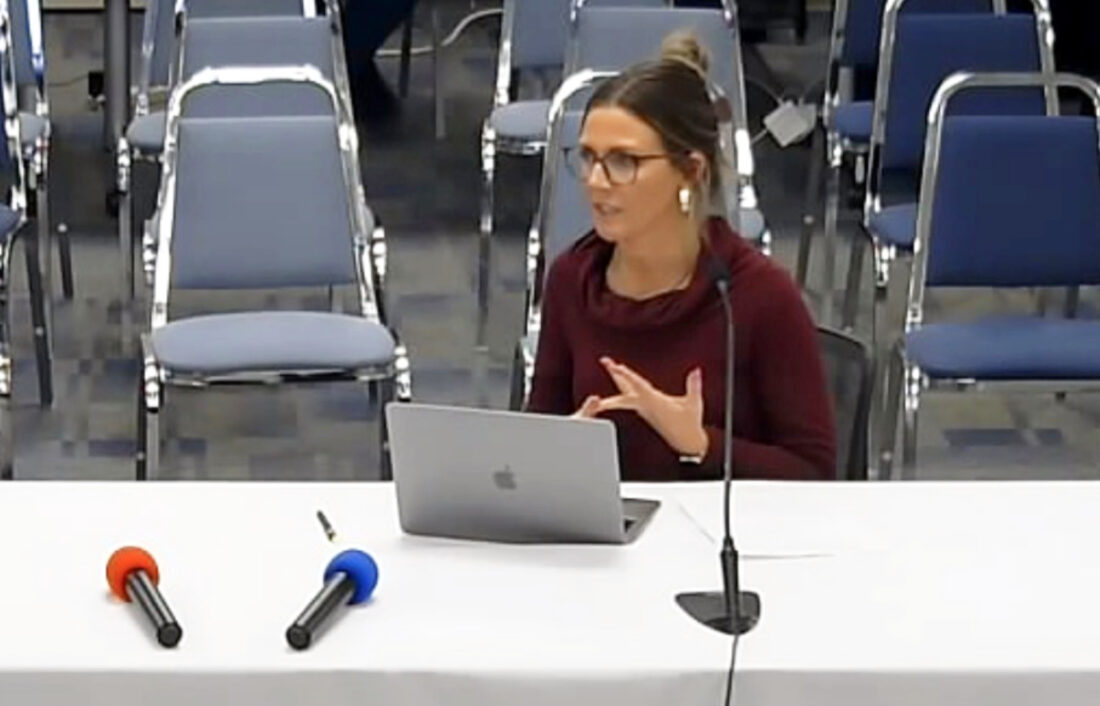
PHOTO PROVIDED Director Of Curriculum & Innovation Megan Hull speaks to the Keystone Central School District Board of Directors about the three-year comprehensive plan at its work session Thursday night.
MILL HALL — The Keystone Central School District is in the final stages of preparing its upcoming three-year comprehensive plan required by the Commonwealth of Pennsylvania.
At its work session Thursday night, the district’s board of directors were presented with information about the plan, which would encompass 2026-2029, by Megan Hull, director of curriculum and innovation.
Hull said she and CTE Director Kurt Lynch intended to present their respective plans at the meeting, but Lynch was feeling under the weather and could not attend. She noted the comprehensive plan for Career and Technical Education aligned in many ways with the district’s plan.
Hull explained the plan cycles every three years and is mandated by the state.
“The state puts together a specific template. We have very little wiggle room in what that plan looks like,” she told the board.
In October 2025, Hull formed a committee made up of board members, teachers, support staff and community members to compile the plan. The committee met roughly six times up until Monday, Feb. 2.
A large part of the comprehensive plan, which is available on the district’s BoardDocs page, offers an analysis on the district’s strengths and where it could grow, Hull said.
Page 29 within the plan showcases the three main goals the district is looking to achieve in the next three years.
“The goals we landed on are based on what is doing well and what we want to improve,” she said.
The first goal is to improve career pathways at Central Mountain and Bucktail high schools.
She noted earlier in the work session, the board heard from a CMHS Student Government representative who reported students were excited by the variety of class options available to choose from.
“The model is meant to give students coursework relevant to future goals,” Hull said, noting as they continue to offer these courses it can help student retention and maybe even bring students back from cybercharter options.
The goal in relation to the career pathways is to improve college and career indicators. She noted the district is above the state average in this area, but they’d like to stay that way.
Another goal in the plan is climate and culture.
“We know it’s an incredibly important part of the student experience,” she said. “This is a really important part of what we do.”
Hull explained the district uses a multi-tiered approach to address the climate and culture in the district’s schools. The goal for the next three years is to reduce major referral — instances of students disrupting the learning environment — by 10 percent in the next three years.
Academics is the final major focus in the comprehensive plan’s goals, particularly with English Language Arts (ELA) and math.
Similar to how it handles the climate and culture within its schools, the district also has a multi-tiered approach to ensure students are getting the help they need in learning. Over the next three years, Hull said the district is looking to increase its growth percentile by 10 percent.
“We put a lot of value in making sure our students are growing,” she said.
Ultimately, Hull said the comprehensive plan being proposed builds off of the district’s strengths and focuses on areas where improvement could be made.
Attendance is also a major focus within the plan.
“We’re looking at continued improvement in our attendance components,” she said.
Speaking briefly on behalf of Lynch, she said one of his biggest goals in the CTE program’s comprehensive plan is related to student attendance.
During questions from the board, member Chris Scaff asked how the district can better lighten the load for teachers so they’re able to assist students who may need extra help learning.
“I was told not long ago by a couple of teachers that said they went to school to teach and ow they have to do multiple other things,” he said.
Hull explained roughly 80 percent of students keep pace with an instructor, with 10 percent needs slightly extra assistance and another roughly five percent needing intense help.
She said the district has intervention programs at all grade levels to help students in the 10 and five percent categories.
One program is the What I Need (WIN) time where students can visit teachers and receive extra help on subjects.
Hull said the goals related to climate and culture, particularly behavior in learning environments, is one way to try and help teachers focus on teaching. Though, she noted small class disruptions are things that may still occur.
She added sometimes issues in the classroom with students can be brought into the learning environment.
“Some of it is cultural and societal,” she said. “Everyone in our schools works really hard to meet students’ needs, whether it’s academic or behavioral.”
She noted the more serious behavioral issues are typically referred to guidance counselors or administrators who are better equipped to handle the situation.
Board Member Manny Rodriguez asked if the district is tracking behavioral issues, whether minor or major.
Hull said the district utilizes a program, in which teachers fill out forms related to a behavioral problem. This creates a database staff can look to.
“Anything from small to major, teachers document,” she said.
Following board discussion, Hull said she is looking for approval of the plan by the board at its voting session Feb. 12 so it can be posted publicly. Members of the public will have the opportunity to offer input regarding the plan before it is submitted to the state before March 23.
Local news

Creating art for US coins is tricky. Pa. artists have made it a career
KC board to consider personnel items at voting session
MILL HALL — The Keystone Central School District Board of Directors reviewed a number of personnel items during ...

‘The Gold Standard’: Bellefonte alumna awarded highest degree in FFA
District staff present next comprehensive plan
Jay Alexander shares next steps as Clinton County Solid Waste takes on Lycoming County landfill