
Business manager provides update on Keystone Central’s 2026-2027 budget process
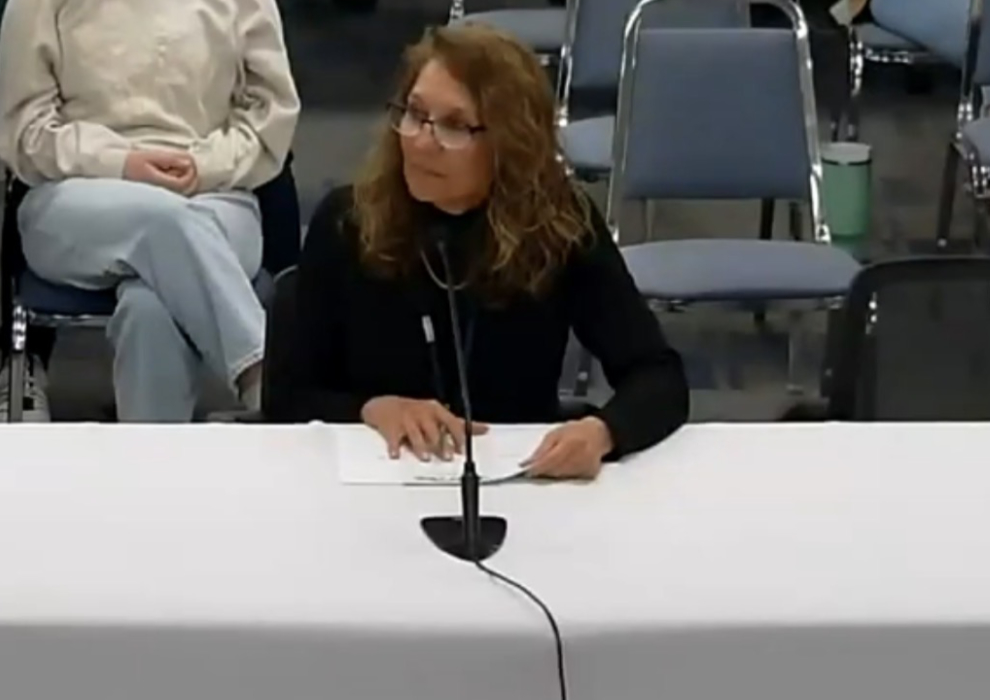
PHOTO PROVIDED Keystone Central School District Business Manager Joni MacIntyre answers questions from the board of directors during her preliminary 2026-2027 budget presentation on Thursday night.
MILL HALL — Staff at the Keystone Central School District are continuing to look at ways to trim its estimated $93 million budget, though it’s made some headway since February, according to Business Manager Joni MacIntyre.
MacIntyre presented the board of directors with a preliminary look at the budget, the second time she’s done so since February.
In February, MacIntyre had emphasized the numbers the board reviewed were very preliminary, as she and staff were digging into ways to trim budgets across the board and as she waited for more accurate numbers related to insurance rates.
On March 5 at the board’s work session, MacIntyre presented information about the preliminary budget, which included staff’s work to reduce expenses and explained where some of the larger costs are coming from.
MacIntyre’s presentation noted Gov. Josh Shapiro’s budget proposal for 2026-2027 did include additional education revenue. In total, under Shapiro’s proposed budget, the district would see increases in the following: $123,583 in basic education to $24,660,455; $489,508 in Ready to Learn to $1,260,210; $104,579 in special eduction to $4,198,014; and $56,729 in Career and Technical Center subsidy to $1,055,558.
“Overall we are receiving $744,399 more next year than this year. For how large our budget is, that’s not a whole lot of money,” MacIntyre said.
She noted the cyber-charter school formula change enacted by the state in 2025 did help with some additional savings and cost avoidance in the upcoming budget.
“I’m estimating, so far this year (savings) to be about $500,000,” she said. “I’m hoping by the end of the year we’re going to see somewhere near $750,000 of what we would have paid.”
MacIntyre said this savings is due, in part, because the state government has allowed school districts to reduce proposed numbers by 60 percent for maintenance and student activities for students who opt to attend a cyber charter school or brick and mortar charter.
She noted Shapiro has talked about upping this reduction another 20 percent to allow up to 80 percent reductions.
“That was an extremely helpful, good reform. There’s a long way to go but at least it’s a start,” she said.
Following a request during the board’s Finance Committee meeting, MacIntyre offered a cost breakdown for students within the district’s boundaries that attend either a cyber charter school or brick and mortar charter.
The chart, which is featured on MacIntyre’s presentation available on BoardDocs, took the current enrollment in the district and divided it by the state’s subsidy contributions.
That number comes out to about $11,000 in state funding that is put towards each child’s education.
MacIntyre said it costs the district a total of $14,806 — including the subsidies — to educate students.
“If you were to take the difference between what we get and what it actually costs, it’s almost $4,000 — and almost $15.6 million — that the school district has to come up with that we are not subsidized for, if we were to educate all of our students here,” she said.
However, because some students attend cyber charter or physical charter school, the district has to pay tuition.
According to MacIntyre’s presentation, it costs a total of $15,620 to send a basic education student to a brick and mortar such as Sugar Valley Rural Charter School and $14,396 for a student who attends a cyber charter.
For special education, it costs $32,166 for basic education at SVRCS and $27,208 for a cyber charter.
“So you see we’re only getting in about $11,000 but we’re paying out much larger numbers. It’s not dollar in, dollar out,” she said.
If a basic education student were to return to KCSD from a brick and mortar charter it would be an $800 savings, she said. For special education, it would be a $17,000 savings.
“This is just to show you what the savings would be, what the cost avoidance would be,” she said.
Board President Elisabeth Lynch asked if Shapiro’s increase in reduction opportunities he is proposing next year would help.
MacIntyre said it would only help the cyber charter costs, not the brick and mortar. She explained that the formula is based on the district’s own budget.
“When our budget is increasing, their tuition payments are also increasing,” she said. “We are allowed reductions, like transportation. That’s extremely helpful. But, again, there’s no reform for the brick and mortar.”
Board Member Christ Scaff asked if reducing the district’s budget could help reduce these rates.
“It would. The issue is the money we pay out is three times as much as the money we get in to cover the cost,” she said. “But yes, we have to be mindful of our own budget when we are understanding the tuition.”
MacIntyre also reviewed the cost the district ultimately pays out of pocket per student that attends a brick and mortar charter school or cyber charter. This is after the $11,000 government funding is taken into account.
For brick and mortar, the district pays about $3,100 per student for basic education and $21,200 for special education.
For cyber charter, the district pays about $1,800 for basic education and $16,259 for special education.
Beyond discussions about costs per student, MacIntyre touched on how the district staff are working to reduce the budget.
So far, through a variety of means, the district has been able to reduce expenses by $4,973,522. This includes:
— $2,500,000 in staffing study/resignations.
— $931,560 from technology. MacIntyre noted this was done through the technology department choosing to not purchase new SmartBoards.
— $41,860 from the elementary schools.
— $615,102 through insurance co-pays.
— $675,000 in a PSERS rate reduction.
In other positive news, MacIntyre said the district should see about $550,000 in extra real estate tax funding in Clinton and Centre counties due to organic growth.
“Centre County is seeing a lot of growth. There’s a lot of new buildings going up so that is because of new growth, new development in this area,” she said.
This was echoed by Scaff who said, “the more industry, the more taxes. We need to bring some of those industries to Clinton County.”
MacIntyre also reviewed notable expenses, including an expected $2.6 million increase in health insurance costs. She explained the district is expecting to see a 20 percent increase in its insurance rates over last year’s figures.
Its cost for brick and mortar charter is expected to increase by $750,000, she said.
Due to inflation and other factors, the cost for electricity and propane is expected to increase by about $150,000. Software and hardware costs are expected to increase by $250,000 as well.
Finally, MacIntyre said the district is expected to see an increase of $275,000 for transportation due to additional support staff needed in transporting special education and alternate education students.
The preliminary budget at this point, according to MacIntyre’s presentation, includes a $2.5 million shortfall, a $1 million decrease from 2025-2026’s $3.5 million shortfall.
Money from the district’s reserves would be used to offset this.
MacIntyre said the district is continuing to take other factors into consideration to close that funding gap. She encouraged the board to reach out to her office with ideas as she and staff continue to work on the budget.
The board will review a proposed general fund budget on April 9. If approved, it will be posted for public inspection.
On May 14, the board will vote on adopting the proposed final budget and then, on June 18, adopt a final 2026-2027 budget which MacIntyre would submit to the Pennsylvania Department of Education.
Local news
Business manager provides update on Keystone Central’s 2026-2027 budget process

This weekend’s US clock change is a problem, and there’s a deep divide on how to fix it
Keystone Central Board to consider various personnel items

Trump rules out talks absent Iran’s ‘unconditional surrender’ as Israel strikes Lebanon
PA secretary of the commonwealth answers questions on elections at House hearing
Bresnahan’s plan to revive farm-to-food bank program advances
The latest federal Farm Bill advanced out of the U.S. House Agriculture Committee on Thursday with a 34-17 vote. ...