
How does ICE benefit from long-existing government contracts?
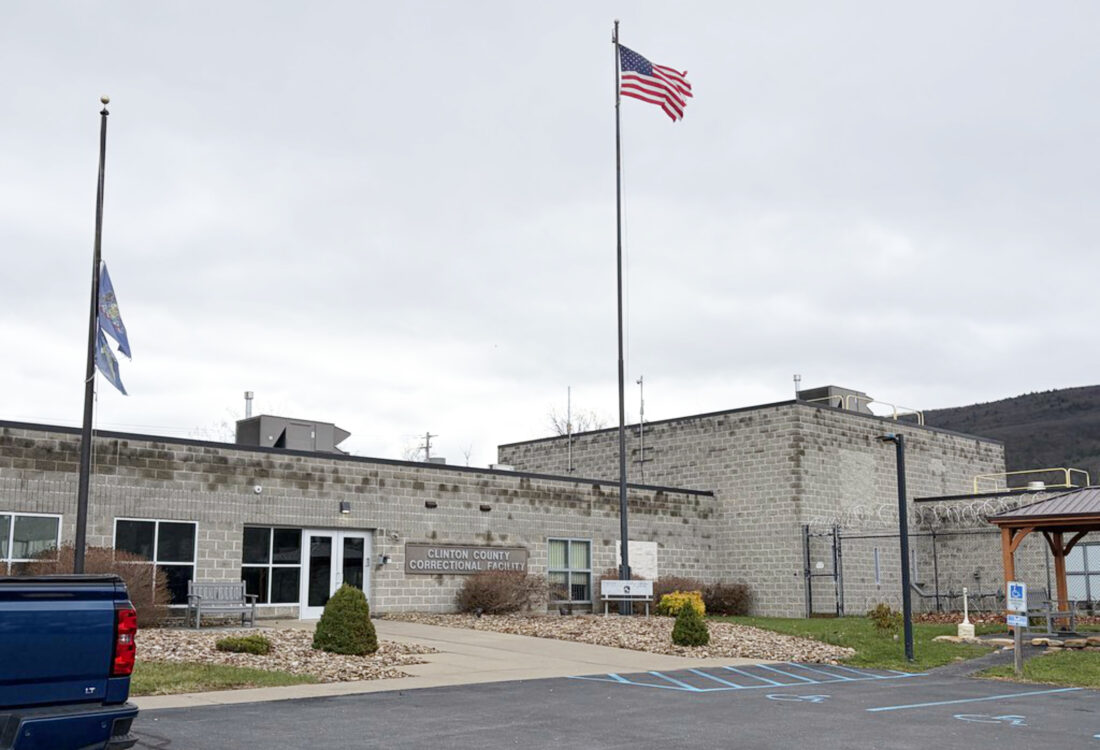
HUNTER SMITH/THE EXPRESS The Clinton County Correctional Facility is pictured. In recent months, the prison’s population has seen its contingent of ICE detainees swell.
McELHATTAN — Like hundreds of local jails across the country, the Clinton County Correctional Facility (CCCF) houses Immigration and Customs Enforcement (ICE) detainees under contracts originally established with the U.S. Marshals Service (USMS).
By co-opting existing contracts with USMS, experts say ICE can quickly expand detention capacity by avoiding negotiating new agreements, but critics argue the arrangements are often opaque, complex and largely hidden from public view.
Although ICE holds tens of thousands of detainees at any given time, it operates only a handful of its own detention centers. Rather, most ICE detention occurs in local jails and privately run prisons, using a sprawling network of agreements with government agencies and private contractors.
In Pennsylvania, seven facilities hold ICE detainees. Two are federal prisons and another is run by a private company as part of an agreement between ICE and the Clearfield County Commissioners. The remaining four are county jails that lease a portion of their beds to federal authorities. They include the Clinton County Correctional Facility in McElhattan and jails in Cambria, Pike and Franklin counties.
Until recently, the Erie County Prison also held detainees for ICE, but it no longer will following the county’s decision to end its contract with the agency.
Except for the Pike County Correctional Facility in Lords Valley, which contracts directly with ICE, the county jails all house detainees through intergovernmental agreements (IGAs) with USMS, which federal immigration enforcement is authorized to use.
Between October 2025 and January 2026, about 18 percent of ICE’s average daily population in Pennsylvania was held in facilities operating under USMS IGAs.
Nationally, statistics provided by ICE show the practice is widespread among facilities: as of Jan. 22, 2026, approximately half of those housing detainees operated under USMS contracts.
“These longstanding agreements, which usually have no expiration and often predate even the existence of ICE, frequently include ICE as an ‘authorized agency user’ for the contracted bed space,” according to Immigration Attorney Ellyn Jameson, who published research on the topic with the Georgetown Immigration Law Journal.
Clinton County’s contract, for example, remains in effect indefinitely unless terminated in writing by either party.
“Even where ICE is not authorized, it can quickly be added to an existing USMS IGA by modification. This structure means that ICE can quickly and easily vary where it houses detainees without having to negotiate its own intergovernmental agreement,” Jameson said.
The ease of expansion is one of the arrangement’s key features, as it allows ICE to scale detention quickly, while offering local governments a relatively simple way to generate revenue.
The National Immigrant Justice Center (NIJC), a nonprofit that advocates for immigrants’ legal rights, explained, “Acquiring detention space in a local jail or private facility with a USMS agreement in place is the fastest and easiest option for ICE to expand because it does not have to negotiate any new terms, rates or conditions.”
At the same time, advocates and researchers say the structure of those agreements can blur the lines between policymaking and service provision, shaping how local officials view their role in the system.
The NIJC asserts that ICE’s detention management system incentivizes incarceration for profit. Though ICE maintains custody over its detainees, the agency pays a per diem rate specified by the facility’s USMS contract.
Locally, the Clinton County Correctional Facility receives $82 per day for each detainee to cover their housing and safekeeping, whether they are in the custody of the USMS, ICE or the Board of Prisons, which is also an authorized user of the contract.
For local governments, that structure can create strong financial incentives to participate. Especially in rural areas facing economic stagnation or rising jail costs, housing federal detainees can provide a steady source of revenue, as even comparatively small facilities receive significant income from housing and transporting federal detainees.
Over the past five years, the Clinton County Correctional Facility has averaged $2.5 million annually in revenue from the detention program, according to Warden Angela Hoover. She said that revenue represents about 37 percent of the facility’s total expenditures. Although the total includes USMS detention revenue, ICE detainees comprise 95 percent of those held under the agreement.
“Regardless of how local officials viewed the shift in federal detention policies, they stood to profit immensely from them,” Jameson said. “From the perspective of a sheriff or a county commissioner worrying about the bottom line, there is little difference between an immigration, pretrial or criminal detainee.”
Jameson said the payment model encourages increasing detainee populations and reducing care costs.
“In this system, private prison companies grossly enrich themselves while local governments pad shrinking budgets,” the NIJC said. “The people trapped in this system, however, suffer severe human rights abuses.”
Advocates and researchers also say that framing the agreements as routine service contracts obscures their broader policy implications.
“ICE, the USMS and local governments have distinct and sometimes conflicting incentives that shape their understandings of the agreements as merely contracts for services,” Jameson’s research found. “As a result, what should be a deliberate and conscious act of policymaking, subject to multiple layers of transparency, is instead turned into an opaque and intricate business transaction that takes place largely out of public view.”
That framing is reinforced by how the agreements are negotiated and carried out, which largely follows federal contracting procedures rather than public policymaking processes.
“Despite their problematic framing as procurement rather than policy, these IGAs are not just contracts; they are a central piece of a nationwide policy of immigration detention that would not be possible without state and local cooperation,” Jameson said.
At the local level, researchers say the structure can also diffuse political responsibility. Because federal agencies determine who is detained and where they are held, local officials can characterize their role as limited to housing detainees rather than shaping detention policy. Some officials have used that distinction to argue that participation is pragmatic, reasoning that if detention will occur regardless of local involvement, communities should at least benefit from the associated revenue.
More broadly, the separation between arrest and detention functions allows even officials who oppose certain enforcement policies to distance themselves from their outcomes, while still participating in the system, according to research.
Researchers note that this dynamic is not unique to ICE detention through USMS contracts, but may be more pronounced because USMS detention has historically drawn less political scrutiny than immigration enforcement, allowing the arrangements to operate with less public attention.
Local news

How does ICE benefit from long-existing government contracts?
ICE detainees dominate federal population at Clinton County prison
Area churches announces Holy Week services
LOCK HAVEN — In preparation of the Easter holiday, many area churches have announced their Holy Week ...

LH man convicted in rape of woman with intellectual disability

Clinton County Community Connections to hold Life Sharing open house
KC admin talk protocols following threats
MILL HALL — Following the multiple threats made to Central Mountain High School in the past week, which pushed ...