Police radar bill referred to Senate Transportation Committee
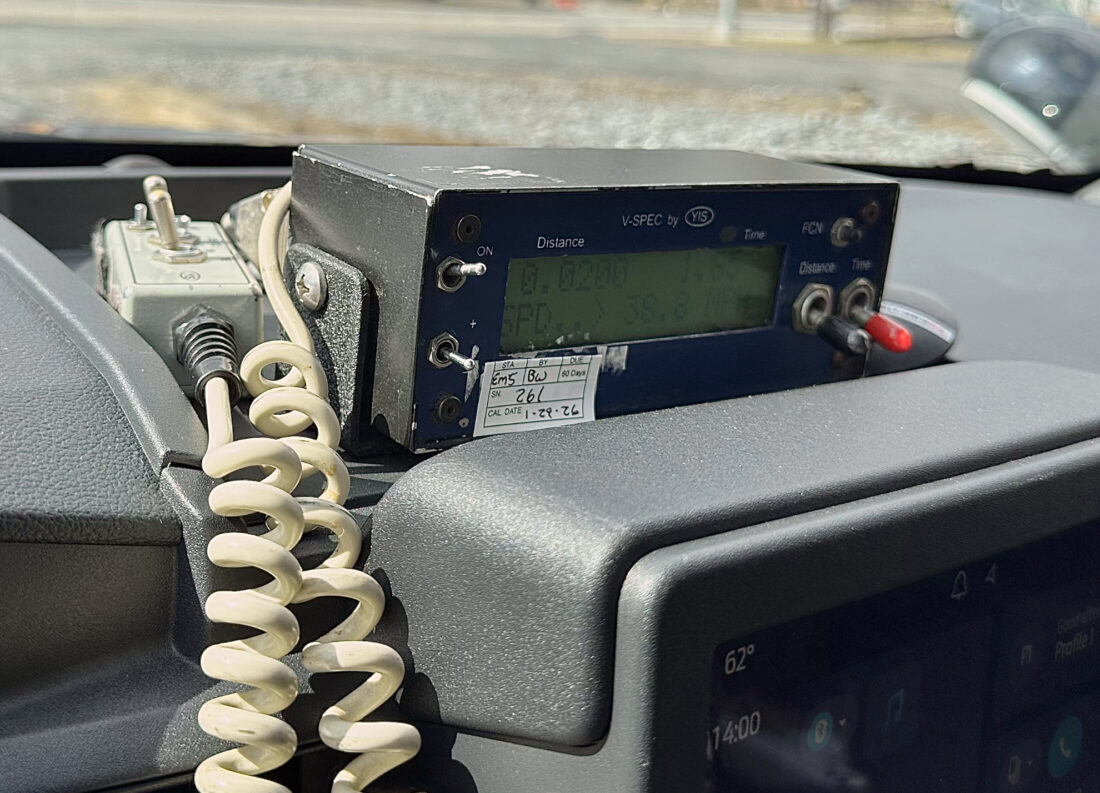
BRAD REIDER/FOR THE EXPRESS Speed computing Vascar equipment is seen inside a patrol vehicle.
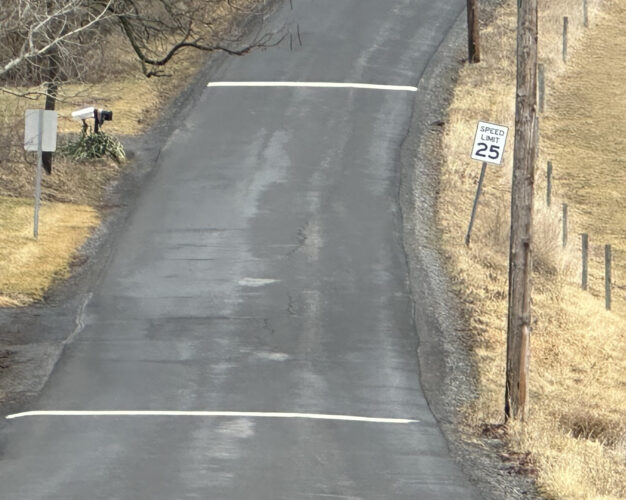
BRAD REIDER/FOR THE EXPRESS
A set of Vascar lines are pictured on Brush Valley Road in College Township, Centre County.
Legislation recently introduced would allow municipal police officers to use speed detecting radar equipment. Pennsylvania is the only state which prohibits the use of radar by municipal police, although state police have employed the technology since 1961.
Senate Bill 1237 was introduced by Sen. Nick Miller (D-14), who represents parts of Lehigh and Northampton Counties. The bipartisan bill has several co-sponsors and was referred to the Senate Transportation Committee on March 18.
One of the bill’s co-sponsors is Sen. Cris Dush (R-25) who represents parts of Clinton and Centre counties.
Historically, other legislative initiatives have failed after facing pushback from officials citing concern for radar being relied on as a source of revenue for the municipalities.
In 2025, Sen. Greg Rothman (R-34) proposed similar legislation (Senate Bill 509), but the bill never made it to the full senate for a vote.
Pennsylvania has allowed photo-radar through a private vendor since 2020, but enforcement is restricted to active work zones and violations are issued by mail.
The current proposed legislation includes several restrictions to mitigate the concerns for abuse to include a prohibition on quotas as well as a limit to the percentage of monies collected via fines. The bill would also restrict its use to officers using clearly marked police vehicles readily visible to motorists and to full-time police agencies with 24/7 coverage.
Currently in Pennsylvania, municipal officers are limited to using systems such as VASCAR (Visual Average Speed Computer and Recorder) and ENRADD (Electronic Non-Radar Device), both of which use a time/distance formula to electronically calculate a vehicle’s speed.
With VASCAR, officers visually observe a vehicle passing between two fixed points, commonly marked with solid white lines across the travel lanes. Speed is electronically computed from the time it takes a vehicle to pass between the marked lines.
ENRADD uses roadside laser equipment to measure a vehicle’s speed with a set of laser beams that measure the time it takes for a vehicle to pass between two points, then converts that time and short distance into a speed.
RADAR (Radio Detection and Ranging) uses radio waves emitted by a vehicle mounted or handheld device to measure the change in frequency of the waves. That change in frequency is then converted to speed which is digitally displayed to the officer. In the case of a handheld RADAR gun, the device requires little setup and could be used to obtain speed readings in any given area of road.
Under this proposed legislation, Pennsylvania State Police (PSP) troopers would also be able to utilize radar in “moving” mode, something widely practiced outside of Pennsylvania, while local officers would be restricted to “stationary” mode. The legislation would also authorize PSP to use hand-held Lidar (laser) for enforcement purposes.
When reached for comment, Sen. Miller stated through his office said, “outdated equipment is less reliable, more expensive to maintain and slows enforcement when communities need it most.”
Potential ‘Game Changer’
Adam Salyards has been the Chief of Police in Spring Township, Centre County since 2021 and has been a police officer for over 23 years.
Salyards says that not a month goes by without at least a few complaints from residents about speeding in the township, but the current VASCAR and ENRADD systems his agency uses have several drawbacks.
According to Salyards, ENRADD ideally requires multiple officers to use effectively, with one keeping watch over the equipment while traffic stops are being made by the other officer.
Spring Township currently has just seven officers, and sometimes a single officer covers the nearly 30 square miles of the township on their own, allowing less time for enforcement.
With VASCAR, Salyards says that some of the streets within the township do not have enough line of sight required to use VASCAR to begin with, making speed enforcement nearly impossible on those roads.
Salyards said that radar would be “a game changer” as far as enforcement goes and would allow his department to focus on some of the areas of common complaints and crashes, such as state Route 144 over the Centre Hall Mountain.
Salyards rejected the idea that radar would be abused, at least in Spring Township, saying that only 50 percent of the traffic fines go to the municipality.
Salyards added that in some instances, it costs the township far more money in overtime (for a citation) should a defendant request a court appearance to have their case heard, with hearing dates being set by the court.
As written, SB 1237 would still restrict Spring Township from using radar since they are not currently a 24/7 agency, relying on PSP during the overnight hours.
What’s next
For now, Senate Bill 1237 is under consideration within the Senate’s Transportation Committee, and it is not known when or if it will move forward for a full vote in the Senate.
For the full text of SB 1237, visit palegis.us.
Local news

Dush, other lawmakers launch caucus opposing human trafficking
Police radar bill referred to Senate Transportation Committee
Fed is watching energy price spikes, but Powell says bank is limited in what it can do
CAMBRIDGE, Mass. (AP) — Federal Reserve Chair Jerome Powell said Monday that it is important to closely monitor ...

A nonprofit linked to a combative PR firm is opposing a minimum wage hike in Pennsylvania

Healthy habits: SkillsUSA students share hygiene knowledge at Acorn School