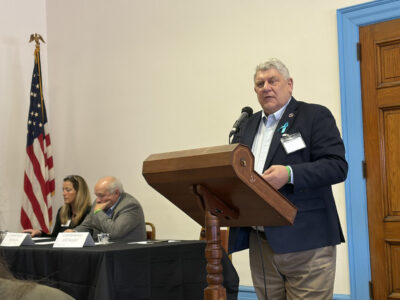
Clinton Co.’s elected officials gather to discuss local issues
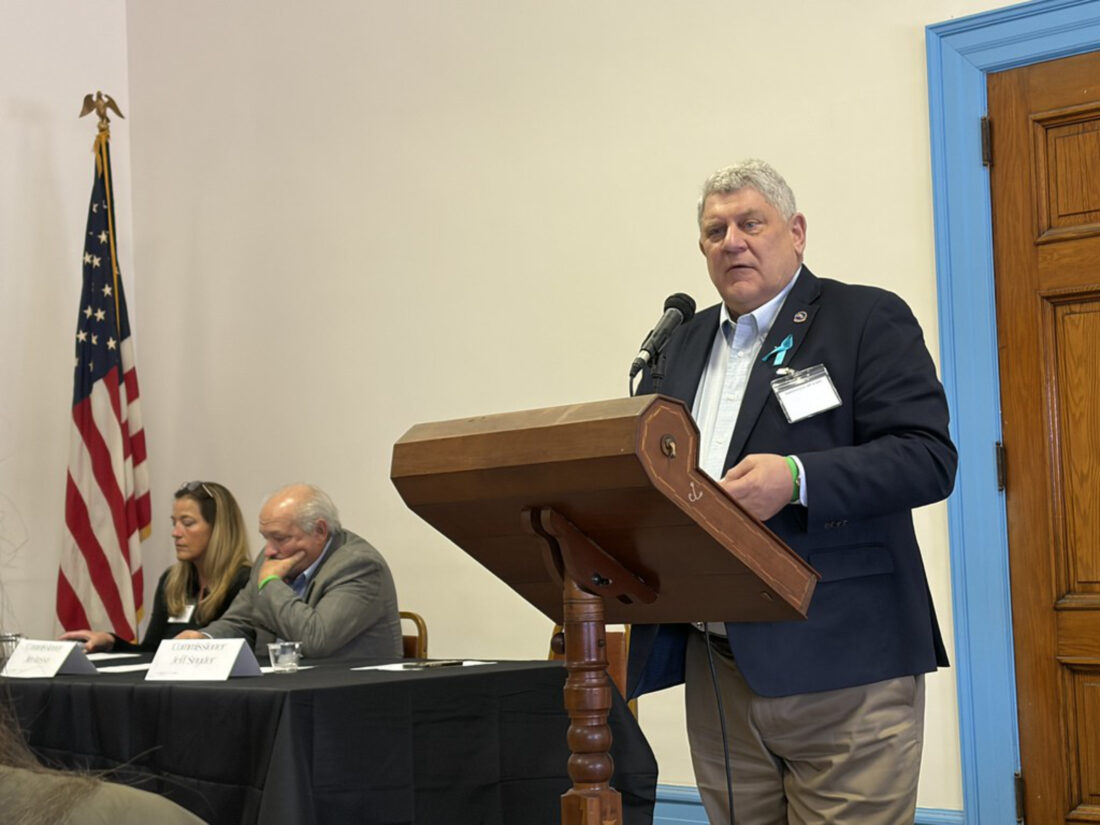
HUNTER SMITH/THE EXPRESS Clinton County Commissioner Jeff Snyder speaks at the podium, as fellow commissioners Angela Snyder and Jim Russo sit in the background.
LOCK HAVEN — County officials, legislators and their representatives gathered this week in Lock Haven to discuss economic development priorities for Clinton County, including tax base constraints, state funding disparities and workforce needs.
Hosted by the Clinton County Economic Partnership (CCEP), the event served as a forum for discussing issues shaping economic conditions locally and policy in Harrisburg and Washington. Attendees included Clinton County Commissioners Jim Russo (R), Jeff Snyder (R) and Angela Harding (D), and U.S. Rep. Glenn “GT” Thompson (R-15), along with representatives for Sen. Dave McCormick (R-PA) and state Sen. Cris Dush (R-25).
State Rep. Stephanie Borowicz (R-76) was invited but was unable to attend due to a conflicting legislative session.
SNYDER
Commissioner Snyder said the county faces structural challenges tied to its tax base and land ownership and called for change in the state and nation’s capitols.
Sixty-five percent of Clinton County’s land mass is controlled by state, federal or local government, meaning “Taxable properties are limited in Clinton County,” Snyder explained, adding that’s why “It is imperative that Clinton County has legislators in Harrisburg that will advocate for us.”
He pointed to scarce state grant funding as an example of what he described as a lack of advocacy for the county. Last year, Clinton County applied for financial assistance under the Multimodal Transportation Fund program, but of the 1,329 awards totaling more than $282 million, “Clinton County received zero because we do not have people in Harrisburg advocating for us,” he said.
He also noted that of the 67 counties in the commonwealth, “Clinton County is the only county that does not have Section 8 housing vouchers.”
“I bring these issues up today, because meaningful change is necessary in Harrisburg and Washington with how our government, and how those people that we elect to represent us, carry out their responsibilities,” Snyder said. “Too often, it seems our representatives think that it’s more important to fight across the aisle than it is to work together to make the lives of our constituents easier.”
He also took aim at the state’s charter school funding formulas, which he called inequitable and said cost the financially troubled Keystone Central School District (KCSD) about $3 million a year, along with health care funding he said is insufficient.
“We are seeking clarity on why the Department of Health thinks that a rural county, like Clinton County, can start a mental health crisis center with a $3 million grant when urban counties have received $10 and more,” said Snyder, asking, “Why is there such disparity?”
“We’re not asking for special treatment, we’re just asking for fair treatment,” he said, adding that Clinton County deserves equitable treatment, clear communication and strong advocacy at both the state and federal levels.
HARDING
Commissioner Harding, who spoke next, focused much of her remarks on the county’s open space and comprehensive plans, which she said are designed to help develop innovative solutions to the challenges Snyder addressed.
“There are a lot of great things in our community, but we have a lot of building to do,” Harding said. “So this comprehensive plan is going to address housing, health care, transportation, education, infrastructure, emergency services, health and human services, as well as agriculture and other topics.”
She said the plan will give the county and its municipalities greater ability to pursue funding opportunities and engage state and federal legislators on local priorities and their importance to the county’s future. She urged residents to participate in the process so their perspectives can be included.
“We’ve struggled for a long time to increase our tax base, and part of that is because we are landlocked,” she said. “The other part of that is because we have other challenges in our community that don’t necessarily fall in the wheelhouse of the county commissioners.”
She said one of the most significant barriers to local development is the quality of education in Clinton County, which she said makes it difficult to attract young families and professionals.
“We have a lot of success stories coming out of Central Mountain High School, but somehow that narrative gets changed,” Harding said.
Emphasizing the need for collaboration across the community’s institutions, she warned that continued siloing would hinder progress.
“If you have an opportunity to take on an apprenticeship, to do the diversified occupations, to get involved somehow in our education system here in Clinton County, please look into those opportunities,” she said. “If we do not all rally around these students in our community, the chances of retaining them or recruiting new families to our community is going to continue to be bleak.”
THOMPSON
In comparison to Snyder and Harding, Thompson’s remarks were more optimistic and complementary.
“I’ve always believed that a region is only as strong as the community that calls it home,” said Congressman Thompson. “Building a thriving county requires partnership, collaboration and working toward a shared vision, and that’s exactly what the Clinton County Economic Partnership has done for many years.”
Thompson said the partnership serves as the foundation for the community and its people to succeed.
“This unified front is why the county’s economy is growing, businesses feel supported and residents have plenty of opportunities, with more to come,” he added.
Thompson said his mission is “to deliver economic stability to Main Street America,” particularly across the 18 counties he represents.
“My overall vision is to restore a robust rural economy, and as a result of that to restore our numbers to what we had in the past,” he said.
Thompson also highlighted legislative efforts he said have supported rural health care and workforce development, including funding for Bucktail Medical Center that allowed the facility to modernize its beds and upgrade laboratory and imaging capacity, as well as investments in career and technical education.
He referenced his 2018 legislation, the Strengthening Career and Technical Education for the 21st Century Act, saying, “I’ve seen some of the fruits of that program today with these talented young people,” referring to students who catered the event. He added that since its passage, he has seen CTE programs shift from being cut due to low enrollment to having waitlists.
He also discussed H.R. 1, the “One Big Beautiful Bill Act,” which he said “included a lot of significant policies that have lowered the cost for business owners and brought real tax relief to millions of Americans.”
Among its provisions, he highlighted the permanent extension of the 20% small business tax deduction and the elimination of taxes on tips and overtime pay.
Others
Aside from the legislators in attendance, Mark Long from state Sen. Cris Dush’s office and Juliet Harshbarger from Sen. Dave McCormick’s office gave remarks on behalf of their legislators, who both had other engagements.
Long talked about Dush’s efforts to combat human trafficking, strengthen domestic critical minerals processing and manufacturing and improve rural health care, while Harshbarger spoke of McCormick’s emphasis on constituent service, communication and engagement in advancing his priorities of saving Pennsylvanians money, providing transparency and accountability in Washington and creating transformational economic growth across the commonwealth.
Overall, the speakers emphasized the need and opportunity for investment in Clinton County.
The luncheon concluded with a Q+A session where the representatives brainstormed funding options for the Mill Hall Pool, local infrastructure priorities and obstacles to economic development.
The event was sponsored by Geisinger, and the venue provided by the Masonic Temple, LaFayette Lodge No. 199.
Catering was prepared by KCSD CTE students in Candice Grimes’ culinary class. According to the partnership, it was their first time catering an event and was widely considered a success.
Local news
Pa. primary election 2026: Your complete guide to Republican Stacy Garrity in the race for governor
Zoning hearing for possible psychiatric facility to continue in May
DUNNSTOWN — The continuation of a zoning hearing for a proposed adult psychiatric residential treatment facility ...
Who is on the ballot in Clinton County?
LOCK HAVEN — With roughly a month and a half until Primary Election, local Democrat and Republican voters can ...
‘A True Hero’: Jersey Shore teen honored by local officials for saving grandfather’s life
KCSD faces $3.5 million deficit as it shapes 2026-2027 budget
MILL HALL — Facing a potential deficit of about $3.5 million, the Keystone Central School District Board of ...