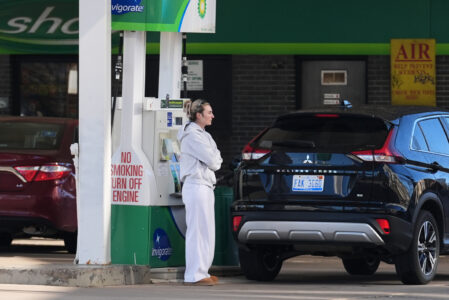
Diesel prices continue to climb, hitting Pa. wallets
Pennsylvanians’ pain at the pump may only be beginning as the United States’ war with Iran continues.
In the five-plus weeks since the war started, gas prices have steadily ticked up. AAA puts the statewide average at $4.152 per gallon, slightly above the national average of $4.119.
But the surging price increase of diesel hasn’t yet had the same effect on wallets. Diesel prices are up to $6.088 per gallon in the commonwealth — up from $4.059 a year ago and just shy of the record-high of $6.328 in May 2022, according to AAA.
Dylan Troxler, an owner-operator passing through Harrisburg last week, told the Capital-Star that he didn’t know how much longer he could afford to fill his tractor-trailer. The 24-year-old from Natchez, Mississippi has been driving commercially for just four months.
“I’m sure if you have a company car, you don’t mind it as much,” said Troxler. “But I can’t keep doing $500 (to fill a tank) and it only lasts a day.”
Company drivers work as full-fledged employees with the business paying for maintenance and fuel costs. Owner-operators may get a stipend for gas, depending on their particular contract. Troxler said he gets reimbursed $150 when he fills up.
According to the Pennsylvania Motor Truck Association, nearly 90,000 truck drivers transport 414,630 tons each day in the commonwealth.
Over time, the costs paid by drivers like Troxler will trickle down to consumers, inflating costs for groceries and Amazon deliveries alike.
“Much of the U.S. economy is powered by the heavy machinery that needs diesel,” said Patrick De Haan, head of petroleum analysis at GasBuddy. “Trains, tractors and trucks all need diesel. That’s how products move in the economy.”
De Haan added that logistics companies have increased rates “at a furious pace to try and keep up with diesel prices.”
Oil in the Middle East
Iran has slowed shipping through the 30-mile-wide Strait of Hormuz to a trickle, clamping down on a key transportation route for roughly 20% of the world’s oil.
Over the weekend, President Donald Trump renewed his threats against Iran, saying that power plants and bridges would be targeted if the country didn’t reopen the Strait of Hormuz by Tuesday.
“The entire country can be taken out in one night and that night might be tomorrow night,” said Trump at a Monday press conference.
Destroying such infrastructure could potentially be a war crime. In his initial budget proposal last month, Trump requested $1.5 trillion in defense spending — a 43% increase paid for by cutting non-defense programs like health care. He also didn’t rule out asking Congress for an additional $200 billion to cover costs this year.
But even if traffic starts to flow through the Strait of Hormuz by April 10, some economists estimate that the average household will spend an additional $857 on gasoline in 2026, but predictions didn’t address business costs.
“Until there is a concrete and visible reopening of the Strait of Hormuz, we could continue to see diesel prices rising,” said De Haan. “The longer the strait remains blocked, the higher diesel, gasoline and jet fuel prices go.”
The waterway transports the oil needed to operate trucks, machinery and airplanes as well as one-third of the world’s nitrogen fertilizers, putting an additional pinch on farmers planting crops this spring.
Though negotiators have proposed peace talks, De Haan said prices wouldn’t decline until the strait’s reopening was “verifiable.”
“Confirmation is very, very important,” said De Haan. “We’ve heard a lot about the possibilities, but we just haven’t seen a whole lot of credible information.”
Some states have proposed gas holidays, which typically include diesel fuel, though research is mixed about whether the initiatives benefit consumers or if savings are simply absorbed by the supply chain.
“The only real long-term and major solution to rising prices is to reopen the strait and allow the flow of oil to resume,” summarized De Haan.
——
Pennsylvania Capital-Star is part of States Newsroom, a network of news bureaus supported by grants and a coalition of donors as a 501c(3) public charity. Pennsylvania Capital-Star maintains editorial independence. Contact Editor Tim Lambert for questions: info@penncapital-star.com. Follow Pennsylvania Capital-Star on Facebook and Twitter.
Local news
Trump warns a ‘whole civilization will die’ if a deal with Iran isn’t reached
TEHRAN, Iran (AP) — U.S. President Donald Trump threatened Tuesday that a “whole civilization will die ...
Council reviews city manager job description
LOCK HAVEN — The majority of council’s first meeting in April surrounded continued steps to hire a new city ...

First Day Beauty: Bellefonte teen catches 21” rainbow trout on opening day

All American: CMMS eighth grader to play in national fastpitch softball tournament
Diesel prices continue to climb, hitting Pa. wallets
Pennsylvanians’ pain at the pump may only be beginning as the United States’ war with Iran continues. In the ...