
Lawmakers talk priorities for Pa., Centre County over breakfast
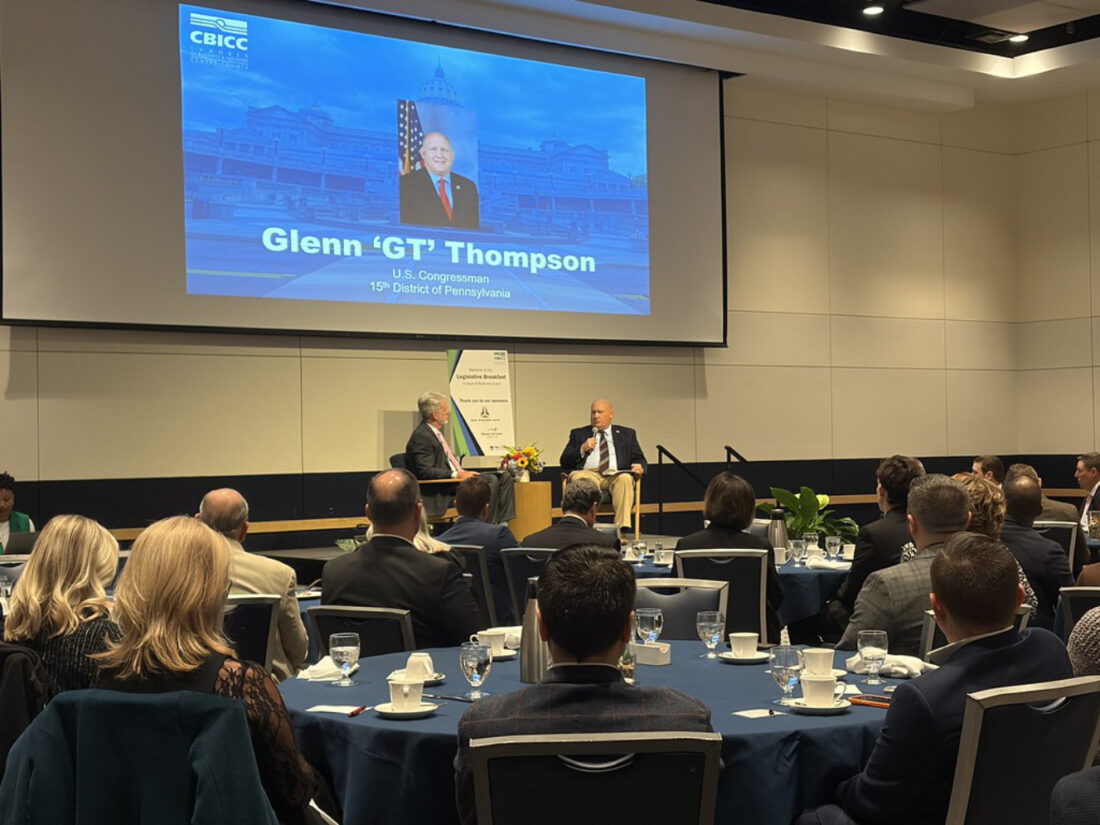
HUNTER SMITH/THE EXPRESS U.S. Congressman Glenn “GT” Thompson is pictured on stage speaking with Greg Scott, CBICC President and CEO, during a Legislative Breakfast held in Centre County this week.
STATE COLLEGE — Local lawmakers warned Tuesday that rural population decline, workforce gaps and infrastructure challenges are threatening Pennsylvania’s long-term economic momentum.
During the Chamber of Business & Industry of Centre County’s annual Legislative Breakfast at the Penn Stater Hotel and Conference Center in State College, state lawmakers and Congressman Glenn “GT” Thompson outlined policy priorities aimed at addressing those issues, including agricultural legislation, education investment and economic development initiatives.
Other topics of discussion included the future of SCI Rockview and rural healthcare.
The event featured conversations with Thompson, State Rep. Paul Takac (D-82) and State Sens. Cris Dush (R-25) and Wayne Langerholc (R-35), moderated by CBICC President and CEO Greg Scott.
THOMPSON
Thompson said his top priority remains passage of a new farm bill, the multiyear, omnibus federal law governing agricultural and food programs. The current framework, the 2018 farm bill, has been extended three times, most recently through Sept. 30, 2026.
As chair of the House Agriculture Committee, Thompson pointed to the committee’s recent approval of the Farm, Food and National Security Act of 2026, which would extend and reform U.S. Department of Agriculture programs through 2031, as progress.
“That will be on the floor soon,” Thompson said. “Probably a couple weeks after we return to Washington here next week.”
He acknowledged past challenges advancing the legislation, citing a lack of coordination with the Senate, but said that has shifted with John Boozman now leading the Senate Agriculture Committee.
“I really haven’t had a willing partner on the Senate side, but today I do,” Thompson said, adding Boozman is eager to take up the bill once it clears the House.
Thompson also highlighted a separate, bipartisan workforce proposal tied to reforms to the H-2A visa program, which allows employers to hire temporary foreign agricultural workers.
He said H-2A Temporary Agriculture workers are filling “jobs Americans don’t want to fill,” and that reforms support the country’s food security.
Beyond agriculture, Thompson emphasized the growing importance of career and technical education, particularly as automation and artificial intelligence reshape workforce demands.
“You may have the same job title, but the description is different,” he said. “It’s estimated that at least 50 percent of the core skill sets will be outdated because of the evolution of science and technology and innovation in the workplace.”
Thompson pointed to the Strengthening Career and Technical Education for the 21st Century Act, signed into law in 2018, as a driver of expanded programming and enrollment. He said career and technical centers — including Centre County’s CPI and nearby Pennsylvania College of Technology — are helping meet workforce needs.
“When these individuals graduate, they graduate with a diploma and certifications in one hand, and multiple job offers in the other,” he said. “And what they don’t have is student debt.”
He also underscored the economic impact of Pennsylvania State University, calling it “an economic engine” for all 67 counties and a leader in research commercialization.
“Research is so important in this world,” Thompson said. “You’re either moving forward or you’re falling behind.”
In addition, Thompson briefly referenced federal funding priorities, including support for the Department of Homeland Security and Transportation Security Administration pay, as well as tax policy he said would benefit working families and businesses.
“Soon, there are going to be tax returns coming back that are going to be significantly higher,” he said. “People will have the money they are going to need to deal with the expenses and costs they have.”
DUSH
State Sen. Cris Dush emphasized workforce development, infrastructure and public safety as central to strengthening Pennsylvania’s economy, while also raising concerns about rural health care and government transparency.
Dush said infrastructure and permitting challenges continue to hinder business growth and workforce retention, particularly in central Pennsylvania.
“Our infrastructure has been terrible for our businesses. The permitting processes have been terrible for our businesses,” Dush said, adding that such barriers ultimately impact working-class residents who rely on those jobs.
He pointed to Route 219 as a key project, describing it as an incomplete but critical corridor for international trade stretching from Canada to Miami.
“The largest unfinished portion is right here in Central Pennsylvania,” he said.
Dush also warned that Pennsylvania is losing young talent to other states.
“They are our best export, and I want them back,” he said.
On public safety, Dush highlighted his role in leading a bipartisan, bicameral caucus focused on combating human trafficking, which he described as a growing and highly profitable criminal enterprise.
“You combine Starbucks, Target and a couple other huge corporations — you put all their incomes together, and you can’t touch what human trafficking is doing,” Dush said, adding that traffickers are increasingly shifting away from drugs because human trafficking can generate repeated profit.
“These kids are going through hell,” he said. “We have got to be pushing hard against this scourge.”
Dush’s claims about the scale of human trafficking could not be independently verified by The Express.
Dush also raised concerns about access to rural health care, citing the loss of services such as the Lock Haven Hospital and Bucktail Medical Center emergency room as significant setbacks for the region. He said he is working with federal and state partners, including U.S. Congressman Glenn “GT” Thompson, to support and preserve rural hospitals.
As chair of the Senate State Government Committee, Dush said he is closely monitoring the future of the State Correctional Institution at Rockview property, noting developer interest following discussions about its potential closure.
“What kind of disturbed me is when I was actually approached prior to knowing anything about Rockview closing,” Dush said, suggesting concerns about possible insider knowledge.
He said future decisions about the site should prioritize community needs, including agriculture, housing and economic development.
“We’ve got some very lush land out there,” he said. “We have food that needs to be produced, we have businesses that can benefit and housing.”
More broadly, Dush called for greater coordination among state agencies and increased involvement from business leaders in policymaking, while expressing concern about the role of unelected officials in regulatory decisions.
“We need business leaders involved in government,” he said. “The people making the rules that impact you and your employees should be people you can fire — not a bunch of unelected bureaucrats.”
TAKAC
State Rep. Paul Takac focused on education, economic development and population decline, emphasizing the need for coordinated policy solutions to sustain growth across Pennsylvania.
Takac, who was recently appointed to the state’s higher education board, said the role presents “a tremendous opportunity” to support institutions locally and statewide, particularly as demographic trends shift.
While Centre County continues to grow, Takac noted that much of the Commonwealth is moving in the opposite direction.
“We’re very fortunate here, but 48 of the 67 counties in our commonwealth are shrinking in population, and that’s projected to accelerate,” he said.
He said reversing that trend will require targeted investment in education, infrastructure and economic development, along with bipartisan cooperation.
“Pennsylvania, we’re a purple state — we have to compromise. We have to work together,” Takac said.
Education, he added, remains central to that effort, whether K-12, to career and technical training or higher education. Takac criticized what he described as inequities in how public education and major institutions are funded.
“We have an inequitable system of funding public education in this Commonwealth, and frankly an inequitable system of funding Penn State,” he said.
Takac also pointed to innovation in agriculture as a key economic driver, highlighting legislation he sponsored in 2023 aimed at advancing agricultural technology.
“That has been tremendously successful in terms of helping drive new technologies,” he said, citing applications ranging from artificial intelligence to robotics in farming.
He said future efforts could expand into areas such as biofuels, helping stabilize energy costs while supporting rural economies.
“Having a reliable domestic supply while continuing to support our farms and our rural communities is really important,” Takac said.
Beyond agriculture, Takac stressed the importance of supporting early-stage businesses, particularly during the gap between startup and profitability. He suggested policies such as transferable tax credits to help young companies attract capital and scale operations.
“I think those are the kind of innovative things that we can do to stimulate these young companies,” he said.
Takac also highlighted the broader role of Pennsylvania State University in driving research and economic activity, while warning that global competition for talent is intensifying.
“For 50 years, the United States has enjoyed preeminence in research and innovation,” he said. “That isn’t necessarily the case anymore.”
He added that job growth in Pennsylvania, while strong overall, remains unevenly distributed — a gap he said policymakers must address.
“I’d like to see more of it in Centre County,” Takac said.
Local news

The show must go on! A farewell to seniors showcased with performance by CMHS Drama Club is this weekend
Long Island architect pleads guilty to murdering 7 women, admits he killed an 8th
Lawmakers talk priorities for Pa., Centre County over breakfast
Centre County proclaims April Sexual Assault Awareness Month
BELLEFONTE —The Centre County Commissioners proclaimed April as Sexual Assualt Awareness Month in Centre ...
Council OKs multiple use requests
LOCK HAVEN — Lock Haven City Council approved nearly a dozen use requests as area businesses and organizations ...
Trump warns a ‘whole civilization will die’ if a deal with Iran isn’t reached
TEHRAN, Iran (AP) — U.S. President Donald Trump threatened Tuesday that a “whole civilization will die ...