
Swept away: The missing history of Sulphur Spring
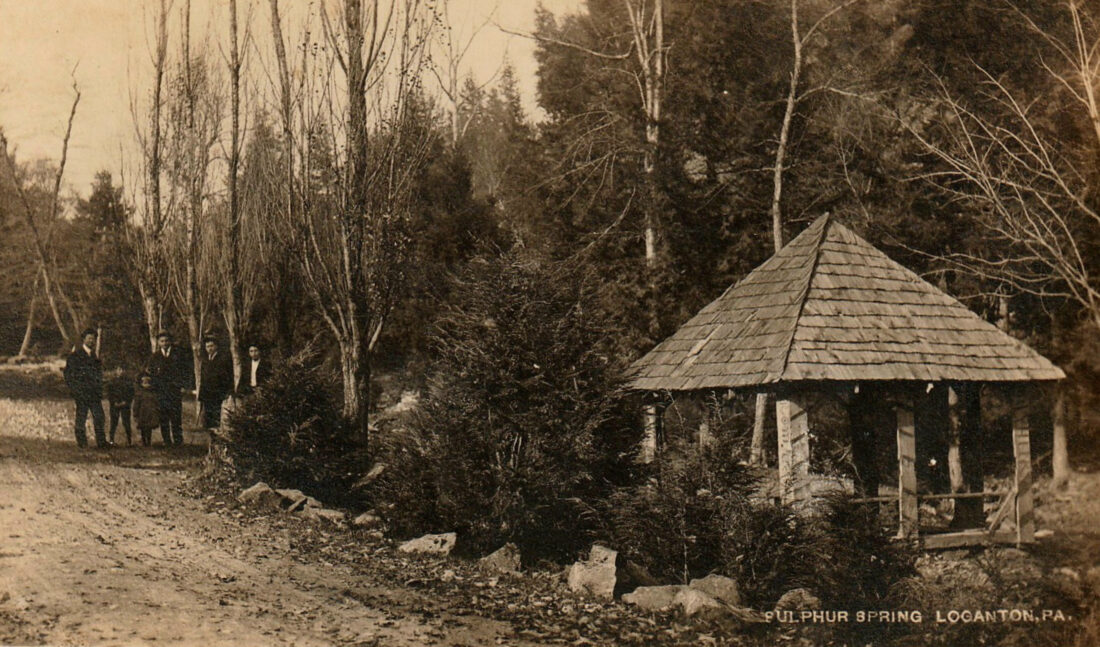
Photo provided This photo, known as Photo #1, shows Sulphur Spring sometime between 1889 and 1907. Pictured are four well-dressed men and two young boys standing on the then-dirt road that is now state route 477 north.
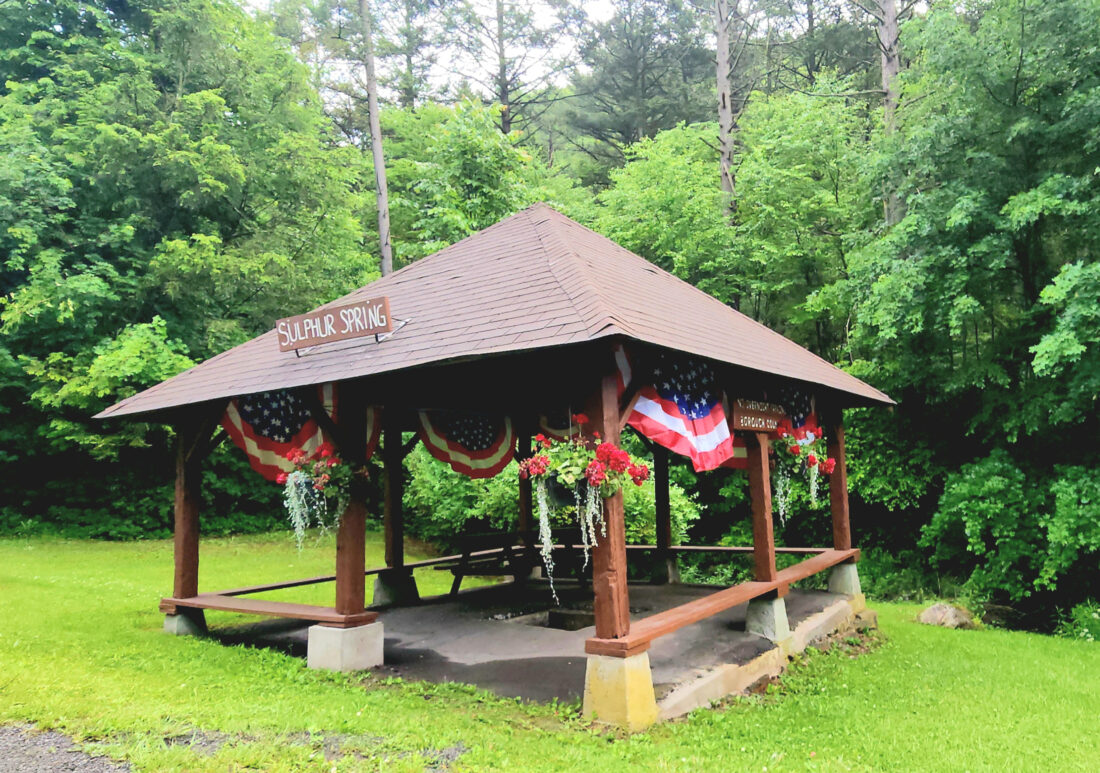
Amber Morris/FOR THE EXPRESS Sulphur Spring is seen in June of 2026, above.
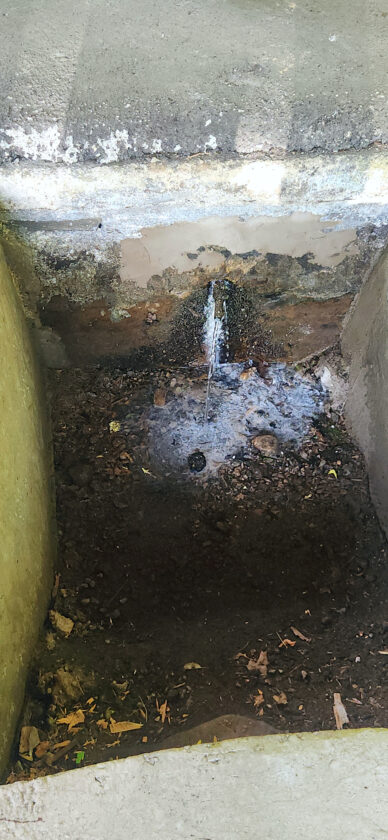
AMBER MORRIS/FOR THE EXPRESS For centuries Native Americans and townsfolk, including Loganton’s namesake Chief Logan, drank the waters for medicinal purposes.
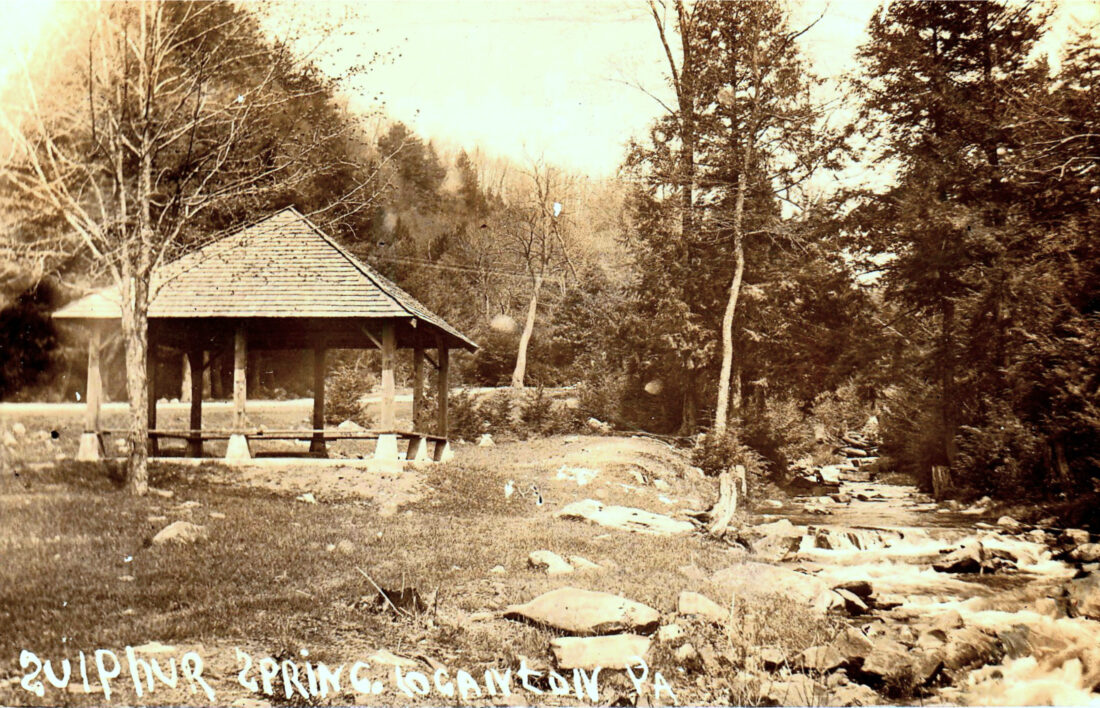
Photo provided A postcard postmarked 1910 shows the concrete blocks at Sulphur Spring which were installed sometime between 1907 and 1910.
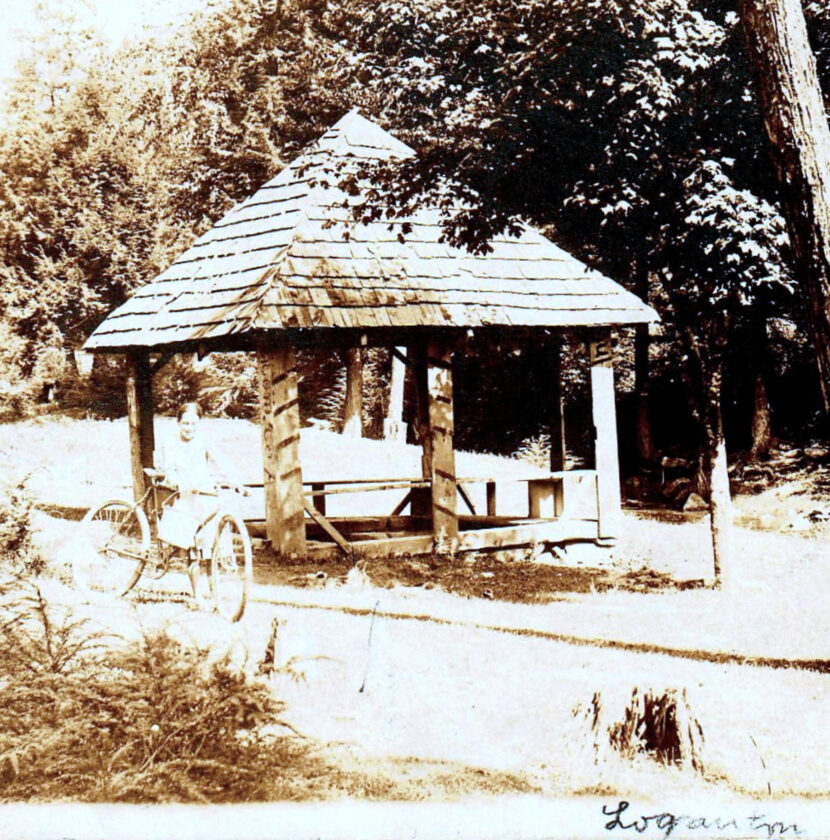
Photo provided A young girl is pictured on a bike. It is believed that she is the daughter of Daniel Scott Currin, Faith, who was approximately 13 years old at the time. Daniel Currin was the publisher of the Sugar Valley Journal from 1884 - 1917.
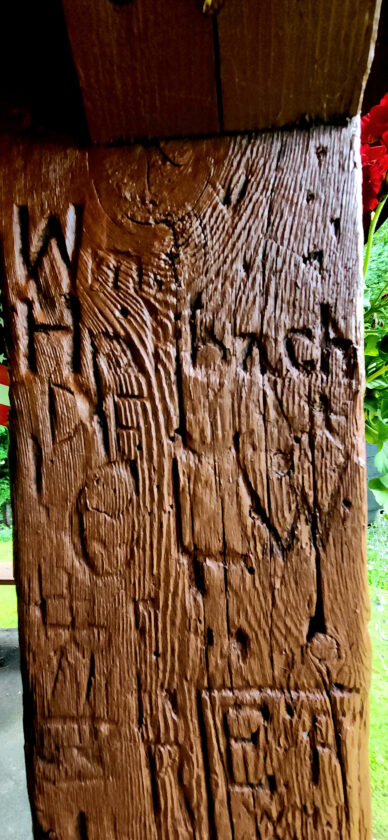
AMBER MORRIS/FOR THE EXPRESS The posts on the spring house have dozens of names carved in them from over the past century.
Photo provided This photo, known as Photo #1, shows Sulphur Spring sometime between 1889 and 1907. Pictured are four well-dressed men and two young boys standing on the then-dirt road that is now state route 477 north.
Amber Morris/FOR THE EXPRESS Sulphur Spring is seen in June of 2026, above.
AMBER MORRIS/FOR THE EXPRESS For centuries Native Americans and townsfolk, including Loganton’s namesake Chief Logan, drank the waters for medicinal purposes.
Photo provided A postcard postmarked 1910 shows the concrete blocks at Sulphur Spring which were installed sometime between 1907 and 1910.
Photo provided A young girl is pictured on a bike. It is believed that she is the daughter of Daniel Scott Currin, Faith, who was approximately 13 years old at the time. Daniel Currin was the publisher of the Sugar Valley Journal from 1884 - 1917.
AMBER MORRIS/FOR THE EXPRESS The posts on the spring house have dozens of names carved in them from over the past century.
Trending
Just inside the Loganton Borough line, right outside of town, is a historic landmark that almost every Sugar Valley resident passes daily, but never pauses to think about -- Sulphur Spring.
To most, it just looks like a simple four post pavilion that sits alongside Mill Creek. Townspeople typically don't stop there unless they need to turn around or make a quick phone call, but occasionally a bicycle rider or a family in a car with out-of-state plates can be spotted at the picnic table having lunch.
The grounds are kept nice by the borough. The small parking space is always plowed in the winter, and in the summer the grass is mowed and flowers are planted. In May of 2026, in honor of 250th anniversary of America, the Loganton Borough, through local donations, partnered with the Advanced Woodworking class from the Sugar Valley Rural Charter School to do improvements on the structure which protects the spring, giving it new life.
But what is interesting about Sulphur Spring is how easily its rich history has been swallowed by time. Even its correct name has been almost lost due to a regional colloquialism -- people are quick to mispronounce and misspell the name of the landmark as "Sulphur Springs," adding an "s" to the end, making it erroneously seem as if there are multiple springs, when in fact, there is only one.
When researching the property, one can find out that, as the name states, it is a mountain spring which produces sulphur water, and many people over the years believed it had medicinal value.
It's been passed down that Loganton's namesake, Native American Chief James Logan (son of the great Chief Shikellamy) of the Mingo tribe, spent a considerable amount of time stopping to rest at the spring during his frequent journeys from the Island Road near Lock Haven, as he traveled back and forth through Central Pennsylvania in the 1700's. It is written that he and other Natives drank the sulphur water for its healing properties.
Local folklorist Colonel Henry Shoemaker even wrote one of his famous fabulous tall-tales about the spring involving a Native American love triangle, Halley's Comet, a deadly attack, ghosts and a man turning into a giant snake, which all supposedly lead to why the water now tastes and smells like rotten eggs.
The people and historians of Sugar Valley will tell you that their ancestors really did believe in the healing properties of Sulphur Spring, and that people did travel from miles around for cures for "what ailed them."
In the summertime people would come from the cities, New York and Philadelphia, to Sugar Valley to get country fresh air and sulphur water.
Dennis Schrack has lived in Loganton his whole life and is astute on local history. According to Dennis, these visitors would stay at the prominent Logan House on the corner of North Mill and West Main Streets, and prior to its destruction in the Loganton fire of 1918, the hotel would take daily loads of guests on horse-drawn carriages up to Sulphur Spring for water.
He also added that many of the older folks in Loganton visited the spring weekly when he was a child. "My great-grandpa Greninger, who lived at the east end of town, and his neighbors, would go for a walks on Sunday afternoons because that's what people did back then," he reminisced. "They would either walk up to Sulphur Spring or go out the valley. They drank the water, but I never drank it though. I couldn't get it past my nose."
Lifelong Loganton resident Melanie Karchner said she grew up having the occasional drink there. "It never hurt us," she explained. "I had some not long ago and my sister had some last week. We always stopped by there when I was a kid and rode bike up to my best friend's on Rockey Road. And then we'd stop on the way back down," she continued. "A lot of people would stop by for a refreshing drink. I would call it the community watering hole."
Cynthia Ericson Roche, of Queens, New York, told about her, now adult, children's visit to her parent's home in Rosecrans and Sulphur Spring many years ago. "When my children were young and visiting my dad, he stopped at the Sulphur Spring and tricked them into tasting the water as he did to me as a child," she explained. "On a trip back home a few years ago with my son and his boys, he stopped at the spring for them to try it. I guess that would be called generational trickery," she said with a laugh.
Many Sugar Valley people over the age of 70 share the stories their elders told them about the site, and there's vague lore of the Native Americans enjoying the water for hundreds, and possibly thousands, of years, but as for when the pavilion was built, there's not a lot of information out there. The officers of the Sugar Valley Historical Society had a little bit of information, and both the Loganton Borough and the Clinton County Historical Society had none.
Local Clinton County historian, Lou Bernard, provided two notecards from his personal history archives and the only new facts. The words on the cards were typed in now-faded ink, and were documented from the July 9, 1885 issue of the "The Clinton Democrat" (which is now The Lock Haven Express), proving that the current structure protecting Sulphur Spring is not the original. According to the notecards, during the first week of July of 1885 "a neat 12 x 12 ft. building was built over the Sulphur Spring last week and seats were put in for the accommodations of the public. The spring has also been enlarged and walled out, which makes a great improvement over the old way. The work was done by C. F. Herlacher and others." The June 26, 1890 edition of the The Clinton Democrat, mentions the spring again saying "it had been totally lost since the flood of June 1, 1889."
Upon research for this article it was discovered that the destruction of Sulphur Spring was the result of the same storm system that became known as "The Great Flood," which obliterated Johnstown, causing the death of more than 2,000 people, including 400 children, the day before, on May 31, 1889. The rain waters came down fast and hard, and in nearby Lock Haven the rush of heavy water into the Susquehanna River caused the log boom to break and an estimated 200 million feet of logs washed downstream to Williamsport causing significant damage along the way.
There is no documentation saying if the rest of Loganton or Sugar Valley sustained damage from flood waters, or when the new pavilion was constructed. One can assume that it was built quickly, perhaps the summer of 1889, since Loganton and Sugar Valley was full of "do-ers," people who got things done, with numerous carpenters in their midst.
Helen Bierly-Imes, curator and treasurer of the Sugar Valley Historical Society, was able to offer a small piece of the puzzle. "I have identified three Sulphur Spring postcard photos from my personal collection and two of the same from the Sugar Valley Historical Society library that provide insight into the structure's timeline. The oldest photo is undated. Photo 2, is postmarked 1907, and photo 3 is postmarked 1910," she explained. "Notably, Photos 1 and 2 show the structure without concrete blocks supporting the beams. However, Photo 3 shows that concrete blocks were installed sometime between 1907 and 1910. I believe these were added to prevent the beams from touching the ground and deteriorating."
Even though the history books don't tell the current generations much, and those who would have known for sure like Sugar Valley centurion Miller Stamm, are long gone, what is left behind are names, dozens of them, carved into the dark brown beams, a gift of sorts, from those who have visited the spring over the past 13 decades. It is a map of who was here before -- many of them recognizable to today's residents. One in particular stands out -- Wm. Harbach (Jan. 9, 1924-June 5, 2012). Mr. William Harbach was a teacher, who then became principal of Sugar Valley Elementary and High School from 1970 until his retirement in 1979. Along with the names there are dates, and love hearts telling who loved who. When they did this, they thought they were being rebellious and having fun -- little did they know they were really carving their names into a living history book of sorts -- one their relatives and the rest of the world could see and touch.
Lifelong Sugar Valley resident, David Shreckengast was Mayor of the Loganton Borough for 29 years until 2023 and has great pride in all aspects of the town.
"We are really fortunate to have such an important spot in our community," said the former mayor. "When you think back of the years gone by, the name of our town is Loganton, named after Chief Logan. I wouldn't be surprised if what they say is true and that Chief Logan really did drink from the waters there that were so important to so many who thought it had real medicinal value," he stated. "Since it's been repaired and reconditioned, I'm hoping that the ones who follow us will be able to enjoy it for years to come. It's just a really, really beautiful spot, and I'm proud that we can say that it's part of Loganton and Sugar Valley."
Newly elected Loganton Mayor Christopher Miller grew up only a few hundred feet from the spring, and he and his siblings went there often as children, but he personally didn't drink the water. "Even though we lived right below there, I didn't know much about it. Therefore, I'm happy to learn about Sulphur Spring's rich history," said Mayor Miller. "I hope it can be enjoyed by many for years to come."
Sulphur Spring is only one small stop in a plethora of roadside attractions across the great state of Pennsylvania, but there aren't many where you can pull in and experience the sound of a bubbling creek, and read the self-carved names of the local long-gone townsfolk, and see and taste the very waters that were used to heal the first peoples of our nation, and has continued to spark the interest of those today.
Why did Sulphur Spring become almost invisible even though it's in plain sight, and why is most of its history just gone? Was it something that was so present, it was just taken for granted?
Hopefully the next century in Loganton is documented better, and kept safe for the future generations.
Famous Pennsylvania native, and writer of historic non-fiction, including the book "The Johnstown Flood," David McCullough, reminds us, "history is who we are, and why we are the way we are."
Shoemaker may have spun a spooky yarn about the spring that has become an online sensation, but if anything, this is a cautionary tale with a warning to take note of the past and to continue to tell your children and grandchildren the old stories you were told. If not, they too will be swept away like the wood beams, and the memory, of Sulphur Spring.