
‘Building Bridges’: State police program looks to connect with community
Trending
It was the Spring of 2020, and in the wake of George Floyd's death in Minneapolis on May 25 and subsequent murder charges being filed against Officer Derek Chauvin, a crisis of confidence in law enforcement (or the perception of such to some) was taking place in the United States, spanning well beyond the borders of Minnesota.
There were protests, civil unrest and riots. Calls for police reforms came from citizens, politicians and activist groups such as Black Lives Matter and others.
Joseph Dunsmore had been a trooper for about 10 years at that point and was serving as the public information officer for the Pennsylvania State Police's (PSP) Hollidaysburg Station in Blair County.
Dunsmore believed that a disconnect between law enforcement and the communities they serve was taking place, not just in Minnesota, but across the country. He wanted to change that, believing law enforcement should be able to engage with citizens in a frank and open manner, with controversial issues involving the police being openly discussed.
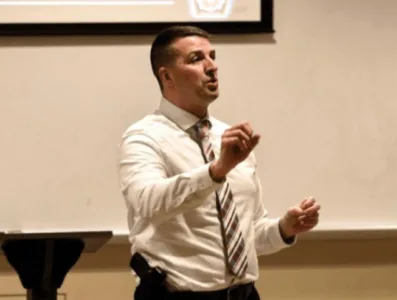
Dunsmore created the framework for what would become PSP's Building Bridges Program, a program which would involve troopers speaking with local groups and organizations in an open-dialogue environment where such topics could be discussed.
Unbeknownst to Dunsmore, the state police command staff in Harrisburg saw a similar need and was already in the process of creating the agency's Office of Community Engagement (OCE) later that year.
Dunsmore was later transferred into OCE and Building Bridges became a key component of the unit. He now conducts approximately 100 Building Bridges presentations across the commonwealth annually.
During the presentations, Dunsmore covers topics ranging from traffic stops, immigration enforcement, qualified immunity, PSP diversity and the use of force among others. He also uses the presentations to dispel misconceptions related to law and police procedures, misconceptions he believes are often fueled by inaccurate information shared on social media.
Dunsmore has a statistically rare perspective amongst law enforcement officers regarding one of the most hotly debated aspects of law enforcement, the use of deadly force, with most police officers never being involved in a deadly force situation during their career.
On Dec. 30, 2016, one of Dunsmore's colleagues, Trooper Landon Weaver, was shot and killed in Juniata Township while investigating a Protection from Abuse (PFA) violation.
After a large-scale manhunt, the suspect in that matter was located by troopers the following day. When troopers attempted to take him into custody, the suspect produced a handgun and was shot and killed. Dunsmore was one of several troopers involved in the shooting incident.
Dunsmore says he talks about that experience during his presentations if deadly force issues are discussed, which they often are.
Dunsmore says that his Building Bridges presentations are attendee-driven in nature, with audience members guiding which direction the presentations take depending upon what topics they'd like to discuss, making the sessions unique to each other.
"My goal is not to make the audience like or support the laws we enforce or the policies that the state police have, but to help them understand what those laws and policies are," says Dunsmore, who uses contemporary body-camera footage of various incidents to aid with the presentations.
Dunsmore says that he's made his Building Bridges presentation to church groups, student groups, community organizations and at town hall meetings, adding that one of his main objectives is for PSP to "regain trust with the citizens of the commonwealth."
One place that Dunsmore has made several presentations in recent years is Lycoming College in Williamsport.
Edward Robbins is a criminal justice instructor at the college and has invited Dunsmore to his Introduction to Criminal Justice and Criminology class during each of the past several semesters.
Robbins says that Building Bridges allows his students to discuss various topics openly and "encourages them to be critical thinkers," adding that he asks for student feedback after each guest presenter he hosts, and that the feedback for Trooper Dunsmore has been "very positive."
Robbins described Building Bridges as "one of a kind," adding that "it's necessary given our country's current feelings that communities have between them and the police, sometimes warranted, but sometimes media-driven."
During last Spring's semester, Robbins collaborated with the college's leadership, fellow instructors and student organizations to open one of Dunsmore's presentations to all of the student body, not just the criminal justice students.
One of the organizations that arranged for the event was Lycoming College's Black Student Union (BSU), an organization, according to Lycoming College's website, which was "established to expand Black awareness on campus" with the goal of extending "outreach to all students and faculty alike."
At that time, Francine Bacon was the BSU's vice-president, and was involved in coordinating the event with Robbins, the BSU and the college's Latin American Student Organization (L.A.S.O.). Bacon, who is Black, noted that BSU is open to all students, regardless of race.
Bacon, who graduated from Lycoming with a degree in criminal justice, says that although she didn't personally have any negative preconceptions regarding law enforcement, she believes that some of her fellow students and BSU members did, which was part of the reason for hosting the presentation.
Referring to Building Bridges, Bacon said that Dunsmore's presentation helped "provide a better understanding" regarding law enforcement and with some of the topics that were discussed, adding that she learned a lot from the program even though she was a criminal justice major on the verge of graduating.
Bacon, 23, who is pursuing a law degree with the aspiration of becoming a criminal defense attorney, recalls that at the time, feedback from other BSU members was positive and that overall, she believes the presentation was helpful.
Bacon does believe that a "more direct" approach to race and police interactions (during the Building Bridges presentations) could be helpful, adding that she thinks other students would appreciate it.
If you'd like to learn more about PSP's Building Bridges program, you can visit patrooper.com/building-bridges.
Dunsmore partners with other troopers throughout Pennsylvania to conduct the presentations and urges anyone interested in scheduling a Building Bridges presentation to email him at jdunsmore@pa.gov