
Peeking at the past: Notable figures from Clinton County history
Trending
From Staff Reports
LOCK HAVEN -- Throughout America's 250 years, Clinton County has produced a number of notable figures. Some that gained national recognition and those who may have stood the test of time right here at home.
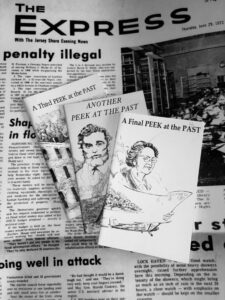
The Express, with assistance from The Ross Library and its "A Peek at the Past" series have outlined just a few of these figures.
PETER MEITZLER
1832-1909
Nobody knows too much about the exact appearance of many of the pioneers who built Lock Haven. There is a picture of Jeremiah Church, the chief founder of the city, as an old man, leaning on his cane; there are tintypes of others, some showing them as young men in Civil War uniform, and there are early photographs of elderly men and women, family groups and proprietors of Main Street stores standing proudly in front of their business places, with their clerks, customers and errand boys.
One colorful citizen of the good old days, however, can still be seen in a three-dimensional representation, which he himself commissioned and paid for and erected to his own memory in Highland Cemetery. His name was Peter Meitzler.
The statue still stands in the old portion of the burial ground, overlooking the city, adjacent to Soldiers' Circle.
Peter Meitzler, mounted on his pedestal, appears to be gazing across the valley, where Lock Haven stretches eastward.
He wears a frock coat, a "Prince Albert," and holds out his right hand as if greeting someone. A sharp observer can see that the hand appears to be slightly mutilated.
That's the point of the story. Originally, it appears, Mr. Meitzler specified that the hand should be carved holding a beer, a pose he felt was appropriate to his position as the proprietor of a hotel, then considered to have one of the best bars in Lock Haven.. Named the Montour House.
Mr. Meitzler had come to Lock Haven after serving on both sides in the Civil War, first in the Union Army and later in the Confederate forces, or, perhaps, the other way around. He earned a wide reputation as a hospitable hotel man and the Montour was the scene of many civic and other public gatherings including the big party thrown in honor of Jerry Church, when he returned in the late 1850s for a visit to his original Susquehanna River town. He came from Iowa, where he had started two more towns.
Peter Meitzler prospered sufficiently, it is clear, to be able to indulge himself in the extravagance of having an Italian carver make him a statue of himself, to preserve his likeness for posterity. The finished statue was shipped to Lock Haven by steamship and rail and was erected in Highland Cemetery, perfect in every aspect, including the mug in the outstretched hand.
The erection of the statue apparently roused stormy passions among some of Peter Meitzler's critics and especially members of the "anti-saloon movement." Versions of the story vary, but the one irrefutable fact is that the stature has held out an empty hand for decades. One account is that a foray was made by grim-faced members of the Women's Christian Temperance Union, accompanied by at least one husband, armed with a sledge hammer. They drove a horse and buggy, or maybe a carriage, up the winding road into Highland Cemetery, and there committed a pioneer deed of vandalism in defense of the principle of prohibition.
Whether this was a demonstration of conviction by the WCTU or some other agency opposed to the blatant display of a granite stein by an innkeeper who wanted to see his monument before he died, or whether it was a mere youthful destructiveness by pranksters who had never seen a stature before, may never be known. It was deftly done, at least -- Peter Meitzler stands oblivious to his empty hand, dignified and impervious, his bearded face and his elegant frock coat giving him an air of undamaged dignity, defying the birds of the air as nonchalantly as he accepted the sabotage of his toast to Lock Haven.
WILLIAM RAYMOND
1892-1966
The 305th Ambulance Corps of the US Army in World War I, organized in Clinton County, was filled with Clinton County recruits, from its commanding officers to its lowliest private. Its equipment was supplied by the homefolks, too. The ambulance and personnel carriers were bought by local contributors, and there was a big turnout when the outfit took off by train for its training camp on Long Island, N.Y., to prepare for rescuing the wounded on the battlefields of France in 1918.
The Commanding Officer, who served with the rank of Major, was Dr. George D. Green, a family physician with no previous military experience. His subordinate officers were also more oriented with the discipline of medicine than to the discipline of military service. The men came from every walk of life and every town and village in the county, but preponderantly from Lock Haven.
The volunteers included William H. Raymond, universally known as Billy, a Black youth whose mother was one of the renowned cooks for the wealthier families of Lock Haven in the time when the big houses built by lumber money on West Water and West Main streets employed cooks, maids, gardeners and men who took care of the horses and drove the carriages.
The 305th Ambulance Unit entered training at Camp Upton, where the men moved into tents to begin learning what the Army was like. It was only a day or two before some questions were raised by the men of other details, who noted the young Black man with the Clinton County boys. Major Green was called to the office of the commandant.
"Where did you get that Black boy?" the Colonel asked.
He's one of us," the major replied. "We are all volunteer recruits. He volunteered and we recruited him. We're all in this together, and we're all from Clinton County, Pa."
"Well it won't do," said the commander. "You'll have to send him off to a Black unit."
That's what Major Green had no intention of doing. When he could get no satisfaction from the highest ranks at Camp Upton, he managed to get permission to go to Washington, where he was admitted to the office of the Chief of Staff, General Summerall.
There he went through his original arguments, and, when recounting the story later, he declared that he pounded the desk of the General and risked court martial for insubordination in his energetic appeal for permission to keep Billy Raymond in his company.
In the end, he won the argument, whether or not he won General Summerall over to his point of view. He went back to Camp Upton with permission to keep Raymond on his roster. To his knowledge, he said, years later, after the 305th returned from considerable service under fire in France, he had the only integrated unit in the armed forces of the United States in World War I.
Meanwhile, Billy Raymond just went about his military duties and did what he was told. His comrades had to deal with numerous queries from the men in adjoining areas of the camp.
When asked about him every few days they'd reply "He's a darn good cook. We brought him along to pep up the army chow."
With that and other impromptu alibis, the boys of the 305th joined in the scheme to keep their outfit integrated.
Billy may not have been such a darn good cook as his mother was, but he did have a darn good voice. Before the 305th took ship for France, a few men of the Broadway theatre came out to Camp Upton to put on an Army show. It was called "Yap, Yap, Yaphank" and Billy Raymond was one of the participants. The show was sponsored by such show business luminaries as Irving Berlin and Eddie Cantor, and several of them complimented Raymond on his voice and invited him to look them up when he came home from war.
Billy had learned to sing as a member of the choir of St. Paul's Episcopal Church, and some members of the congregation thought he deserved a musical education. He attended Ithaca School of Music through their interest and, ultimately, did achieve a career on the New York Stage, especially as a member of the famous Hall-Johnson Choir. He appeared in "Scarlet Sister Mary" with Ethel Barrymore and in a number of Broadway shows.
He returned to Lock Haven after retiring from show business from later work as a manager of a New York apartment house, and employment by the Reid family, owners of the now vanished New York Herald-Tribune.
NELL BURROWS
1889-1961
Nell Burrows, the second of three daughters, disappointed her father the day she was born; he had hoped for a son. He took out this frustration by bringing her up to do all the things he had expected from a boy. She grew up a stocky girl, not unattractive, but given to the mannerisms of a boy, doing the type of errands and outside work allotted to boys in the (18)90s, playing boys' games, but fiercely annoyed by the taunts of the other children who called her "Tomboy Nell."
She had feminine accomplishments, too, as she grew older. She was an excellent seamstress, and had her share of attention from young men, but she wore her hair short, long before it was the fashion, affected rough and ready dress long before casual clothes were in style. She didn't give her swains a tumble and continued, long before anyone had heard of the ERA, to hold jobs normally assigned to men.
One such job was that of a railroad telegrapher during World War I, when so many men were mobilized for the war that women were put to work in jobs left vacant by the fighting men. Nell's job was remote from civilization and not without hazards.
She worked a night shift at the railroad tower on the north side of the river at Ferney. To get there, she had to go to the Harvey Farm, about 15 miles upstream from Lock Haven, and cross the river in a rowboat, returning the same way after the day's work was done. She carried her lunch, packed a gun and made the trip daily, in all kinds of weather, day and night.
To guide herself, in rowing across the river at night, she built a small structure on an outcropping of rocks in the river, where she could place a lighted lantern on the way to work so she could keep to a direct course rowing back in the dark. Faithful and competent, she kept the trains moving between Renovo and Lock Haven by her signals to the trainmen, who praised her as one of the best tower operators they knew.
Her language could be as rough and ready as her garb. When she got dressed up in a white dress and took part in a social activity, however, she shed the rough and ready image and spoke like a lady, as she was underneath the rugged exterior.
She had been the "man of the family" from the time of her father's death, which occurred while his daughters were all young. Nell's education beyond the public schools was mostly self-training, for she could learn whatever she decided to know. Her two sisters were educated as teachers, and the older one, Belle, was recognized as an early expert in education of deaf children.
Finally, all three girls were living together on a farm they purchased several miles from Lock Haven on Renovo Road. Belle set up a loom for weaving in a log cabin structure on the property and the third sister, Ruth, undertook the management of a herd of goats when the sale of goats' milk was encouraged by the belief that it was beneficial in the diet of people with certain illnesses.
Both sisters died, however, and Nell was the last of the family, operating the farm on a small scale, looking after the goats, for which had but scanty affection, even running the loom occasionally.
One day, as Nell was herding the goats from the field where they had been grazing to the barn, on the other side of the road, she was having more than the usual amount of trouble with the wayward and capricious animals. She was in the roadway brandishing a stick and trying to keep 20-some goats all moving in the same direction, when a cousin of hers, who was, by then, her next of kin, came driving down the highway in his car.
He slowed down and drove quietly toward the goat herd and its shepherdess. Then, noting that Nell was so intent on her task that she didn't know the car was there, he blew a blast on the horn, as a joke.
It was no joke to Nell. As the goats scattered in all directions, she turned, with fire in her eyes and ire in her tones, and cried: "Just for that, I'm going to take you out of my will."
She did just that!
WILLIAM T. PIPER
1881-1970
William T. Piper, who brought the Piper Aircraft Corporation to Lock Haven after a fire had destroyed the original plant in Bradford in 1936, was a man of decided convictions. These convictions included a devout belief in the principles of the Republican party and an old-fashioned faith in the virtue of hard work.
Senator Joseph C. Clark, Democrat, during his last term in the US Senate, accepted an invitation to give the commencement address to the graduating class at Lock Haven State College. College officials arranged through Piper Aircraft officers to have an airplane pick up Senator Clark at the Washington Airport and fly him to Lock Haven for the campus festivities, and whisk him back to Washington in the afternoon so he could make the trip in one day.
There was a reception for the senator in the hangar at the airport before he took off on the return leg of the flight, and when he and Mr. Piper met at the function, the senator seized the occasion to express his thanks for the ride from Washington and back.
"Don't thank me," said Mr. Piper in a gruff voice which was belied by a characteristic twinkle in his eye. "The boys didn't ask me before they sent the plane for you."
Another visitor, a year or so later, was being escorted through the plant by Mr. Piper, who was showing him the aircraft assembly lines.
Much impressed, the visitor asked: "How many people do you have working here?"
Mr. Piper smiled and launched a wisecrack which has been repeated in a lot of other settings: "Oh, I don't know exactly, but I'd guest about half of them right now."
The same wisecrack was put in the mouth of a character in the "Agatha Crum" nationally-syndicated comic strip, by Bill Hoest.
ANNIE SNYDER
1852-1927
Annie Snyder began to paint as a child, growing up on a farm near Salona, where she first experimented with red barn paint, applied to stray boards. Soon, her talent as an artist was recognized and encouraged, although she was never able to earn a sizable income for the sale of her pictures.
She was a prolific painter, however, a skilled copyist and versatile in her choice of subjects. Although prices were low, she sold many of her works in Lock Haven and vicinity, still-life studies of fruits and flowers, copies and adaptations of classical masterpieces, often done from reproductions she found in books, including religious paintings on the grand scale and occasional portraits.
She was a familiar figure on the streets of Lock Haven, not only in the vicinity of her second floor studio, across East Water Street from the Fallon Hotel, but throughout the town, as she went from house to house, a painting under arm, selling "chances" at 25 cents, to "raffle it off."
Her animal pictures were very popular, especially such domestic animals as the horses, cows and sheep she knew from childhood, but also including wild animals, deer, rabbits and more exotic creatures. She was so successful with her animal paintings that one of her greatest admirers, the late D.K. Shalde, who made an extension of the collection of her works, called her "the second Rosa Bonheur" ranking her next to the famous French artist. Some of her religious paintings were of heroic size and are still to be seen as altar pieces in churches of the area; one of her largest canvases was painted for the East Main Street Methodist Church. Four other very large paintings now hang in the Masonic Temple. Representing the four seasons, they were painted for the late James W. Bridgens, who hung them in the third floor lounge he maintained in his East Main Street store for the comfort and pleasure of his customers.
Although she was one of the most widely known of the artists who plied their brushes in Clinton County, she was a contemporary of several other great abilities and talents. Two men of high professional skill and reputation were Paul H. Welch, of Lock Haven, and George Pletcher, of Blanchard. Their works, more than Annie's, reflected the local landscape, although they also had painted and traveled abroad.
There were a good many amateur painters, too, in her day, including a lady of Salona, whose taste in choosing subjects for her brush was similar to Annie Snyder's. This lady, whose home was far from Annie's, had one of her own canvases hanging in her living room, a fairly large painting of cows in a meadow.
JOHN SLOAN
1871-1951
John Sloan, the famous American painter who won his reputation in New York City, picturing aspects of the real life of people in the slums, saloons and salons of the metropolis, left Lock Haven with his parents, Mr. and Mrs. James Dixon Sloan, when he was five years old.
He returned only once during his lifetime. That was in 1940, when he was invited to speak in the new auditorium of the Lock Haven State College, and to take part in a big local art show housed in the first Stevenson Library.
Sloan and his wife, Dolly, arrived from New York on the Pennsy flier in mid-afternoon and were met at the depot by Dr. Edna Bottorf, head of the Art Department at the college, and Rebecca F. Gross, editor of The Express. They took the Sloans to the Fallon Hotel to get settled, and asked if the visitors would like to take a ride around town before the festivities of the evening.
Dolly was tired and decided to rest at the hotel, but Sloan wanted to see the town and the surroundings, so the editor gave him a guided tour. They rode up the Renovo Road to the Hyner Park. It was a dull November day and the driver commented that it was too bad that all the bright autumn foliage had turned dull and brown.
"Oh no," the artist exclaimed, "this is much more beautiful than that blinding color. I can see more colors in this brown foliage. I'm glad it's November."
Would Sloan like to see his birthplace? Yes, he would. "I've often wondered in what kind of place I was born," he said.
The car stopped in front of 206 North Grove Street, a charming small house of red brick with white trim, standing at the back of a tall brick business building which once had been the site of the J.N. Sloan undertaking and cabinet making business.
"So that's where I was born!" The tone of voice sounded slightly miffed. "I don't like that birthplace. It's too respectable. I was hoping I'd find that I was born in a house that looked interesting, at least. Can't you find me a better birthplace than this?"
The hunt was on. A newspaper editor knows some locales of interesting events, and she took Sloan around the town to look some more, but he was hard to please. Not until they traveled up West Church Street, to the block facing the furniture factory, the oldest industry in town, historically speaking, did he find something that met his standards for his birthplace.
"There it is," he exclaimed as the car slowly passed an ancient and tumbledown house, large and unpainted, weatherbeaten and gray, with a wide porch in front and slanted post holding up a sagging roof. It had been used as a store in the recent past, and a huge dingy thermometer was still clinging to the wall next to the door. Unoccupied and falling apart, it retained an air of raffish dignity, and reflected a checkered past which might have led from long-vanished eminence to the more recent role of neighborhood commerce in groceries and penny candies.
"That's the birthplace I want," said John Sloan, leaning back with great satisfaction. "If anybody ever comes here and asks to see John Sloan's birthplace, bring them here. Don't take them to that neat, smug little house downtown."
John Sloan came back once more. After the death of his wife, Dolly, he lived for a while in Santa Fe, New Mexico, and, later, he remarried again. To his second wife, Helen, he entrusted a special errand. It was to bring his ashes and Dolly's to Highland Cemetery.
During that trip in 1940, he had been enthusiastic about the outlook from the hill occupied by the cemetery.
"I like the view up here," he has said, after settling the matter of an appropriate birthplace. Apparently, he also settled the matter of a final resting place.
GOLDIE KNARR WALKER
1886-
In the spring of 1983, the newest member of the Col. Hugh White Chapter of the Daughters of the American Revolution was Goldie Knarr Walker, 97 years old, of Flemington.
A legend in her own time, and in her own right, in her hometown and in the rest of Clinton County, as well, she had been eligible to join the DAR from the day of her birth, as a direct descendent of Revolutionary General John Philip DeHaas. He had acquired a grant of 809 acres in the "Officers' Survey" of Bald Eagle Valley for his services as a major in the British Army in the French and Indian War.
A native of Flemington, Goldie, married James R. (Pat) Walker, a professional housepainter who also had a master's touch when it came to preparing a clambake. They became the parents of 17 sons and daughters, all of whom grew to maturity as upstanding, civic-minded people, patriotic citizens and industriously productive workers. Five of their boys served in World War II.
When motherhood no longer claimed most of her time, Goldie branched out and her activities soon embraced half a dozen expanding interests. She continued her services to the Methodist church, entered more fully into "get out and vote" concern with politics and served as one of the first nurses' aides at the Lock Haven Hospital during wartime. She helped instigate a big Election Day dinner in Flemington which became so popular that it was a dependable money-raising activity for the church and gave voters an incentive to go to the polls and stay around for the traditional "pot-pie."
After her husband's death, she took on a new activity, becoming a house mother at the Lock Haven State College, where she gave the students the same interested sympathy she had bestowed on anxious patients at the hospital, and enjoyed her contacts with the young until she retired "on age." At that point, instead of curtailing her activities, she took on the Red Cross Bloodmobile and became one of the most dependable volunteers who helped make the blood-donor program a great success.
One July day, the Bloodmobile was due to carry on its program at the Woolrich United Methodist Church. Volunteers, of course, were responsible for their own transportation. When Goldie was notified of the date for this blood-collecting visit, she said she would be there and one of her children would drive her down. When the day came, however, the Bloodmobile visit was postponed for some good reason, but the word did not get around to all the volunteers, including Goldie and a number of others.
A carload of "the others," driving to Woolrich about the time the Bloodmobile was due, passed Goldie coming down Park Avenue, walking at a furious pace in spite of the hot July sun, heading away from the church. They commented to each other what a marvel she was to be walking at that pace at the age of 90, and unanimously agreed that they hoped to be half as agile as she when they reached her stage of life.
When they got to the church, they learned of the postponement, and backtracked quickly to offer Goldie a lift. They caught up with her, still stepping lively, at the crossroads where the road from Woolrich intersects with the highway to Lock Haven. She was just about to raise a thumb in the air to hitchhike a ride to Flemington.
"I wasn't going to waste a whole day waiting for someone to come get me," she said, as she climbed in the car.
Well, to get back to the DAR, it was not that she was keeping herself too busy to exercise her eligibility to join that organization of descendants of Revolutionary War patriots. Goldie had decided she was not qualified, on account of the treachery of General Benedict Arnold, and would not risk embarrassment of seeking membership.
General DeHaas had married Betsy Shippen of the Philadelphia Shippens, and Betsy's sister, Peggy, had been the wife of Benedict Arnold. That had no effect on Goldie's eligibility, since she was the descendent of John Philip and Betsy, and shared no taint for anything done by their brother-in-law. It took some years to convince her that she should forget about Benedict Arnold. Finally, last year, Goldie agreed to apply for DAR membership. Her granddaughter made it her birthday present.
SGT. GEORGE DRASH
1890-
Born in Poland, son of a gendarme in the Polish policy agency, George Drash decided to emigrate to America at the age of 18. He curtailed his four-or-five syllable name to "Trash" to help cut down on the red tape at Ellis Island, in New York harbor, while he was going through the routine of immigration.
He had landed in the United States without a friend, without much knowledge of the English language, without much money in his pocket and with a new name. He did become acquainted with a Polish family in New York City, who befriended him and helped him get a job. They also advised him that if he intended to Americanize his name, they would not recommend "Trash." He quickly instituted another change -- to Drash.
As George Drash, he quickly picked up new skills and kept himself going in the New York area until 1912, when he came to Lock Haven as a track walker for the New York Central Railroad.
While he walked the track, looking for loose spikes or broken rails, he carried a dictionary and practiced the pronunciation and use of English words and, in this way, mastered the basics of the language.
Always interested in music, as soon as he got a little money ahead, he bought a trumpet for $10, and became a member of the famous Nypen Band, subsidized by the paper mills, then the New York & Pennsylvania Company.
With the outbreak of World War I, he was inducted into the U.S. Army. When his officers found out that he could speak Russian, he was shifted into Army Intelligence and sent to Shkalova, in Siberia, where, according to George, the mercury in the thermometers occasionally shrank to 70 degrees below zero. The Army soon recognized his musical talent too and made him the regimental bugler, although he found that it takes a lot of puffing to get a good note out of a bugle at 70 below.
Between his duties as an interpreter and the tasks of blowing "reveille" at 6 a.m. in the coldest weather he had ever known, George traveled extensively through Russia until he contracted pneumonia and was reassigned to the Philippines as a bugler. There he acquired another talent, that of a telegrapher, and, when he was discharged in 1922, he came back to Lock Haven to work for Western Union. The telegraph office was then on N. Grove St.
By this time, George had acquired a taste for the military life, early rising and all. He joined the National Guard in 1924 when the Lock Haven-Clinton County unit was part of the 103rd Cavalry.
It was back into the regular army for him, in 1941, when a new war broke out. The Cavalry was wiped out a year or so before the attack on Pearl Harbor. Troop F, like the rest of the regiment, was retrained as artillery. Sgt. Drash continued as a bugler, however, and practiced his skill in that role when the troop went to Camp Drum in New York for a readiness exercise.
President Franklin D. Roosevelt visited the camp to inspect the troops, and it was Bugler Drash who called them to attention to march in review before him. A little later, when the newly-fledged artillerymen were on maneuvers in Louisiana, umpired by Lt. Col. Dwight D. Eisenhower, it was again Sgt. George Drash whose faultless bugle calls rang clear across the countryside to guide the troops in their performance for the future President.
Later, near the end of the War, there was a Service of Remembrance at Princeton University in honor of the alumni whose lives had been lost in the nation's wars. Donald W. Griffin, Alumni Secretary, a former officer in the local National Guard, invited Sgt. Drash to come and play the bugle. President Harry Truman attended the ceremony and listened to the plaintive, mournful notes of "Taps" from Drash's bugle. He left with tears in his eyes.
The Guardsmen spent the year before Pearl Harbor in training for what might come next, for the war was already being bitterly fought in Europe. They were awakened in the morning, called to meals and put to bed with the bugle calls of Sgt. Drash. Col. Sam Wolfe of Lewisburg, regimental commander, often said to him, "George, when I'm not here, you're in charge."
In the last year of the war, 1945, President Roosevelt died suddenly at Warm Springs, Ga., and his military funeral was planned swiftly. Gen George Marshall alerted George that he should be there to play "Taps." George quickly boarded a train for Washington, D.C., not realizing that the funeral would be at Hyde Park, N.Y.
So George missed the opportunity to play the last bugle call for his Commander-in-Chief. It may have been the biggest disappointment of his life.
He's 93 now, but George still plays the bugle for many a military funeral wearing his last government issue-uniform and raising his Army-issue bugle to his lips with pride, glad he is still able to pay this last tribute to his comrades-in-arms.
ANNIE SNYDER
(1852 – 1927)
The first automobile in Lock Haven was imported by a leading dentist, Dr. Thomas B. Stewart, who had it shipped in by rail, with instructions for its operation, which he read carefully before steering it out into the public streets.
In a short time, others acquired "motor buggies" and the dirt-surfaced roads of Clinton County began to see more motor traffic. Most of the enthusiastic drivers wore long light-weight coats, called "dusters" for obvious reasons.
One of the young men who acquired a horseless carriage in the early years of the present century was the artist, Paul Welch.
A talented young man who painted numerous oil and water landscapes in Lock Haven and vicinity, which he sold to local admirers. Mr. Welch also went to Europe in his youth, on a sketching trip to Ireland, bringing home an attractive harvest of art, some of which doubtless still hangs in Clinton County homes.
He was one of several practicing artists who were at work in Clinton County, including Miss Annie Snyder, who had begun painting as a young girl living on a farm near Salona, using red barn paint for her earliest efforts.
She became an accomplished artist, with little benefit of professional instruction. She remained a complex personality of conflicting traits and often surprising reactions to people, places and events, in short, something of a "character" as well as something of a genius.
For a time she maintained a painting studio in Lock Haven, on the second floor of the old building which once stood on the municipal parking lot across from the Fallon Hotel on East Water St.
About the turn of the century, she was a teacher of art at the Central State Normal School.
About the time of the First World War she was a familiar figure about town, usually dressed in a long black skirt and matching shirtwaist or coat, carrying one of her paintings from house to house, selling chances. Many homes in Lock Haven displayed her still-life flower and fruit paintings, or a scene copied from some famous masterpiece of art, which had been won in these raffles, her most profitable means of selling her works.
Annie's first ride in an automobile was provided by Paul Welch, who was driving from Mill Hall to Lock Haven one day when he saw her carrying her painting equipment with a picture under her arm, walking by the side of the road, making her daily trip to Lock Haven. He stopped his car and invited her to finish the trip with him.
She accepted the invitation somewhat doubtfully, and he proceeded toward Lock Haven circumspectly. At the top of the Bellefonte Avenue hill, however, he yielded to temptation and decided to give his passenger a thrill.
Boasting that the car could travel at a terrific speed of 15 miles an hour, he proceeded to demonstrate by opening the throttle. The car picked up speed and rolled rapidly down the hill, with Annie Snyder, clutching her paintbox and picture, and bracing her feet in fear of disaster.
When the car stopped downtown, she gave him no thanks for the ride.
"Darn you, Paul Welch," she cried in an outburst of anger, relief and embarrassment. "You scared me so much I wet my pants."
REBECCA F. GROSS
Rebecca F. Gross was born in Lock Haven, April 27, 1905. After graduation from Lock Haven High School she attended Temple University Journalism School, serving as student editor of the University News her sophomore year. She spent her college vacations working for the Lock Haven Express, joining that newspaper in 1925 after her college graduation.
In 1931 she became managing editor in charge of all news gathering and editorials until her retirement in 1970.
She played a leading role in the organization of the Pennsylvania Women's Press Association and was president for a number of years.
In 1947 she was one of the first two women to be chosen Niemann Fellows at Harvard.
During World War II, she served in the Waves, being released with the rank of lieutenant. She was editor of "Firepower," a Naval Ordinance magazine.
In 1949 she was elected to the American Society of Newspaper Editors. She made several trips to Europe with groups of editors. On the last one in 1953 she was among a group of editors who were the first Americans to visit Europe.
She served as president of the Lock Haven Civic Club, Lock Haven Recreation Board and as a member of the board of directors of the Community Service. She also was on the Board of Directors of the Ross Library. She had become a card carrying member of the Library at age 10.
She had one sister, Lydia Gross, who was a professor at the Lock Haven University. Her brother, John, was lost in the Pacific during World War II while serving as a navy pilot.
ROBERT F. RICH
(1884 – 1968)
Robert Fleming Rich was one of the most highly respected citizens in the United States in the 1930's. Having been the first born son of Michael and Ida Shaw Rich it was a foregone conclusion he would someday be at the helm of the family business started by his grandfather, John Rich.
The John Rich Co. opened in Mill Hall where it flourished for over 30 years. Mill Hall, at the time, was the manufacturing center of the county. Fishing Creek was the essential element, as the velocity of its water there maintained the force that turned the water wheels of many manufacturing plants to receive their power. John Rich was a foresighted merchant, and patented the lumberjack plaid of his woolen material, which is still famous as is all the Woolrich hunting apparel. He eventually moved from Mill Hall to the Old Mill building on Chatham Run. He felt he would succeed if he could build an entire community around his business, so he moved his enterprise to the area where it is now, in the small valley where the village and factory meld together.
The valley was surrounded by forest, filled with game for food and plenty of firewood. A pristine stream flowed through the area which provided power for the mill and plenty of fish for food for the village he hoped to develop. The area was sparsely settled by a few families that were engaged in farming.
When Bob Rich took over the reins of the business in 1930, which was 100 years after his father started it, he changed the name to Woolrich Woolen Mills.
Bob was known as a devoted Methodist and a staunch Republican. His business keenness, common sense in politics and his community philanthropy made him seem like a man of a lost era.
He ran not only the mill, but the community, with the strength of a feudal baron. It was often said to work in Woolrich one should be or want to be both Methodist and Republican.
Bob served on all boards of concern in the community. As president of the school board for many years, he interviewed every applicant for a teaching position. Sitting in his office behind his desk, he would keep his eyes hidden behind his steel frame glasses and interrogate the trembling applicants. Always his four questions: "Do you smoke?" "Dance?" "Drink?" or "Play cards?" It was a frightening experience but the Woolrich schools always had a splendid faculty.
Besides leading the family business and the community, he became the choice of the Republican Committee to run for Congress. He won his first attempt in the political arena, and served continuously from 1931 to 1951, serving under the most liberal Democratic President, Franklin D. Roosevelt, our country had ever known.
During these years Roosevelt tried to push through many expensive programs. With the United States just recovering from the most devastating depression ever known, Robert Rich was determined to keep the country solvent. To make his opinion known he had a familiar battle cry, heard frequently. This famous remark, never to be forgotten, is credited with defeating many of Roosevelt's proposed liberal agencies. It was: "Where are we going to get the money?"