
The Pine Creek Declaration of Independence: Remarkable coincidence or enduring legend?
Trending
JERSEY SHORE -- Across 140 miles of untamed Pennsylvania wilderness, frontier settlers and colonial leaders reportedly arrived at the same revolutionary conclusion on July 4, 1776.
As the story goes, on the West Branch of the Susquehanna River in what is now Clinton County, a group of illegal settlers known as the Fair Play Men gathered on that day to declare independence from British rule, unaware that delegates to the Continental Congress were doing the same in far-flung Philadelphia.
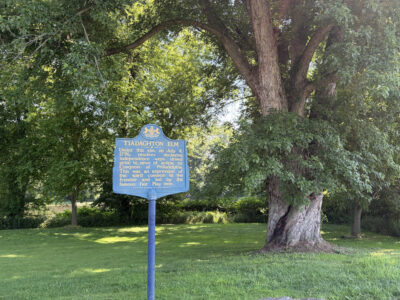
Whether a remarkable coincidence or frontier folklore, the story has taken root in Jersey Shore, where the memory of the Fair Play Men's declaration under the bygone Tiadaghton Elm has been woven into the borough's identity two-and-a-half centuries later. The borough seal features the fabled tree, and a mural overlooking downtown's Veterans Park depicts the moment the Fair Play Men are said to have gathered beneath its branches to declare independence. Each Fourth of July, that legacy is honored during a week-long Town Meeting, which includes a procession and reenactments commemorating the Fair Play Men and the Tiadaghton Elm.
But long before the Tiadaghton Elm became a symbol of local pride, the region was at the center of a struggle over land, power and settlement.
The French and Indian War, the North American theater of the global Seven Years' War, grew out of long-standing French and British competition for control of the colonial frontier. Both powers, along with colonial settlers and Native American nations, sought to expand their influence across the contested North American interior.
The war ended with the British Empire in control of a vast new territory, but victory created new problems. The Crown now faced the challenge of governing and defending a greatly expanded frontier, while also managing strained relations with Native American tribes and paying down the costs of the war. To address those pressures, the British Crown issued the Proclamation of 1763, which barred colonial settlement west of the Appalachian Mountains.
The empire's new policies angered many colonists, who resented both the restrictions on westward expansion and the expectation that they help fund imperial defense. Those tensions became part of the broader buildup to the American Revolution.
Persistent disputes over western settlement boundaries eventually led to the Treaty of Fort Stanwix, which sought to more clearly define the frontier.
Under the 1768 treaty, British officials negotiated with the Iroquois Confederacy to cede claims to lands in Pennsylvania and New York, opening much of the region to colonial settlement, including what is now present-day Lycoming County. However, some of the treaty's borders were disputed by the settlers and native people.
One point of contention centered on a western boundary defined by "Tiadaghton Creek." "Tiadaghton" (pronounced ty-a-DOT-un) was the name the local Iroquois used for Pine Creek. Colonists argued the boundary referred to what is today accepted as Pine Creek, farther west, which would allow them access to more land. Indigenous nations, meanwhile, maintained it referred to Lycoming Creek, farther east.
According to "A Picture of Lycoming County" published by the Lycoming County Commissioners in 1939, "This was the state of affairs until the treaty of 1784, when the Indians finally admitted that Pine Creek was the Tiadaghton."
But for 16 years, the disputed land between these two tributaries was, in effect, Indian land and was recognized as such by the Provincial Government. While colonial authorities had forbidden settlement there, "a number of fearless Scotch-Irish settlers from the lower counties and from New Jersey had come up the river and squatted near the mouth of Pine Creek."
Those settlers from New Jersey, another story goes, are said to have given Jersey Shore its name, but that's a tale for another time.
According to historical records, the exceptional fertility of the soil proved compelling enough to attract settlers despite the risks of Indigenous attack and conflict with the colonial government.
Settling in territory claimed by Native Americans, they had no recourse to the Pennsylvania colonial government, so for protection, they established a simple form of self-government known as the Fair Play System.
Under this system, three elected commissioners adjudicated land claims and other disputes among the settlers. While most rulings involved property issues, they also handled civil and criminal cases within the territory.
On July 4, 1776, the commissioners were Bratton Caldwell, John Walker and James Brandon, according to "A Picture of Lycoming County." Because these are the only known names, historians inferred that the system was governed by these three commissioners throughout its existence.
The Revolutionary War had begun in April 1775, and many frontier settlers volunteered for service in the Continental Army, as sentiment in the region was largely supportive of independence in response to colonial restrictions on western settlement.
On that fateful July day in 1776, a town meeting was held less than a mile from the mouth of Pine Creek, just over the present-day Clinton County line, beneath a stately elm tree more than seventeen feet in circumference and estimated to be roughly 300 years old. The site lay west of Pine Creek, in what was clearly defined Native American territory. After extensive discussion and a series of patriotic speeches, the settlers passed resolutions renouncing allegiance to Great Britain and declaring themselves free and independent, historians said.
According to historical accounts, they did so at roughly the same time the Continental Congress was adopting the better-known Declaration of Independence in Philadelphia.
Following the meeting, the Fair Play Men gathered at their nearby Fort Horn and selected two messengers to carry news of their declaration to Philadelphia, still unaware of the result of the Second Continental Congress.
The messengers, Patrick Gilfillen and Michael Quigley, Jr., were reportedly ambushed and robbed by Native Americans and later jailed by Loyalists, though they eventually escaped and reached Philadelphia on July 10. The riders are said to have lost their copy of the declaration either during the ambush or while imprisoned, but they later returned with word of the United States Declaration of Independence.
The parallel declarations have long raised a question: was it serendipity attributable to shared revolutionary fervor or a story embellished by generations of retelling? While the legend makes for a compelling patriotic tale, evidence supporting the claim that the declarations were signed simultaneously is scarce.
No original written records from the Fair Play Men or their declaration survive, although later accounts do exist. Two main explanations have been offered for this absence.
The first is that any original documents were destroyed during the Great Runaway of 1778, the mass evacuation of the frontier following attacks by Loyalists and Native Americans allied with the British.
Abandoned settlements were burned during the raids, and some settlers described fleeing at night with the glow of their homes lighting the sky behind them. Fort Horn and most other Fair Play settlements were destroyed. Only one structure in the entire West Branch Valley is said to have survived.
The second explanation is that no records were kept in the first place, in order to avoid incriminating settlers who were occupying territory outside colonial authority. This aligns with what historians understand to have been the informal practice of the Fair Play System.
Whether the most "unparalleled coincidence in the annals of American history" truly happened, we may never know. Either way, the legend lives on -- even if the legendary Tiadaghton Elm, which succumbed to the ravages of old age and disease in the 1970s, has not.