
All aboard? Centre County planners assess interest in local passenger rail
Trending
BELLEFONTE -- Local passenger rail may be coming to the region, depending on the results of a 30-day comment period which has begun in Centre County -- and has less than a week left to go.
The comment period, which ends on Monday, Aug. 17, will tell the Centre County Metropolitan Planning Organization (CCMPO) whether they should look further into the possibility.
The CCMPO is made up of state and local officials who develop planning programs for "urbanized areas with populations of more than 50,000 persons," according to the organization's website. This includes Centre County, but would not include Clinton County, which is small enough to not be mandated to have an MPO.
Nonetheless, a regional change such as local passenger rail could eventually expand to include -- and benefit -- much of the area.
Senior Transportation Planner Greg Kausch that "while (these connections) are not within the scope of the present study," they "may certainly be worth looking at and discussing going forward."
According to a press release, "the Centre County Passenger Rail Access Study is intended to revisit the options and alternatives presented in the 2014 'Keystone West Feasibility Report and Service Development Plan (SDP)' with more of a local emphasis, assess demand for passenger rail service, identify the most sustainable options to improve access and evaluate the willingness and ability of required partners to provide this access."
So far, the CCMPO has published a draft study, which features four possible paths forward that they are seeking community input on.
These options are Direct Passenger Rail, Rail Shuttle, Dedicated Amtrak Connector and Expanded Intercity Bus Service.
Kausch summarized the four plans as including two lower-cost and easier-implentation bus-based options, as well as two more expensive and difficult rail options.
Any of the four would involve "an investment of time, an investment of resources and close coordination across a number of interested parties," Kausch said. However, the impacts each would bring to the region vary with which option is selected.
Direct Passenger Rail
Direct Passenger Rail is the most expensive option listed, both in upfront capital costs and in operating costs. It is also viewed as challenging to implement, and would have a long lead time -- the draft study suggests more than 10 years to get it off the ground.
However, it also has the highest convenience for passengers -- making it the most likely to be a relevant service which people will continue to use -- and it is listed as having the highest level of long-term expansion potential, with lines extending to Lock Haven and Williamsport easy to imagine. For now, however, the direct line is only envisioned as connecting to the Amtrak Station in Altoona.
According to the study, there has been "strong interest" from students and faculty at Penn State, as well as visitors, including tourists and regional commuters. Another advantage is that this would function as a "one seat ride," meaning passengers would not have to transfer.
That being said, the study identifies many challenges. Perhaps most substantially, the sticker price: an upfront capital cost estimate of $250-500-plus million is estimated, along with a continuing operating subsidy of $15-20 million per year.
Other challenges include needing a new station in the greater State College area, including parking; the ownership of the Nittany and Bald Eagle Railroad line itself, which Norfolk Southern currently has operating rights over; needing negotiating agreements with three different railroads; needing to shift freight rail to night-time operation, which will increase freight costs; and operational constraints such as Tyrone having street-running track with 10 mph operating speed limits.
That capital cost estimate would include projects such as right-of-way acquisition, new track construction, signaling and sidings, grade crossing protection and the aforementioned stations with parking.
Rail Shuttle
Rail Shuttle is listed as the next most expensive and complicated option. It is cheaper and easier, nearly across the board, than direct rail.
Expected to launch within 3-8 years, rail shuttle would still offer many of direct passenger rail's benefits, including a one-seat rail connection to the Amtrak service in Tyrone; provide service to multiple Centre County destinations, including Bellefonte; providing more reliable travel than highway traffic, especially during congested times such as Penn State football home games; supports transit-oriented development, especially in areas surrounding stations; attracts riders who might be averse to bus transit solutions; and aligns with future planned Amtrak expansions throughout the Pennsylvania corridor.
Despite lower costs than the direct line, make no mistake: this would still be an expensive and involved endeavor. Estimated capital costs reach $50-150-plus million, with $6-12 million operating costs per year.
Like with the direct line, there are still considerations for rail infrastructure and ownership; track access agreements and dispatch coordination; and the frequency of service and sizes of the shuttles -- which would be expected to run on a 30-60 minute frequency.
Capital costs would be invested into a maintenance and storage facility for the rolling stock, the rolling stock itself, new ADA-compliant stations, track upgrades and expansions, sidings and signaling.
Dedicated Amtrak Connector
Dedicated Amtrak Connector is one of the two low-cost options for alternatives to passenger rail. Costs are listed as "low to moderate," although no specific dollar value is assigned. Costs would need to provide for a fleet of intercity-grade buses, a passenger terminal/boarding facility and ticketing integration.
Operating costs are also listed as "low to moderate," as there would be a contracted service to maintain.
While a dedicated Amtrak connector would come online quite quickly by comparison to the previous two options, within 1-3 years, there is also less long-term expansion potential.
Challenges include the continued operating funding need, with the study citing the previous failures of bus services to/from State College once financial subsidies ended; strong seasonal demand causing issues with providing adequate resources and service levels year-round, and not having too much or too little the rest of the time; schedule coordination with Amtrak; the complexity of ticket integration, which would involve coordinating with various systems, Amtrak and bus services; limited revenue potential as feeder bus routes rarely recover their costs through fares alone; and the vehicle and facility requirements.
On the other hand, as an access strategy, the cost is much lower while connecting Centre County to a preexisting service, it would build on documented, extant demand in the State College area and provides opportunities to partner with Greyhound, CATA, CCOT and other bus services in the region.
Expanded
Intercity Bus
Service
Expanding the intercity bus service is the final listed alternative, which also has a much cheaper capital and operating cost listed compared to the direct rail or rail shuttle options, with capital costs estimated at around $4 million, with operating costs estimated at around $100-150 per hour.
Along with the Amtrak connector, it is listed as one of the highest feasibility options, coming online within 1-3 years.
Costs would be invested in a fleet expansion of four buses; an expansion of the storage facility to hold them; upgrades to the bus terminals; and improvements to Greyhound.
Like with the Amtrak connector, strong existing demand is cited as an advantage, along with lower capital costs and a flexible service frequency which can be adjusted as needed depending on local events, holidays and campus activities. This option would also still allow for regional and Amtrak connections, including a direct line to Harrisburg Transportation Center.
Challenges include operating funding requirements, as previous services experienced financial challenges; issues with roadway reliability, as buses still need to share the road with congestion, crashes, and construction; and service coordination challenges between bus operators, Amtrak, local transit agencies and Penn State.
Four options
for the future
These four options present an array of different options, each with their own ups and downs, benefits and challenges. Community members are invited to weigh on these options.
This specifically includes community members from Clinton County.
"Although the focus of this project is Centre County, we would welcome any Clinton County residents -- or any other residents from outside of Centre County -- who work in Centre County or travel to Centre County for special events or other purposes to share their thoughts also," Kausch emphasized.
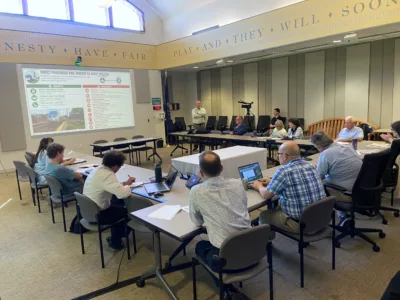
Thus far, the CCMPO held two in-person sessions on Aug. 4, which both received attendance from the general public.
Above and beyond those listening sessions, the CCMPO has received several hundred responses from community members, with well over a thousand being received during a different survey period in the spring. However, more input is always welcome and sought.
And, as Kausch said, "when it comes to transportation, the door is always open to talk about issues of common concern."
Next steps
After the comment period ends, Kausch said, "we are seeking to have the CCMPO Coordinating Committee accept the draft final results and report for the project at their Tuesday, Sept. 22 meeting. All public comment received will be retained for the project record, and factored into the draft final report and other project deliverables."
Following this, the next steps will be weighed based on the feedback received. Regardless of which option the CCMPO ultimately selects -- as informed by the public -- investment and coordination will be required, which will take time to assess and gather.
The public comment period ends the evening of Monday, Aug. 17. Comments may be submitted by email to Senior Transportation Planner Greg Kausch at gkausch@crcog.net, or by the website (www.crcog.net/transportationstudies). You may also call Kausch at 814-231-3050.