
Her Own Way: Local couple celebrates daughter’s first birthday, reflects on challenges and health
Trending
JERSEY SHORE -- When Angel was born at just 23 weeks, doctors weren't sure what the future would hold.
She weighed 15.2 ounces -- small enough to fit in the palm of her father, Jesse's, hand -- and spent the first nine months of her life in a neonatal intensive care unit.
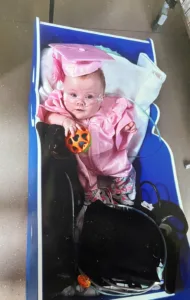
Now, Angel has celebrated her first birthday, and the once-fragile micro-preemie is a happy, curious and determined baby who continues to make progress on her own timeline.
"She's always done what they want her to do," her mother, Jamie, said. "Just on her own time, and in her own way."
That has been the theme of Angel's life from the beginning.
Jamie went into labor when she was only 23 weeks pregnant. Doctors initially worked to keep the pregnancy going, but a week later, Angel decided she was ready to enter the world.
Her delivery was unlike a typical birth.
Because Angel was so premature, she was delivered in an operating room located beside the NICU and immediately taken through a small window to the medical team waiting for her.
Her parents heard Angel cry briefly after she was born -- a tiny sound that provided a measure of reassurance -- but then they waited.
For roughly five hours, they received little information.
"They kept saying, 'No news is good news,'" her mother recalled. "And I'm like, 'That doesn't make you feel good.' At that point, I'd take any kind of news."
When they finally saw their daughter, Angel was wrapped tightly and connected to a ventilator because her lungs were not developed enough for her to breathe independently.
She would remain intubated for five months.
Those first months were filled with procedures, tests, treatments and uncertainty. Jesse and Jamie watched as their daughter fought to grow strong enough to survive outside the hospital.
For about a month, her parents could not hold her.
When they were finally allowed to, it was a carefully coordinated event that required several people to manage Angel's tubes and equipment.
"You sit down and don't move," her mother said. "And you're terrified because all of a sudden you're like, 'Oh my gosh, my nose itches.'"
Her mother, meanwhile, spent virtually every day at the hospital. When she needed somewhere to sleep, she stayed at the Ronald McDonald House near the hospital.
She arrived at Angel's bedside around 7:30 each morning and stayed until her daughter was asleep, returning to the Ronald McDonald House only to shower, eat and get a few hours of rest.
Being present became more than simply providing comfort.
She worked with therapists, learned how to care for Angel and continued exercises with her daughter when therapists could not be there.
For Jamie, being involved was one way she could help her daughter make progress in an environment where so much was beyond the family's control.
One of the biggest milestones came when doctors began considering whether Angel was ready to have her breathing tube removed.
Previous accidental episodes in which the tube had moved out of place had not gone well, making the prospect frightening.
Her mother worried Angel might be extubated before she was ready.
Then one doctor suggested giving her more time -- and trying again under controlled circumstances.
"She was like, 'Why don't we give her a shot today?'" Angel's mother recalled. "And I was like, 'Do you think she's ready?'"
Angel was ready.
After the tube was removed, she did well.
For her mother, the experience reinforced one of the biggest lessons she learned during Angel's hospitalization: parents have to advocate for their children.
"If you think your kid needs extra time, ask for it," she said. "Do whatever you need to advocate for your baby because that's what they need the most."
After nine months in the NICU, Angel finally went home.
But going home did not mean the medical challenges were over.
She still requires supplemental oxygen and receives nutrition through a gastrostomy tube, commonly called a G-tube.
The family also has to manage medications, feeding equipment and a constant schedule of medical appointments.
Because Angel requires skilled nursing care, Jamie said finding appropriate home health support has been extremely difficult.
There is no ordinary daycare option for Angel because caregivers need to know how to manage her oxygen, medications and feeding tube.
The family has learned to carry Angel's medical world with them wherever they go.
They travel with oxygen, feeding supplies, medications and an emergency G-tube kit.
Angel's parents also learned infant CPR before bringing her home.
Her mother believes every parent should be required to learn it.
It is knowledge she hopes she will never need, but knowing what to do in an emergency provides at least some sense of preparedness.
The equipment that once seemed overwhelming has gradually become part of their routine.
Her medications are generally given through her G-tube, often during feeding times so her stomach can tolerate them.
The family once worried constantly about missing a medication, sleeping through an alarm or making a mistake.
Eventually, they found a rhythm.
"It's very frustrating, very overwhelming for parents to be like, 'Oh my God, but what if I missed something?'" Jamie said.
But they learned.
And Angel continued to grow.
That growth has been one of the family's biggest victories.
She has gone from 15.2 ounces at birth to roughly 17 pounds.
Her mother said Angel has consistently followed her growth curve without significant setbacks.
At one point, Angel gained about a pound and a half in one month -- more than doctors expected -- and her mother realized that feeding was becoming one less thing to worry about.
"It's one more thing that you can check off," she said. "OK, this isn't a problem for us. We're doing great on this side."
Her corrected age of 1 will come in December, when Angel would have been due to be born. Her mother hopes some of the skills that have been delayed will begin to develop more naturally as she reaches that milestone.
For now, Angel is still learning.
And learning has always been something she has done in her own time.
Now, she is beginning to explore the world beyond the hospital. She is learning to sit. She is learning to drink. She is learning about food. She is becoming curious about everything around her.
And she has developed a personality.
The baby who once had to be handled with extraordinary care now reaches for anything she can grab, chews on whatever catches her attention and keeps her parents on their toes.
Her family has thousands of photographs documenting the transformation.
Some show a tiny baby almost completely hidden beneath lights, tubes and medical equipment.
In one of her mother's favorite photographs, Angel has pulled one tiny hand free, her fist raised beneath the equipment.
To her mother, it looks almost like Angel is making a declaration.
She's a fighter.
There are still challenges ahead. Angel still needs oxygen and a G-tube. She still has therapies, specialists and appointments. Her parents still have to plan around feedings and medical equipment and think carefully about the environments in which they take her.
But the focus has changed.
For nine months, the goal was simply to get Angel home.
Now, the goal is to help her discover everything she can do once she gets there.
Her progress has not always followed the schedule doctors expected.
But that has become part of Angel's story.
"She's taken her sweet time," her mother said. "That's always been her style."
And after everything Angel has already overcome, her mother has learned not to underestimate what a little more time can accomplish.
"In the beginning, they weren't sure if she was going to make it," she said. "But she did, and now she's great."
Angel's message, her mother joked, might be simple:
"Just give me a little more time. That's all I need."