
Local agricultural leaders hold public information session with KeyState CEO
Seek locally-sourced fertilizer production in light of Hormuz disruptions
Trending
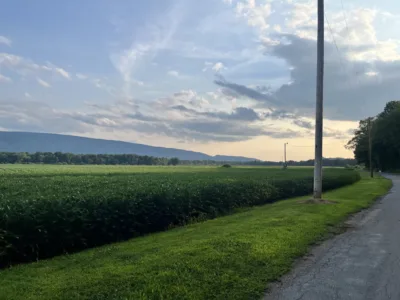
LAURA TARANTELLA/THE EXPRESS
Locally-sourced fertilizer could help farms such as this one, along Rails to Trails near McElhattan, insulate their production from foreign stresses.
LOCK HAVEN -- Farmers and agricultural leaders in central Pennsylvania say a proposed nitrogen fertilizer production facility in Clearfield County could provide a much-needed domestic source of fertilizer while bringing thousands of jobs and significant economic investment to the region -- and it could use natural gas from a site in Clinton County to do it.
Penn State's Ag Progress Days, along with Clearfield, Clinton and Centre County Farm Bureaus, recently hosted a public information session with KeyState Energy to discuss the company's proposed 1-million-ton-per-year fertilizer production facility in Karthaus, Clearfield County.
The project, referred to as KeyState to Zero, would use natural gas produced in Clinton County to manufacture nitrogen-based products, including urea and urea ammonium nitrate, according to an article published by the Clean Air Council. The facility would also produce hydrogen and ammonia, which could be used in fertilizer production or sold as fuel.
If approved and constructed, the project is expected to contribute an estimated $1.3 billion to Pennsylvania's economy. Construction is projected to take about two and a half years, with completion potentially occurring as early as 2031.
For farmers, the project comes at a time when fertilizer prices and other input costs are putting significant pressure on farm finances.
Dan Kniffen, president of the Centre County Farm Bureau, said crop prices have not kept pace with rising production costs, particularly the cost of fertilizer.
Kniffen pointed to disruptions in the global fertilizer market as one factor contributing to higher prices. About one-third of the world's fertilizer shipped by sea passes through the Strait of Hormuz, according to the United Nations Conference on Trade and Development, making disruptions in the region a potential threat to global fertilizer supplies.
Kniffen said urea fertilizer cost more than $1,000 per ton this spring, compared with roughly $350 per ton in recent years. For farmers cultivating hundreds or thousands of acres, he said, those increases quickly add up.
A domestic source for Northeast farmers
Perry Babb, CEO of KeyState Energy, said the company recognized early in its development that producing fertilizer closer to Northeast markets could give the project a competitive advantage.
Babb said the Northeast and Mid-Atlantic have been heavily dependent on international sources of nitrogen fertilizer, including Russia, making domestic production an important consideration for farmers and agricultural businesses.
"So we knew when we began developing the concept, we'd have a competitive advantage on proximity to market in the northeast mid-Atlantic," Babb said while attending Ag Progress Days. "We could displace international imports, and we'd have a competitive advantage on gas feedstock."
Babb previously introduced the KeyState energy project in 2020, with a facility planned for a 30-acre portion of a private 7,000 acre tract in West Keating Township near Frontier Natural Resources' new LNG plant (liquified natural gas). The project has evolved and been re-imagined several times in the ensuing years.
Agricultural leaders at the event said establishing a domestic fertilizer production hub in Pennsylvania could help insulate farmers from disruptions in international markets.
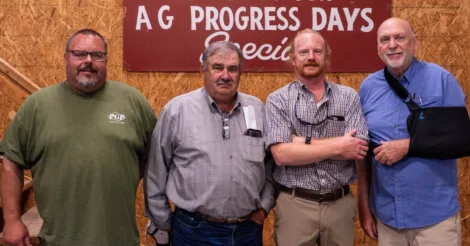
The event also included Clearfield County Farm Bureau President Steve Blackburn, Centre County Farm Bureau President Dan Kniffen and Clinton County Farm Bureau President Cory Chelko.
Beyond fertilizer production, supporters say the project could provide a significant economic boost through construction employment, permanent jobs and increased economic activity in surrounding communities.
Environmental
concerns remain
While agricultural and economic benefits have drawn support for the project, environmental groups have raised concerns about the facility's potential effects on air quality, water resources, traffic and the surrounding landscape.
The proposed development would be located in an undeveloped, forested area associated with PA Wilds. According to the Clean Air Council, the project would involve converting methane from natural gas into hydrogen and other chemicals, including ammonia and urea. Carbon dioxide generated during the process would be captured and proposed for underground storage.
KeyState has promoted the project as an effort to combine natural gas production with carbon capture and hydrogen production. Babb has also suggested the project could help Pennsylvania pursue federal funding connected to the development of regional hydrogen hubs.
The proposed use of carbon capture and so-called "blue" hydrogen, however, has prompted questions from environmental advocates about the technology's long-term effectiveness and potential climate impacts. The Clean Air Council has also raised concerns about the lack of established carbon-storage infrastructure in Pennsylvania and the potential effects of developing roads and rail infrastructure in the area.
Environmental advocates say additional study would be needed to evaluate potential impacts, including the possibility of groundwater contamination or leaks from underground carbon storage.
The project would also require transportation infrastructure capable of moving construction materials and finished products by truck and rail, raising concerns about traffic and development in a region known for outdoor recreation.
KeyState maintains that the facility could help reduce reliance on imported fertilizer while creating jobs and strengthening Pennsylvania's economy. Critics say the environmental and infrastructure impacts require careful scrutiny before the project moves forward.
For farmers, however, the prospect of a reliable domestic fertilizer supply is increasingly important as global conflicts, transportation disruptions and volatile commodity markets continue to affect agricultural costs.