
Will the quarantine effort for spotted lanternfly work?

This shows the spread of the emerald ash borer from Michigan to numerous states, and was created April 2.
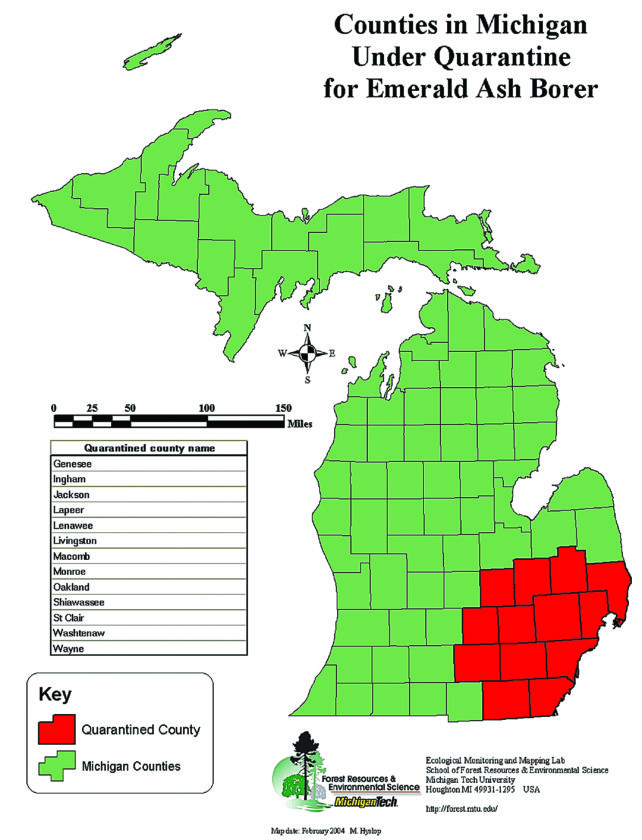
This is the emerald ash borer quarantine map from 14 years ago. It shows the quarantined counties in Michigan, the only state in the U.S. where the pest had been identified in 2004, the year the map was created.
This shows the spread of the emerald ash borer from Michigan to numerous states, and was created April 2.
This is the emerald ash borer quarantine map from 14 years ago. It shows the quarantined counties in Michigan, the only state in the U.S. where the pest had been identified in 2004, the year the map was created.
Trending
For the past few years, I have had several columns on the emerging spotted lanternfly (SLF) issue. If this topic is new to you or you want to refresh your memory on the particulars, I encourage you to visit Penn State's SLF webpage at https://extension.psu.edu/spotted-lanternfly which contains many articles and videos.
Many of us in central Pennsylvania may not be giving this a second thought, as it is out of sight and out of mind. The insect is isolated to the southeast portion of the state and there is an enormous effort to keep it that way. The Pennsylvania Department of Agriculture has imposed a quarantine as one of the approaches to prevent the spread throughout the rest of the commonwealth.
Quarantines are used to restrict movement of material that could carry a troublesome organism from one area to another. But do they work? And will this one be effective in preventing the spread of SLF to all corners of Pennsylvania?
To answer these questions, it might be helpful to look at two recent quarantine efforts in Pennsylvania: for plum pox virus and the emerald ash borer.
Back in 1999, a peach grower in Adams County noticed some odd patterns on ripening peaches. Farmers, researchers, and government officials had never seen this before, and it took a little detective work to determine it was a new disease to the North American continent. Plum pox virus originated over in Europe and somehow made its way to our shores. While not killing trees, it greatly reduces yield and quality of the stone fruits (peaches, plums, cherries, etc.).
To prevent the spread to other fruit-growing regions, a quarantine was put in place where surveys determined the virus's presence. This program prohibited the movement of stone fruit trees and grafting wood out of the regulated areas. Once the containment area was set up, then an effort was employed to remove and destroy infected trees and nursery stock.
Most Pennsylvanians have never heard of the plum pox virus, probably because the quarantine and subsequent eradication effort was so successful. After millions of dollars and the destruction of 1,846 acres, the virus is no longer a concern to the Pennsylvania industry.
But just as successful as the plum pox story went, there was a completely different ending for the emerald ash borer (EAB). This insect was thought to be introduced into North America in the 1990s from packing material originating in Asia. It wasn't until 2002 that the insect was fingered for extensive ash mortality in southeast Michigan. For those who need additional information on EAB, The Emerald Ash Borer Information Network (http://www.emeraldashborer.info/) is a wealth of material.
Just looking at the early quarantine maps and then the most updated version illustrates the difficulty in preventing the spread of EAB. From a few quarantined counties in southeastern Michigan, EAB has spread like wildfire to an area that covers 31 states.
It will be interesting to see how the quarantine effort works with SLF. It will take a lot of money, labor and science (and a little bit of luck) to have this insect follow the path of the plum pox virus rather than EAB.
------
Tom Butzler is a horticulture educator with the Pennsylvania State University Cooperative Extension Service and may be reached at 570-726-0022.