
It’s raining what?
Trending
Insects are all around us. Every day and all year long. Most times they go unnoticed and insects and humans go about their daily tasks. But there are times when the little critters step outside their lane and become a major problem and nuisance. And we are experiencing that extreme insect/human interaction in many parts of central Pennsylvania this month.
Some insects have a pretty specific host range. For example, the emerald ash borer only feeds upon ash trees (Fraxinus sp.) The spongy moth (formerly known as the gypsy moth) has a favorite, oak, but it will also consume apple, sweetgum, basswood, willow, and birch. It will feed upon over 300 species of plants. They are not picky eaters.
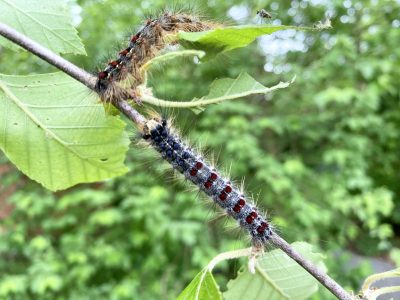
And the spongy moth is munching its way through our forests and landscapes, devouring leaves at a rapid pace. There are some unscientific ways to gauge their population numbers and damage. A glance at the hillsides when driving down the highway, show large patches of brown where there should be a wall of green. Or a walk underneath an infested tree canopy provides a unique atmosphere with the signs and sounds of falling frass (while you may not be able to see the caterpillars eating, their excrement is falling all around and it sounds like it is raining).
Most trees can withstand defoliation which occurs mostly in June. Once feeding is done, the plants can leaf out again and produce enough food to get through the winter and into next spring. But those trees that are under some type of stressor (poor soils, drought, disease issues, etc.) may not bounce back and will die off. Also, very young plants might not have the energy reserve to push out a new flush of growth after feeding.
Spongy moth overwinters in egg masses (about 1,000 eggs) that are covered in fine hairs. These can be located on almost anything (bark, picnic benches, lawn furniture, rocks, etc.). Come May, the eggs hatch and little caterpillars (larvae) emerge. Of course, they don't have wings, but can still move about by ballooning. They spin silk threads that get caught in air currents and they float all over the place. Hopefully to plants to feed upon, but often onto cars, houses, and decks.
Those that are lucky enough to come into contact with a tree or shrub, immediately start to feed. At first, the small caterpillar damage is minimal and only small holes appear on the leaves. Being small, not much bothers them and they just hang out in the canopy. But as they grow, they are more susceptible to predation. To avoid being eaten, they will migrate out of the tree canopy as daylight approaches and head down the trunk to find a hiding place. As nightfall approaches, the caterpillars travel back into the canopy for their nightly buffet. As they grow, their appetite becomes insatiable and they devour everything in sight until the tree is leafless. This is when their presence is widely seen.
At this point, feeding is going to wind down in a week or two and the caterpillars will pupate. After a few weeks, the adult moths emerge, mate and the females lay eggs that will overwinter.
Homeowner options for control are pretty limited. There is not much to do at this point as the feeding cycle is about done. But steps can be taken for next year's possible feeding frenzy. Knowing that the female will be laying eggs, scout later this year for them. Simply scrape off into bags or soapy water. This needs to be done before eggs hatch in April.
Removing egg masses will not give total control as they can balloon in from other areas. Next April, band the tree with a sticky substance to prevent larvae that hatch from low spots from migrating up the tree. Just be careful about catching non-target animals with this method. Consider placing chicken wire over the sticky material.
Another option is a burlap band around the tree trunk. A folding flap of burlap is an excellent hiding spot for migrating spongy moth larvae. Simply inspect the fold twice daily (morning and evening) and scape the caterpillars into soapy water.
And of course, there are several insecticides labeled for spongy moths. If caught early enough (very young caterpillars), then a foliar spray of Bacillus thuringiensis can do the trick. It becomes more difficult to control as they mature and the chemistry will be different. Some products can be injected into the tree which would eliminate spraying.
It is a little easier to apply control measures with larger tracts of trees, especially on Pennsylvania's public lands. This past February, The Department of Conservation and Natural Resource's (DCNR) Bureau of Forestry stated that they would spray 220 sites totaling 209,838 acres. Included will be parts of 14 forest districts, 10 state parks, and sections of the Allegheny National Forest in 20 counties.
DCNR does have a guide available to private landowners on conducting a suppression program for the spongy moth. It might be a good idea to get an idea of what is needed if you feel spongy moths will be a problem for next year, https://www.dcnr.pa.gov/Conservation/ForestsAndTrees/InsectsAndDiseases/SpongyMoth/Pages/default.aspx. Additional information of this insect can also be found at https://extension.psu.edu/gypsy-moth
------
Tom Butzler is a horticulture educator with the Pennsylvania State University Cooperative Extension Service and may be reached at 570-726-0022.
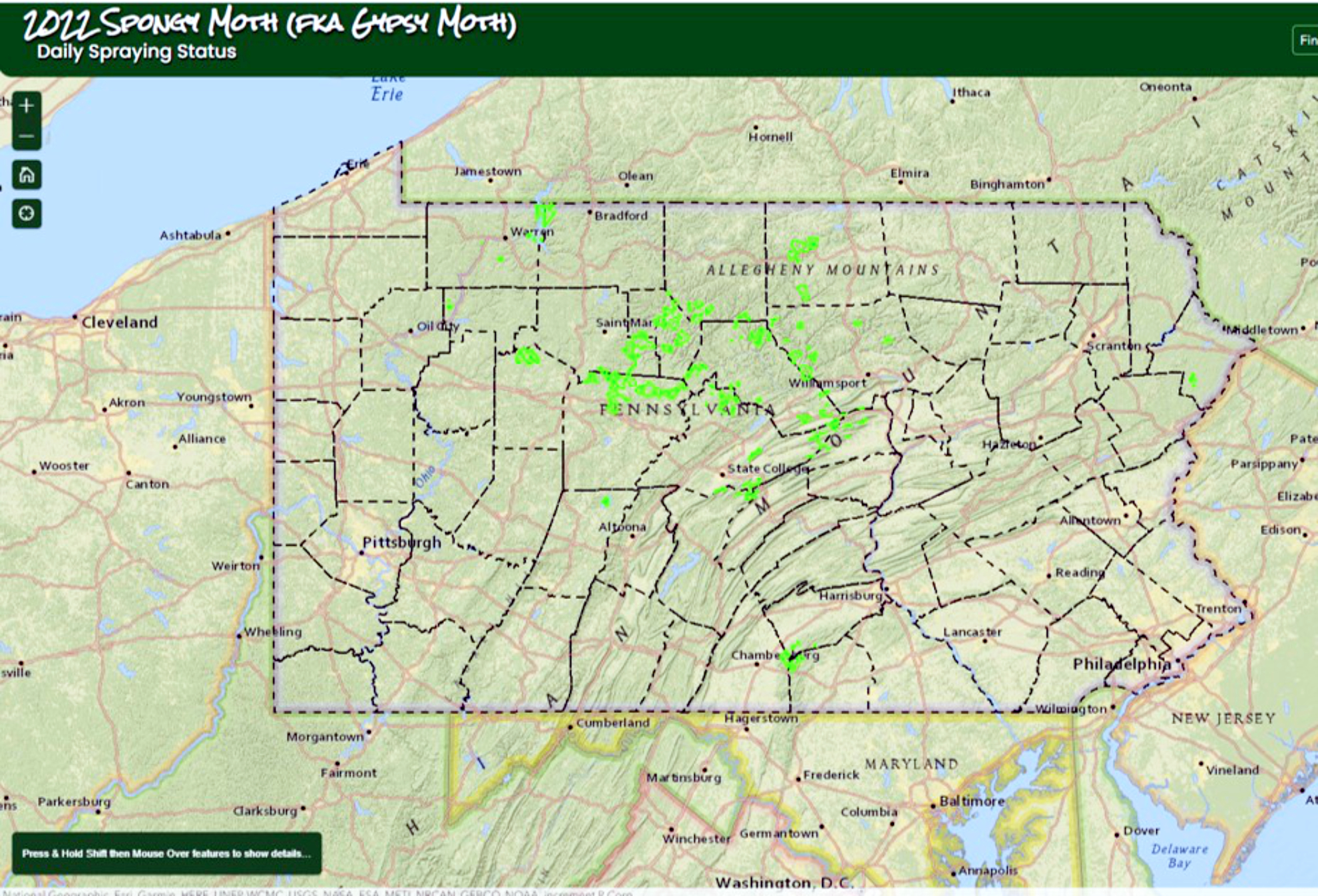
PHOTO PROVIDED
The green represents areas where spongy moth infestation is high and DCNR conducted an aerial application of insecticides.