
Test your fields for Soybean Cyst Nematode right after harvest
Trending
Soybean cyst nematode is the most damaging soybean pathogen in the US. Is it in your fields? Soil testing is one way to find out.
If you are a soybean grower, consider taking soil samples after harvest and have them tested for soybean cyst nematode (SCN, Heterodera glycines). Take advantage of the free SCN testing offered to farmers in PA by the Penn State Extension Agronomy Team and with support from the Pennsylvania Soybean Board.
Why do you have to test your fields?
-- Potential yield losses associated with SCN can reach 50%.
-- The nematode can go unnoticed for many years while nematode populations continue to increase.
-- SCN completes its life cycle on soybean roots and the roots of over 100 hosts.
-- The life cycle of SCN can be completed in about 25 days and ends, meaning that many cycles can occur during the growing season. The life cycle ends with the production of cysts. A cyst is a dead SCN-female-body that contains 200-300 eggs. Cysts can remain in the soil for many years, even in the absence of a host.
-- Long-distance dispersal of SCN occurs through the movement of soil and infected roots carrying cysts and eggs by running water, ag implements, tractor tires, etc.
-- Currently, SCN can reproduce in most soybean varieties with purported resistance to SCN.
Where is SCN?
In Pennsylvania, SCN has been found in the counties with the largest area dedicated to soybean production, Lancaster and York, and seven additional counties.
How do you test the field for SCN?
Soil samples for SCN can be taken anytime during the growing season; however, fall sampling after soybean harvest is the most convenient time. Consider pulling additional samples at the same time you are doing so for nutrient testing to make it easy for yourself.
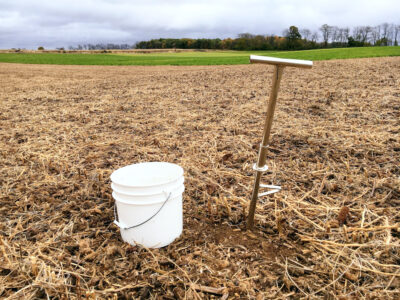
Samples for nematode testing can be obtained by collecting soil cores at a depth of 6-8 inches in a zig-zag pattern. We recommend collecting at least 20 cores for areas of 20 acres or smaller. Samples can also target areas of high risk of introduction, like field entryways, areas prone to flooding, along fence lines, low-yielding areas, near buildings where equipment is stored and high pH areas.
In a bucket, break, mix and homogenize the soil cores and place at least two pints of soil in a sealable bag. Keep the samples away from heat and direct sunlight and put them in a refrigerator (not the freezer) until it is submitted to the lab.
Before submission, ensure the samples are labeled with your name, phone number, email, address, field address or GPS coordinates, current crop, previous crop and acreage. More details about sampling procedures can be found on The SCN Coalition website.
If you want to take advantage of the free nematode testing, send the samples to:
Dr. Dilooshi Weerasooriya
Department of Plant Pathology and Environmental Microbiology
211 Buckhout Lab.
The Pennsylvania State University
University Park, PA 16802
Add a note to the mailing box that reads "For SCN testing."
If you have questions about the free testing program, feel free to contact Adriana Murillo-Williams (axm1119@psu.edu, phone 814-359-7483), Paul Esker (pde6@psu.edu), or Alyssa Collins (aac18@psu.edu).
You can also contact your local Penn State Agronomy Extension Educator for more information about the sampling program.
For more information about soybean cyst nematode, visit The SCN Coalition website, www.thescncoalition.com.