
Trending
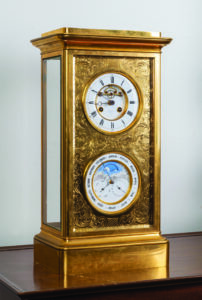
Happy New Year! When the clock strikes midnight on Jan. 1, it's time to open your new calendar and look ahead. Or maybe you have a clock like this one, with a built-in calendar.
Calendar clocks were developed about 1850. That's about when this one, which sold for $5,100 at Cottone Auctions, was made. Its rear movement plate is marked for Constantin-Louis Detouche (1810-1889), a famous Paris clockmaker in the 19th century. He worked for his father's clockmaking business until 1830, when he started his own. He was later appointed official clockmaker to Napoleon III, who was crowned emperor in 1852.
Detouche sold clocks and scientific instruments, and he was known for the precision and craftsmanship of his creations. This clock's perpetual calendar dial is said to automatically correct for the days of each month, even in leap years. It was Detouche's own design.
* * *
Q: I am wondering if you can help us with finding any information about a bear fur coat and a possible value? I have been unable to locate any background information. The coat belonged to my grandfather who lived in North Dakota. He did work in Alaska for a time in the late 1920s. The coat is in excellent condition with no obvious wear marks. Its tag reads "Made by Boultier Redmond Limited Montreal Winnipeg."
A: Boultier Redmond was a Canadian clothing manufacturer and wholesaler. The name was used by the 1920s, but the company may have been operating under different names as early as the 1870s. The company liquidated about 1930. This aligns with the time your grandfather would have been in Alaska. We have seen similar bear fur coats sell for about $300 to $500 in excellent condition and between $100 and $200 with signs of wear. If you are planning to sell yours, check your state laws first. Some states have very strict laws about what kinds of fur can be sold.
* * *
Q: I purchased this train at a tag sale 10 years ago. My grandsons have outgrown it. I have looked several places and cannot find anything on this train as to a value. The train tracks are mounted to plywood and can easily be carried. The train is made of wood and not painted. The top of the box reads "Eichhorn Holz-Gartenbahn."
A: Your train was made by Eichhorn, a German company founded by Hermann Eichhorn in Bavaria in 1949. The company made wooden toys, starting with puzzle blocks. They were making wooden railway toys by 1950 and made their first train and track sets in 1961. Their early train sets were painted, but in the 1970s, they started making unpainted trains from natural wood. Around this time, they also started using synthetic material for their tracks and replaced their hook-and-eye train couplers with magnets. In the 1980s, they returned to painted trains and real wood tracks. The company became part of the Simba-Dickie Toy Group in 1998 and is still in business today. They appeal to today's customers by promoting wood as a safe, sustainable material for toys. Vintage Eichhorn toys tend to sell online, in shops or at auctions for under $50.