
Art nouveau is distinctive, but has many names
Screenshot
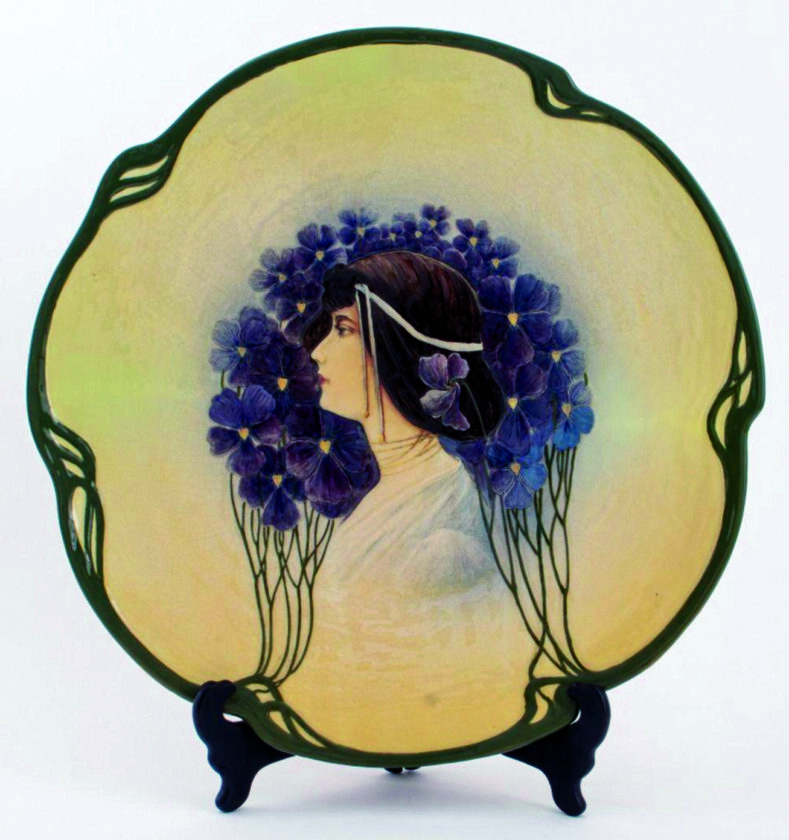
With its soft colors, flower motifs and asymmetrical twining lines, this ceramic charger, made circa 1900, fits right into the art nouveau movement. However, when it sold for $2,500 at Auctions at Showplace, it was described as “Jugendstil.” German for “young style,” named after the journal Die Jugend, it is the German term for what we call art nouveau.
The style, a precursor to modernism, spread throughout Europe with art galleries like the eponymous L’Art Nouveau, opened by German-born Siegfried Bing in Paris; exhibitions, especially the 1900 Exposition Universelle and, above all, graphic design and illustrations in popular books and periodicals. The movement intended to break down the barriers between fine and decorative arts. It certainly transcended national borders, known as “Art belle epoque” or “Art fin de siecle” in France, “Art nuova” or “Stile floreale” in Italy, “Stil’ modern” in Russia, “Sezessionstil” in Austria and Hungary, “Style nouille” in Belgium and “Modernista” in Spain.
——
Q: This vase has been in my family since “whenever” and there is no story behind it. It is 9 inches tall, about 6 inches at the opening and 4 inches at the base. The glass is thick with some bubbles. The main picture is “the Dickens house” and the two figures on the side of the house are Sam Weller and Tony Weller. On the reverse is The Fat Boy. I would appreciate any information on it, though I have treasured it in its unknown state since it was passed on to me.
A: “The Dickens House” is another name for the Dickens Museum, located at 48 Doughty Street in London, where Charles Dickens lived with his wife Catherine from 1837 to 1839. He became a celebrity during that time, finishing his novels “The Pickwick Papers,” “Nicholas Nickleby” and “Oliver Twist.” The Dickens Fellowship, an international society of Dickens fans founded in 1902, purchased the house in 1925. Today, it is a museum, complete with a gift shop called the Curiosity Shop after Dickens’ 1841 novel. We suspect that your vase was a souvenir sold at that shop, although we have not confirmed a date or maker. Similar vases usually sell for under $50.
——
Q: I have some unusual Disney items from my grandmother’s house. They are round, flat pieces either 3 or 7 inches in diameter with character faces on the front. The reverse says, “Exclusive designs of Walt Disney Characters / Made Expressly For Geo. Borgfeldt Corporation 44-60 East 23rd Street, New York.” I don’t know what they are. Can you help?
A: George Borgfeldt & Co. was an importer and distributor in New York City that operated from 1881 to 1962. In 1930, they were granted the first license to sell Disney merchandise. This included toys, figurines, decorations and children’s dishes. The company sourced them from manufacturers in the U.S., Europe and Japan. Your items may be toys or decorative plates. Disney items marked for George Borgfeldt can be worth hundreds of dollars today. For more information on Disney toys and their prices, the Official Price Guide to Disney Collectibles by Ted Hake (Gemstone, New York, 2005) is an excellent source.
——
TIP: For emergency repairs to chipped pottery, try coloring the spot with a wax crayon or oil paint. It will look a little better.
——
Terry Kovel and Kim Kovel answer readers’ questions sent to the column. Send a letter with one question describing the size, material (glass, pottery) and what you know about the item. Include only two pictures, the object and a closeup of any marks or damage. Be sure your name and return address are included. By sending a question, you give full permission for use in any Kovel product. Names, addresses or email addresses will not be published. We do not guarantee the return of photographs, but if a stamped envelope is included, we will try. Questions that are answered will appear in Kovels Publications. Write to Kovels, (Name of this newspaper), King Features Syndicate, 628 Virginia Dr., Orlando, FL 32803 or email us at collectorsgallery@kovels.com.