
You can make your own memory jug, but antiques command premiums
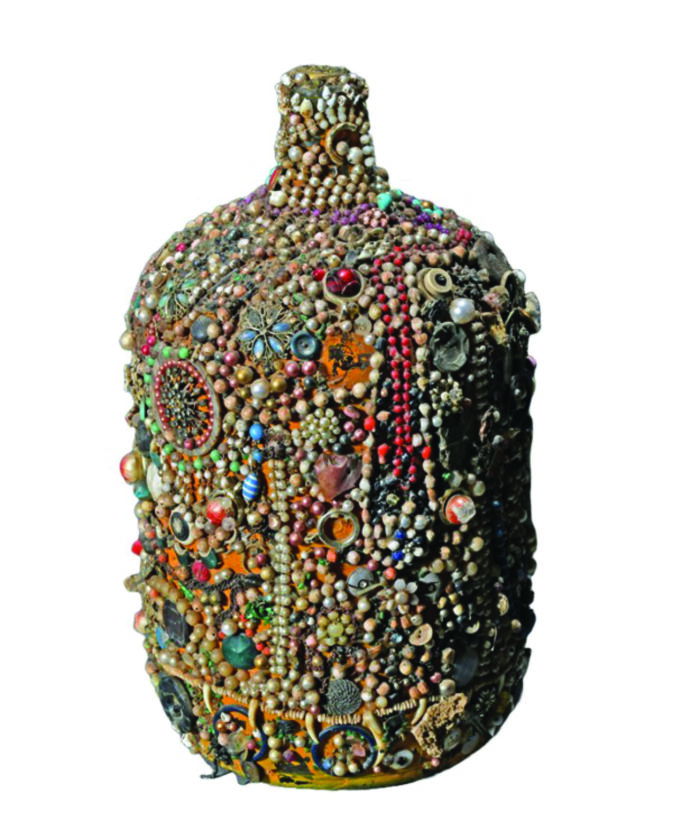
Can you put a price on memories? This memory jug sold for $1,125 at Slotin Folk Art Auction. Memory jugs like this one, with decorative items embedded into the surface, are a famous African American art form. They are believed to have originated in Central and West African traditions, where graves are decorated with broken objects or vessels of water.
Broken objects are said to represent the breaking point between the afterlife and the land of the living, allowing the deceased’s spirit safe passage. Water was believed to be the path to the spirit world. Enslaved Africans continued practicing their traditions in the United States, adapting them to the resources that were available and teaching them to their descendants.
“Memory jug” came to mean a jug or similar vessel coated in a layer of clay with small decorative items, like buttons, beads, keys and shards of glass or pottery, pressed into it while it is still wet. The one pictured here, made by an unknown artist, is covered in beads and bits of jewelry. The art form spread outside African American communities in the 19th century, fitting in well with Victorian sentimentality.
Today, crafters can easily find instructions for creating their own memory vessels; not as grave markers, but as a way to use and display tiny trinkets, souvenirs, and found objects, like a three-dimensional scrapbook. In this case, “memory” refers more to mementoes than to memorials. Still, when talking about an art form that preserves memories, it is especially appropriate to keep its origins in mind.
——
Q: I have an antique upholstered chair that I believe is from the late 1800s. I’m sure it has been reupholstered since then, and I would like to restore it to its original appearance. How can I find out how it originally looked and have it restored?
A: It will probably be difficult to determine how your chair originally looked. Your best chance is probably to consult a furniture restorer in your area. If you know the chair’s manufacturer, you may be able to find one of their catalogs that would have information about the chair’s original design. There are many antique furniture catalogs that have been scanned and made available online.
You are right that your chair has probably been reupholstered since the 1800s. Upholstery is subject to fading, wear and tear, and people have been altering antique furniture to fit contemporary trends for hundreds of years. Victorians had additional decorations carved into earlier, plainer styles; the 20th century saw the removal of these decorations to fit the simpler modern aesthetic; and today’s thrift shoppers look for inexpensive vintage and antique furniture to repaint or reupholster as they please.
A tip for those of you who decide to reupholster old furniture: Save a piece of the original fabric, put it in an envelope, and tape it to the bottom of the seat. Not only will this let a later buyer know about the original fabric, but it will also increase its value.
——
Q: My porcelain tea set has an unusual mark on the bottom of the pieces. There is a row of Chinese characters, and underneath it reads “Made in China.” I have not seen a mark in both Chinese and English anywhere else. Can you tell me the significance? Does it mean anything about the value?
A: The mark helps date your tea set. Items imported by the United States were required to be marked with the name of the country of origin in the 1890s. The words “Made In” were used by the 1910s. Marks like the one on your tea set, written in both Chinese and English, were common in the mid- to late-20th century. The Chinese characters also mean “Made in China.”
There are many variations of these marks; for example, some have the characters written in a straight line, and some in an arc. Sometimes the mark includes a number or letter to identify the date or pattern. Because your tea set was probably made within the last 50 years, based on the mark, and likely mass-produced for export, it would probably resell for a fairly low price, likely under $100. However, that would depend on the size of the set, its condition, and its pattern.
Columns
Big surprises in the 2030 Census estimates
About a month late, presumably due to last fall’s government shutdown, the Census Bureau has released its ...
A painful story taken without permission
Dear Annie: I’m a senior citizen. Fifty years ago, another young girl and I were in a juvenile detention facility ...
Applause, Applause
Each Saturday, The Express community newspaper highlights people, groups and activities our readers deem worthy of ...
Comparing ICE to the Gestapo lets America off the hook
While Immigration and Customs Enforcement terrorizes our nation, I keep seeing social media posts that compare ICE ...
You can make your own memory jug, but antiques command premiums
Consistency matters: Moral clarity requires it
As I read the commentary across social media, legacy media and the broader public discourse surrounding the latest ...