
Antique porcelain makers and decorators weren’t always the same
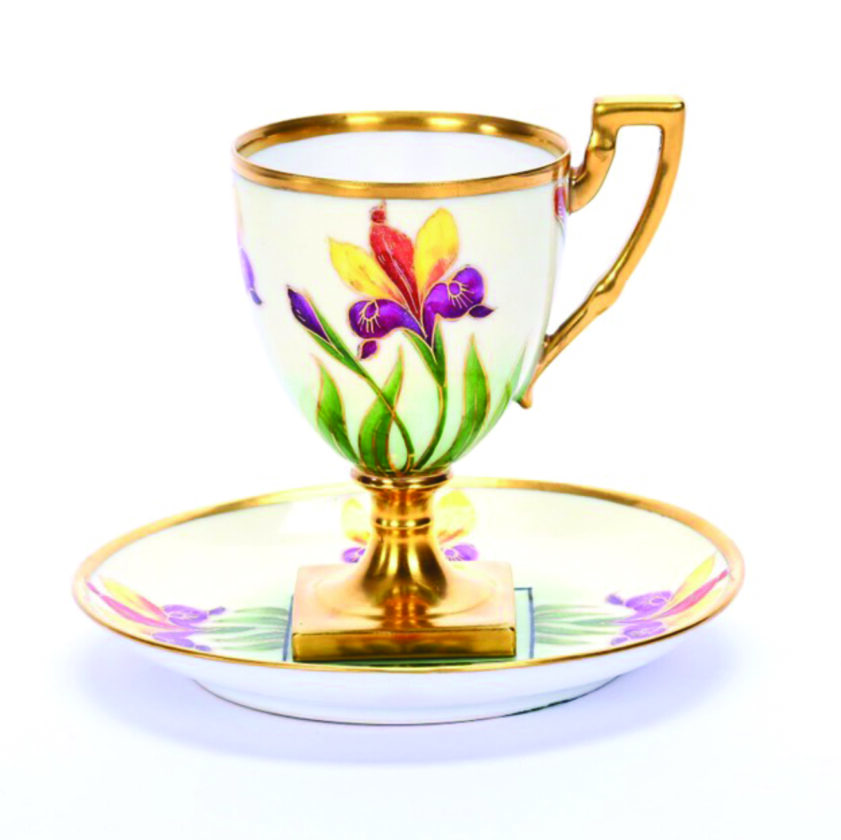
One complication to vintage and antique china sets is the fact that makers and decorators weren’t always the same. Many porcelain manufacturers in Europe and the United States made blank dishes that were sent to other factories for decorating. Some sold the blanks as they were for hobbyists to paint at home. This means that you might see two different makers’ marks in the same set of china; sometimes even on the same piece.
If the decorator signed their work, there might be three. If you turned over this pedestal cup and saucer, which sold at Woody Auction for $120, you would see marks for both Limoges, France, and the E.W. Donath Studio of Chicago, Illinois. The cup and saucer were sculpted in Limoges and exported as blanks to the United States, where the colorful painted irises were added at the Donath studio. Porcelain has been made by many factories in Limoges since the mid-19th century. Edward W. Donath worked for the Pickard porcelain decorating company before starting his own decorating studio in Chicago in the early 1900s.
——
Q: I would like to know about an antique sleigh with a harness that belongs to my mother-in-law. It has wooden runners. The “box” part of the sleigh looks like just that, a box, without the high back or curved sides you see on some sleighs. It measures 36 inches long by 16 inches wide and is 22 inches tall. There is a carved mark on the front that we cannot identify.
A: Based on the measurements you gave us, it sounds like you have a child’s sleigh. The box would be unusual, though; most sleighs have a high back and shaped sides, like you said. They also usually have a seat or bench. Your sleigh might have been made for transporting small amounts of cargo instead. Most of the antique and vintage sleighs you see today date to the 19th or early- to mid-20th centuries. Several new types of sleigh, like the Albany sleigh and Portland sleigh, were invented in the 1800s, and many states and regions had their own sleigh and sled manufacturing companies at the time. Your sleigh has such a simple design, it is difficult to narrow down a date or origin.
A close look at the details of its construction might be able to determine if it was made by hand or by machine and provide clues to its age. (Publications like Fine Woodworking or Popular Woodworking, both owned by AIM, the parent company of Kovels Antique Trader, may have helpful information.) The mark on the front is probably a monogram or similar custom design that may have been put there by the maker or by a previous owner.
The sleigh might have even been homemade, making it truly unique. Making a sleigh or sled for a child was a good way to use up relatively small scraps of wood. They were often painted and embellished with pinstripes or stenciled designs. Today, they are sought as folk art.
——
Q: I have a 6 1/2-by-13-inch plaster plaque made by Morris Studios Boston. I cannot find any information about it. There is a group of babies standing and walking, and one of them has cloven hooves and pulls a reluctant dog. There is part of a paper label on the back of the plaque that reads “Opus Pictum.” When was it made? Did they make other plaques with a similar theme?
A: Your plaque is by Frederick Parsons, an artist from the early 1900s. Working at Morris Studios in Boston, he made plaster relief reproductions of artworks from museum collections. Some reliefs he made are marked for “Morris” Studios of English Arts and Crafts, with “Morris” in quotation marks, indicating that the studio was named after William Morris of the English Arts and Crafts movement, but not formally associated with him or part of his company. “Opus Pictum,” meaning “painted work,” is the term Parsons used for his multicolor painted plaster.
Your plaque is probably a copy of a relief sculpture by the French artist Clodion, or Claude Michel, who lived from 1738 to 1814. He made terra cotta sculptures and relief panels inspired by ancient Greek and Roman mythology. They have been reproduced by many artists in the 19th and 20th centuries. One of his reliefs, known as “Children with Satyr and Dog,” has a scene like the one you describe. The procession is part of a celebration in honor of Bacchus, the Roman god of wine and festivity (Dionysus in Greek mythology). The baby with cloven hooves is a satyr, a part-human, part-goat creature associated with Bacchus. The scene may have been one of the Bacchanalia-themed reliefs that Clodion designed for the hotel de Bourbon-Conde in Paris, a home commissioned by a branch of the French royal family.
Columns
Losing irreplaceable community assets
I don’t drink coffee, and yet I’ve been wanting to write about Viennese coffeehouse culture for quite a while ...
Applause, Applause
Each Saturday, The Express community newspaper highlights people, groups and activities our readers deem worthy of ...
Antique porcelain makers and decorators weren’t always the same
Trump stops race to save the Creation
May we talk about spiritual matters? “In the beginning,” the Bible opens, “God created the heavens and the ...
When a dire decision is the only option left
Dear Annie: I’ve had a dear friend for nearly a decade. He has been addicted to meth, heroin, alcohol — you ...
Raising blood pressure levels doesn’t help to protect the retina
DEAR DR. ROACH: I am an 82-year-old woman who was diagnosed with glaucoma about three years ago. I have been taking ...