
Early airplane toys were modeled after real planes
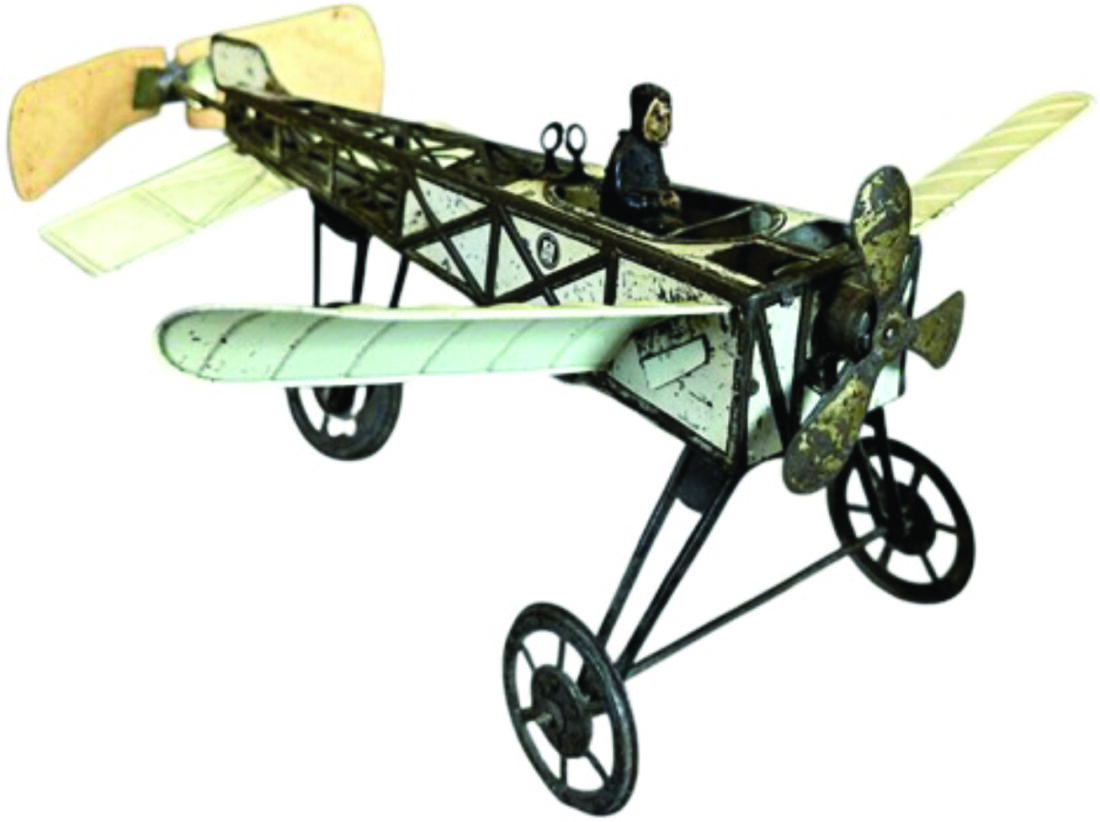
Today’s toy companies might be fueled by flights of fancy, but, in the early days of flight, real-life aircraft were imaginative enough. Many toy airplanes of the early 1900s were miniature copies of existing airplanes, like a windup Bleriot airplane by Gunthermann that sold for $1,080 at Bertoia Auctions.
It was modeled after the Bleriot XI, which, in 1909, became the first airplane to fly across the English Channel. Its pilot, Louis Bleriot, had started his career as an electrical engineer, but, after a long fascination with aviation and several personal experiments, founded his own company to research, design and build aircraft.
After his flight across the English Channel catapulted him to international stardom, many toy companies made copies of his plane that rolled, flapped their wings, spun their propellers, or revolved around a tower. When it comes to toy tributes, Bleriot had an advantage over other pioneering aviators like the Wright brothers: He created the first piloted monoplane, a style that proved much easier for toymakers to copy than biplanes.
——
Q: I would like to know the value of my Libbey wine glasses.
A: The value of your glasses will depend on their age, type of glass, pattern, and condition. Libbey Glass began in 1888 as W.L. Libbey & Son in Toledo, Ohio, and helped Toledo gain its reputation as “Glass City.” The company was a major maker of cut glass during the American Brilliant period, which lasted until about 1914. Sets of Libbey wine glasses from that period sell for about $150, although an individual glass can sell for that much, or even more, if it is an especially rare pattern or has a signature.
Libbey made various other types of glass, including art glass in the late 1800s to early 1900s; pressed glass novelties; and decorated barware in the mid-20th century. These usually sell for lower prices than their Brilliant Period cut glass. The company is active today and makes glassware for retail and wholesale.
If your wine glasses are cut glass, you may be able to identify the pattern with help from the book “Identifying American Brilliant Cut Glass” by Bill and Louise Boggess or online resources from The American Cut Glass Association (cutglass.org). For other types of Libbey glass, the Toledo Museum of Art (toledomuseum.org), which was founded by the Libbey family and has a collection of Libbey glass, may have more information. A collector’s club like the National American Glass Club (glassclub.org) or a book like “20th Century Factory Glass” by Lesley Jackson may also be helpful.
——
Q: I am 86 years old and want to have items that belonged to my grandmother appraised, particularly a large print of “The Horse Fair” by Rosa Bonheur dated 1853. How do I find a reputable appraiser who would be willing to come to my home for appraisal? Also, what is the cost of a standard appraisal?
A: Formal appraisals can be extremely expensive; over $100 per hour. It may not be necessary to have your print appraised. Rosa Bonheur (1822-1899), a French painter and sculptor known for her extremely realistic, lifelike depictions of animals, exhibited “The Horse Fair,” her most famous painting, at the Paris Salon in 1853. The print is probably later than that. The painting was an immediate success, and many famous printmakers, including Currier & Ives, made copies of it during Bonheur’s lifetime.
Today, antique prints of “The Horse Fair” have sold for anywhere from about $25 to $350 at recent auctions. The price will depend on many factors, including the age, size, condition, and type of print. If you do not have all this information, you may want to contact an art museum in your area. They may have a day for authenticating artworks for the public but will not be able to tell you the print’s value. An art or auction gallery in your area may have an event where they provide free appraisals.
If you do need a professional appraisal, a good way to find a qualified appraiser is through a professional association like the American Society of Appraisers (appraisers.org), International Society of Appraisers (isa-appraisers.org), or Appraisers Association of America (appraisersassociation.org). Check reviews and ask for references before you hire anyone.
——
TIP: Don’t repaint old metal toys. It lowers the value.
——
Kovels answers readers’ questions sent to the column. Send a letter with one question describing the size, material (glass, pottery) and what you know about the item. Include only two pictures: the object and a close-up of any marks or damage. Be sure your name and return address are included. By sending a question, you give full permission for use in any Kovel product. Names, addresses or email addresses will not be published. We do not guarantee the return of photographs, but if a stamped envelope is included, we will try. Questions that are answered will appear in Kovels Publications. Write to Kovels, (Name of this newspaper), King Features Syndicate, 300 W. 57th Street, 41st Floor, New York, NY 10019, or email us at collectorsgallery@kovels.com.
Columns
Dear Annie: Seeds of suspicion
Dear Annie: This situation has been bothering me for four years and is much more complicated, but I’ll try to be ...
Havenite memories
At Woolworth’s Lunch Counter, late Express publisher Charles Ryan once quipped, “Steve, what would life be like ...
Applause, Applause
Each Saturday, The Express community newspaper highlights people, groups and activities our readers deem worthy of ...
The political instant replay
In sports, the instant replay was invented and first used by a man named Tony Verna on the Dec. 7, 1963 broadcast ...
Early airplane toys were modeled after real planes
Dear Annie: Waiting for a commitment that may never come
Dear Annie: My best friend of 22 years recently started dating a man who “doesn’t believe in marriage.” ...