
Regional art styles spread across the world
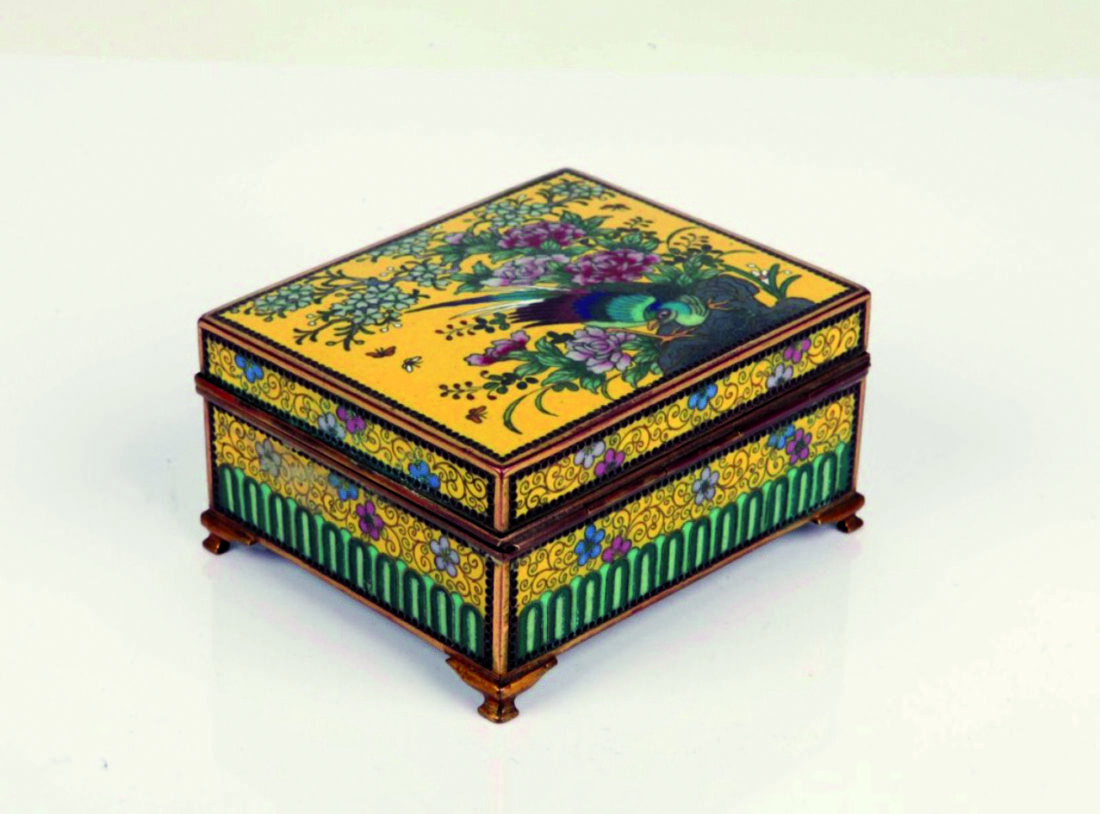
Cloisonne gets its name from the metal “cloisons,” French for “partitions,” that are filled with enamel, creating the multicolor designs. Despite the French name, the technique has been used in many parts of the world. It was revolutionized in Japan in the 19th century, when artist Kaji Tsunekichi, working as a metal gilder to supplement the stipend he received as a former samurai, deconstructed a piece of Chinese cloisonne to develop his own techniques. He soon began training other artists in cloisonne, which exploded in popularity in Japan, where it was called shippo.
Many regional styles were developed, and many regions and artists had their own workshops. Japanese cloisonne gained worldwide recognition when the Nagoya Company won first prize at the Vienna Exhibition of 1873, furthering its popularity and production. Workshops made everything from vases to trays to cigarette cases.
Generally, Japanese cloisonne features a single central motif or scenic design, instead of the stylized repeating patterns popular in other countries. Nature and mythology are frequent sources of inspiration. A small cloisonne box, measuring 3 1/2 inches wide and 2 inches tall, with a colorful bird and flowers on a yellow background with green geometric trim, sold for $132 at Richard Opfer Auctioneering, Inc. It was made by the Inaba Company, which was established in Kyoto in the 1880s.
——
Q: When, if ever, is it a good idea to refinish antique furniture? I have a chest that I believe is from about 1910, and the finish has cracks and blotches all over. Is this considered patina or damage? Does it take away from the value? Will it lower the value to have it refinished?
A: It sounds like the finish on your chest has gone through what some collectors call “alligatoring.” It looks cracked and bumpy like alligator skin, and it happens to some finishes with age and sunlight exposure. Some collectors like it and consider it part of the character of an antique. Others don’t and see it as damage.
In general, furniture from the 20th century or later, even from the early 20th century like your chest, will not lose much, if any, value if it is refinished, unless it is handmade or by a famous maker. As a general rule, refinishing lowers the value of antique furniture from the 18th century or earlier, if it is by a famous maker, or if it is handmade. Original finish, even with damage, is also desirable for some pieces with a rustic or “country” look.
By about 1900, inexpensive furniture was being mass-produced in factories. Most of the furniture from this time period on the market consists of these factory-made pieces and has relatively low resale value. You may want to do some research on your chest to see whether this is the case. If so, whether you refinish it is up to you and will have little effect on its value.
——
Q: I have a collection of Waterford crystal that I would like to sell. How do I know which pieces have value? Where is a good place to sell them?
A: The Waterford glass factory was established in Waterford, Ireland, by brothers George and William Penrose in 1783. The factory quickly became known for its fine crystal but closed in the 1850s. It was re-established by Czech glassmaker Karel Bacik in the 1940s. The Lismore pattern, created in 1952, was based on the company’s original crystal patterns from the 18th and 19th centuries.
Today, Waterford is owned by the Fiskars Group and is still producing high-quality crystal. Vintage and antique pieces are extremely desirable to collectors. Waterford crystal made after 1950 has an acid-etched mark. A seahorse logo was added to the mark in the 1990s. The value of a piece depends on its condition and pattern. Condition is extremely important for crystal; chipped, cracked, or cloudy pieces will have low value.
If you have a large collection of especially rare, valuable pieces, you may want to contact an auction house that specializes in glass. Otherwise, you may want to contact an antique dealer in your area. A pattern-matching service is another possibility.
——
TIP: You can cover up a small chip in an enamel or even a piece of porcelain with a bit of colored nail polish. It comes in almost every color now.
——
Kovels answers readers’ questions sent to the column. Send a letter with one question describing the size, material (glass, pottery) and what you know about the item. Include only two pictures: the object and a close-up of any marks or damage. Be sure your name and return address are included. By sending a question, you give full permission for use in any Kovel product. Names, addresses or email addresses will not be published. We do not guarantee the return of photographs, but if a stamped envelope is included, we will try. Questions that are answered will appear in Kovels Publications. Write to Kovels, (Name of this newspaper), King Features Syndicate, 300 W. 57th Street, 41st Floor, New York, NY 10019, or email us at collectorsgallery@kovels.com.
Columns
Regional art styles spread across the world
Republicans aren’t willing to call the war in Iran what it is
Let’s state the obvious: We’re at war with Iran. My evidence? Turn on your TV. U.S. forces, working with ...
Political parties on perilous ground
As Donald Trump’s Republicans look askance as he launches what looks to some like another long-term war in the ...
Dear Annie: Loyal for a lifetime, disappointed for decades
Dear Annie: I moved 600 miles away from my hometown 40 years ago, but keeping up a relationship with my parents ...
How the worse political party is beating a very bad political party
If you ever thought the President Donald Trump-led Republican Party is bad, well the Democrats are worse. The ...
Tax the rich or discipline the government?
Wherever you look in American politics right now, you’ll find legislators saying the government still doesn’t ...