
Trending
The line between furniture and fine art isn't always clear. Artist Max Kuehne (1880-1968) is known for both. Kuehne was born in Germany and immigrated to the United States with his family in 1894. He took an eclectic, energetic approach to life, trying several different jobs as a young man before he began formal training in art in 1907.
Kuehne spent years traveling between the U.S. and Europe, finding inspiration in the various art styles practiced at the time and in the landscapes and cities he visited. He painted landscapes, waterfronts, and city scenes, combining the light, color, and spontaneity of Impressionism with the subject matter of Realism.
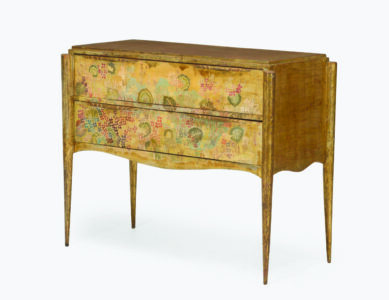
In the 1930s, during the Great Depression, Kuehne began making decorated furniture. He used materials and techniques he knew from making picture frames, like carved gesso, gilding, and silver leaf, and his designs featured flowers, trees, and nature scenes, reflecting his lifelong love of the outdoors.
Today, his furniture is prized by collectors, often selling for higher prices than his paintings. A cabinet that Kuehne signed, carved, gilded, and decorated with colorful flowers and leaves sold for $11,430 at Toomey & Co. Auctions.
------
Q: The time has come for me to let my wall hanging go. It is design 520 by Don Freedman from 1983. It has the original copyright and composition tags. However, in searching online for information as to its possible value, I've been unable to find a reference to or picture of this particular item. Can you provide any information or identify resources for me to check?
A: Don Freedman designed tapestries from about the 1970s to the 1990s. The tapestries were handwoven in India from jute, wool, silk, and cotton, and sold in the U.S. in specialty stores.
He designed many styles of tapestries. Some were round or rectangular and pictured plants, animals, or scenic designs. Others were irregularly shaped with abstract designs, sometimes with textured coils or hanging braids and tassels. They are usually natural colors, and can be recognized by tags on the back; one with Freedman's name and the copyright date, and one with the design number, size, and composition filled in.
We have not found a price specifically for design 250, but similar styles have sold recently for about $150 to $250. Don Freeman's tapestries are collectible and currently popular in mid-century and bohemian decorating styles.
------
Q: I was recently presented with an article from a syndicated paper where you featured a singing bird box. I have a similar item as was pictured and was hopeful you could provide some direction as to where I might learn more about it as well as locate an appropriate auctioneer.
A: Singing bird boxes are collected as music boxes or automata. They were first made in Switzerland in the late 1700s and spread to France and Germany. They are sometimes called "tabatieres," a French term for a small box. They are still being made today.
Singing bird boxes can be very valuable and can easily sell for more than $500. They frequently sell for over $1,000, and even more if they are made of precious metals or by a famous maker, or if they have unusual features like multiple birds.
Even modern replicas of antique singing bird boxes sell for high prices. Another popular variety of singing bird, where the bird is in a cage, generally sells for lower prices. Singing bird boxes sell at most auction houses that deal in decorative arts. You might want to find one that has had a specialized sale of music boxes.
If you are planning to sell yours at auction, look up reviews and ask for references, if possible. Most reputable auction houses will appraise an item for you, and you are not obligated to sell through them if they do.
For more information about your box, or about selling it, you may want to contact the Music Box Society International (mbsi.org). There is a book on singing bird boxes, "Mechanical Singing-Bird Tabatieres" by Geoffrey T. Mayson, that is comprehensive but difficult to find. You may want to see if it is available at your library. If not, you may want to look for some of the many available books on music boxes and automata, like "The Musical Box Handbook, Vols. 1 & 2" by Graham Webb, "Musical Boxes and Other Musical Marvels," edited by Angelo Rulli, or "Automata: The Golden Age, 1848-1914" by Christian Bailly.
------
TIP: Don't use gummed labels on colored paint or gilding.
------
Kovels answers eaders' questions sent to the column. Send a letter with one question describing the size, material (glass, pottery) and what you know about the item. Include only two pictures: the object and a close-up of any marks or damage. Be sure your name and return address are included. By sending a question, you give full permission for use in any Kovel product. Names, addresses or email addresses will not be published. We do not guarantee the return of photographs, but if a stamped envelope is included, we will try. Questions that are answered will appear in Kovels Publications. Write to Kovels, (Name of this newspaper), King Features Syndicate, 300 W. 57th Street, 41st Floor, New York, NY 10019, or email us at collectorsgallery@kovels.com.