
Trending
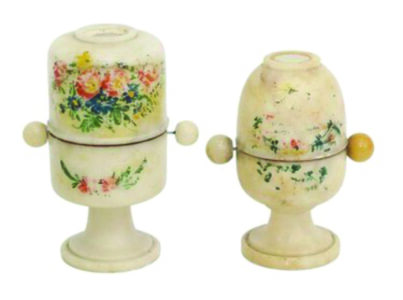
A peep egg might sound like an Easter treat. As a white egg-shaped object, often painted with colorful decorations, like the two that sold together at Austin Auction Gallery for $215, it might look like one, too. Peep eggs are actually Victorian optical devices. At the time, advances in photography and technology, plus increasing travel and tourism, led to the creation and popularity of many optical toys, which often displayed photographs of exotic locations and famous sites.
The taller of the two eggs shown here, measuring six inches in height, has photographs of Niagara Falls inside it. The shorter egg contains images of the Crystal Palace in London and the Paris Exhibition. There is a lens at the top to look through, and the side handles can be turned to rotate through the pictures inside. The eggs are made of alabaster, which is translucent, allowing light to pass through and illuminate the pictures. There were some complex versions that have moving parts to alter the amount of light that reaches the picture, simulating day and night. However, most peep eggs had simple designs like these, with still images and minimal controls, which made them popular souvenirs.
------
Q: I purchased about 50 antique postcards from the former owner of our house a number of years ago. Most of them are dated from the early 1900s and some have been mailed from Brussels, Belgium, or Berlin. There are several Easter cards with designs like children playing with rabbits; rabbits driving a car, riding in a sedan chair, or playing instruments. They have greetings in German or French. They are a true treasure. Can you tell me what they would be worth?
A: Your entire collection could be worth about $50 to $120. Individual cards may be worth anywhere from about $2 to $20. Collectors consider the years 1900 to about 1920 the "golden age" of postcards. The most popular cards of this time had colorful lithographed designs. Many were printed in Germany, even if they had English inscriptions. Some designs were used for greetings in multiple languages. The German and French greetings on yours may increase their value.
Postcards picturing anthropomorphic animals are often worth more, too, especially in unusual designs. There are many Easter cards that have rabbits driving a car, but a sedan chair is much less common, so that postcard may have a higher value. If any of your postcards have the words "Private Mailing Card" printed on the back (used from 1898-1901) or have an undivided back (1902-1907), they will be worth more. Other factors that increase the value of a postcard include moving parts (called mechanical cards), "hold-to-light" features, unusual materials like fabric or metal, or a signature from a well-known artist.
------
Q: I would like to know the value of my set of D'Arques-Durand cut crystal claret wine glasses.
A: Verrerie Cristallerie d'Arques was established in 1892 after a merger of multiple glassworks in Arques, France. The company was managed by Georges Durand starting in 1897. The Durand family became the owners of the company in 1916. It was sometimes called JG Durand, not to be confused with the Durand art glass company that operated in New Jersey in the 1920s to 1930s.
In the mid-20th century, Verrerie Cristallerie d'Arques introduced new processes to automate the production of glassware. The Cristal d'Arques brand, created in 1968, was the world's first lead crystal produced by automation, which allowed the company to sell it at lower prices than other cut glass. The company now operates as Arc International and still produces Cristal d'Arques glass, along with other brands for retailers and restaurants.
Unlike the cut glass of the late 19th to early 20th century, Cristal d'Arques glassware, which was made by automation in the mid-20th century, generally sells for fairly low prices. Sets of four Cristal d'Arques claret glasses are usually worth about $20 to $30.
------
TIP: To clean alabaster, first dust with a soft brush. Then wipe with turpentine or dry-cleaning fluid. Do not use water. Alabaster dissolves in water. Some people like to polish it with paste furniture wax, but the wax will eventually yellow slightly.
------
Kovels answers readers' questions sent to the column. Send a letter with one question describing the size, material (glass, pottery) and what you know about the item. Include only two pictures: the object and a close-up of any marks or damage. Be sure your name and return address are included. By sending a question, you give full permission for use in any Kovel product. Names, addresses or email addresses will not be published. We do not guarantee the return of photographs, but if a stamped envelope is included, we will try. Questions that are answered will appear in Kovels Publications. Write to Kovels, (Name of this newspaper), King Features Syndicate, 300 W. 57th Street, 41st Floor, New York, NY 10019, or email us at collectorsgallery@kovels.com.